
 Afirika
 Asiya
Asiya Bulaaya
 Amerika ey'Obukiikaddyo
 Awusitureeliya ne Oseyaniya
 Antakitika
 Oseyani ya Pasifiki
 Oseyani ya Atlantiki
 Oseyani y'e Buyindi
 Oseyani ya Arakitiki
 Ennyanja ya Mediterenia
 Ennyanja Emmyufu
 Ennyanja ya Karibiyani
 Ennyanja ya Korali
 Ennyanja ya China ey'Obukiikaddyo
 Ennyanja ya Bufilipino
 Ennyanja ya Andaman
 Ennyanja ey'Obukiikakkono (North Sea)
 Ennyanja ya Timor ne Arafura
 Ekikono kya Bengal
 Ekikono kya Kalifoniya
Blotched palm pitviper
 Kiruma
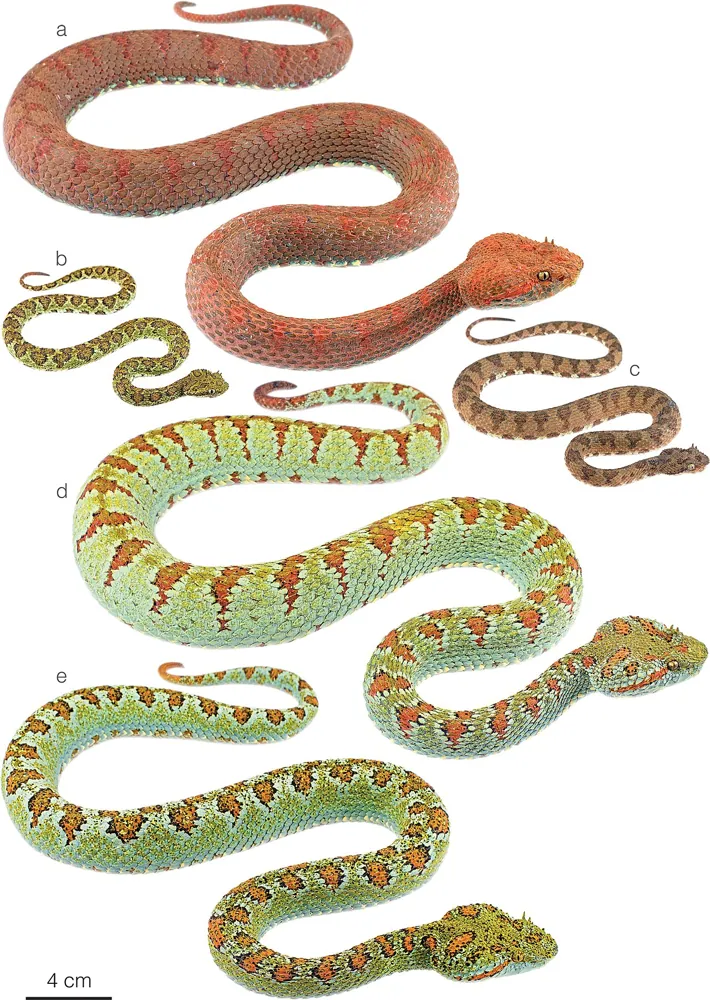
The blotched eyelash-pitviper is a venomous snake that lives in the mountain forests of southern Costa Rica and western Panama. It spends much of its time in trees and is active mainly at dusk or at night. Its bite can cause serious bleeding and muscle damage, so it is important to recognise it and keep well away.1


 Engeri y'okukitegeera
- Usually bright green or moss-green, though it can also be bluish-green, reddish-brown or reddish-maroon.1
- Irregular dark blotches run along the back, and these sometimes join to form crossbands.1
- The belly is light in colour.1
- The head has dark stripes and prominent scales above the eyes, which give it the name eyelash-pitviper.1
- Usually 50–60 cm long including the tail, and can reach 80 cm.1
Amaanyi g'obusagwa
Obusagwa buyita mu mannyo gaakyo amawanvu (fangs) oba mu mannyo amalala nga kiruma.
Obusagwa bwakyo bukola ki?
Its venom has a potent haemorrhagic action, which damages blood vessels and causes bleeding. It also has moderate myotoxicity, which destroys muscle tissue, and a very weak procoagulant effect, which can slightly speed up clotting.1
Kirina akabi kenkana wa eri abantu?
Akabi eri abantu: Kya maanyiOkulumwa kwetaaga omusawo. Okufa kubaawo kitono nnyo. Amawulire amalungi: abasawo balina eddagala (antivenom) oba obujjanjabi ku kino.1
 Bwe kiruma
- Omuntu muleke ateetambula era ateefu, ekitundu ekirumiddwa kibeere ku buwanvu bw'omutima, ggyamu empeta n'ebintu ebinyweza, era omutwale mu ddwaliro mangu.
Bulijjo sooka kuba ennamba y'ebigwa bitalaze (112, 000, 911). Buno bulagirizi bwa bujjanjabi obusooka obwa bulijjo, si kuwabula kwa musawo. Obujjanjabi obusooka obw'omusingi
 Weekuume
- Tokwatako, tokwata wadde okusoomooza ensolo ey'omu nsiko, ne bw'eba ntono, era ne bw'eba erabika nga yeebase oba nga efudde.
- Gireke n'ebbanga. Bw'osisinkana emu, beera mukkakkamu, dda emabega mpola era gireke egende mu kkubo lyayo.
- Bw'emu ekuluma: beera mukkakkamu, totambula, kuba ennamba y'ebigwa bitalaze (112, 000, 911) oba tuuka mu ddwaliro mangu. Jjukira bwe yali efaanana, ekifaananyi kiyamba.
Tekikunoonya. Kikozesa obusagwa bwakyo okukwata emmere oba okwekuuma, era kyandisinze kwekweka. Ebirala ku kwekuuma
Wa mu nsi?
Kinene kyenkana wa?
Kiwanvu kyenkana wa?
 kiwanvu nga kkapa ez'awaka 1,5 okuva ku nnyindo okutuuka ku mukira
 kiwanvu nga ndiizi 4 eziteekeddwa mu lunyiriri
 kyandisobodde okudduka mita 100 mu sikonda 110 (omuntu asinga embiro yeetaaga 9,6)
Blotched palm pitviper kinene kyenkana wa bw'ogeraageranya ne GGWE?
Kubala bwokka mu browser yo. Tewali kitterekebwa wadde okusindikibwa wonna.
Kidduka kyenkana wa?


Ebituufu
Unlike most other Bothriechis species, it spends more time on the ground, and it may rest on the ground or at the base of trees and shrubs during the day.1
Its venom has an estimated LD50 of 6.04 mg/kg. LD50 is the dose that is expected to kill half of a test group, so a lower number means a more toxic venom.1
An antivenom made in horses, using venoms from Bothrops asper, Crotalus simus and another snake species, has been reported to neutralise its venom in tests.1
Females are longer and thicker than males, and this is the only difference between the sexes that has been noted.1
Ebituufu we biva
- Bothriechis supraciliaris (Wikipedia (CC BY-SA 4.0))
- Bothriechis supraciliaris (iNaturalist): amannya n'ensengeka y'ebika.
- Venom Wiki: omutendera gw'akabi, obunene obwa bulijjo n'okuteebereza kw'embiro bibyaffe. Laba engeri gye tubibalamu: Engeri gye tupimamu akabi.
Buli kituufu ku lupapula luno kirina ennamba eraga we kyava. Bwe tuba tukoze ensobi, tusonyiwe, tuli bayagazi ba nsolo, so si magazini ya ssaayansi. Tubuulire ku [email protected] tujja kugitereeza.
 Enjaba erumwa enjala! Venom Wiki pulojekiti ya muntu omu: ya bwereere, tewali birango era tewali bikulondoola. Akasiimo akatono kayamba okugikuuma ku yintaneti.Liisa enjaba
Ebirala okuva mu kibinja kye kimu: Pit vipers (emisota egiwulira ebbugumu)
 TerciopeloPit vipers (emisota egiwulira ebbugumu)Kitta
 Eyelash viperPit vipers (emisota egiwulira ebbugumu)Kisobola okutta
 CottonmouthPit vipers (emisota egiwulira ebbugumu)Kyetaaga omusawo
 Eastern copperheadPit vipers (emisota egiwulira ebbugumu)Kyetaaga omusawo
 CantilPit vipers (emisota egiwulira ebbugumu)Kisobola okutta
 Central American bushmasterPit vipers (emisota egiwulira ebbugumu)Kisobola okutta
Era kibeera mu: Amerika ey'Obukiikakkono
 Eastern coral snakeEmisota gya korali (coral snakes)Kisobola okutta
 Eastern diamondback rattlesnakeRattlesnakeKisobola okutta
 Timber rattlesnakeRattlesnakeKisobola okutta
 Western diamondback rattlesnakeRattlesnakeKisobola okutta
 Arizona bark scorpionEnjabaKyetaaga omusawo
 Brown recluseNnabbubiKyetaaga omusawo