
 Afirika
 Asiya
Asiya Bulaaya
 Amerika ey'Obukiikaddyo
 Awusitureeliya ne Oseyaniya
 Antakitika
 Oseyani ya Pasifiki
 Oseyani ya Atlantiki
 Oseyani y'e Buyindi
 Oseyani ya Arakitiki
 Ennyanja ya Mediterenia
 Ennyanja Emmyufu
 Ennyanja ya Karibiyani
 Ennyanja ya Korali
 Ennyanja ya China ey'Obukiikaddyo
 Ennyanja ya Bufilipino
 Ennyanja ya Andaman
 Ennyanja ey'Obukiikakkono (North Sea)
 Ennyanja ya Timor ne Arafura
 Ekikono kya Bengal
 Ekikono kya Kalifoniya
Caspian cobra
 Kiruma
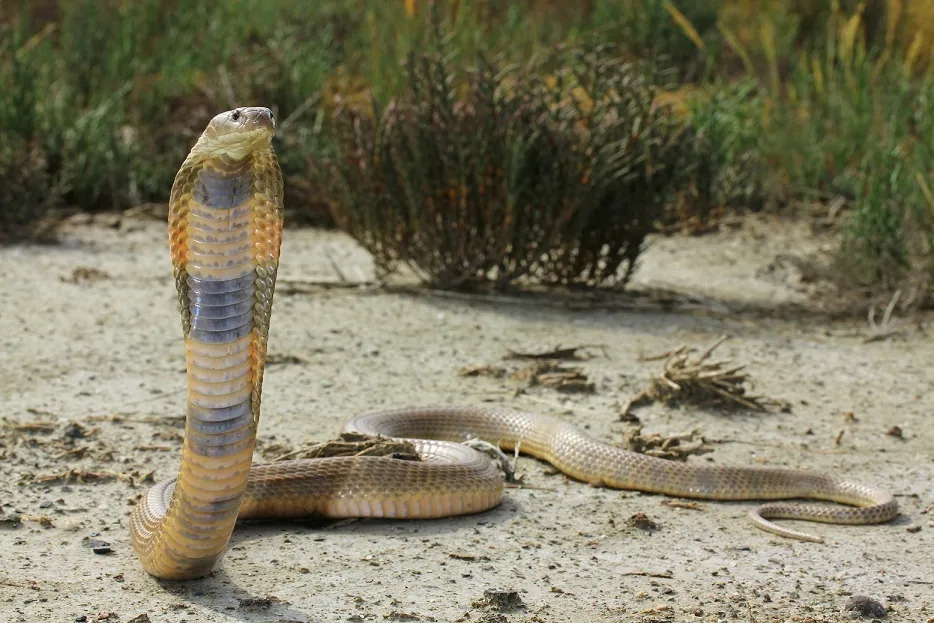
The Caspian cobra is a highly venomous snake that lives in Central Asia, Afghanistan, Iran and Pakistan. Many scientists consider it the most venomous cobra in the world. It is also a strong swimmer and a good climber.1



 Engeri y'okukitegeera
- Adults are light to chocolate brown or yellowish, with no hood marks and no spots on the throat.1
- Juveniles are pale and faded, with dark and light cross-bands of about equal width around the body.1
- The hood is long and tapers gradually, unlike the rounder hood of some other cobras.1
- It has several dark bands under the throat.1
- It is never fully black, although some individuals can be quite dark.1
Kitera okutabulwa ne: The Caspian cobra is often confused with the Indian cobra, and the two live side by side in Pakistan and northern India. Indian cobras without a hood mark look similar. In the black form of the Indian cobra from Pakistan, almost the whole throat is black, while the Caspian cobra has several dark throat bands and is never fully black.1
Amaanyi g'obusagwa
Obusagwa buyita mu mannyo gaakyo amawanvu (fangs) oba mu mannyo amalala nga kiruma.
Obusagwa bwakyo bukola ki?
Its venom is mainly neurotoxic, meaning it attacks the nerves, and most of the venom is made of short neurotoxins. It also contains cytotoxins, which can kill cells, and enzymes called nucleases, which damage tissue at the bite. Severe pain and swelling appear quickly, and weakness, drowsiness and paralysis of the throat and limbs can appear within an hour. The venom can also affect the heart during the first few hours, and at least one heart attack after a bite has been recorded.1
Kirina akabi kenkana wa eri abantu?
Akabi eri abantu: KittaEmu ku nsolo ezisinga akabi mu nsi.It is regarded as the most dangerous snake in Central Asia and has a high death rate. Between 1979 and 1987, 136 confirmed bites were attributed to it in the former Soviet Union. Of these, 8 people died after receiving antivenom, and 11 of the 15 who did not receive antivenom died. In Iran, it causes more deaths from snakebite than any other snake in the country. Without treatment, death can come in as little as 45 minutes or be delayed for up to 24 hours.1
 Amawulire amalungi: abasawo balina eddagala (antivenom) oba obujjanjabi ku kino.1
Kikola ki nga kitidde?
It tends to avoid people, but when cornered or provoked it spreads its hood, hisses, sways from side to side and strikes repeatedly.1
 Bwe kiruma
- Medical treatment with antivenom is essential, because untreated bites are often fatal. Symptoms can worsen rapidly without treatment, so urgent medical care is needed.1
- Omuntu muleke ateetambula era ateefu, ggyamu empeta n'ebintu ebinyweza, era omutwale mu ddwaliro mangu: eddagala eriwonya obusagwa (antivenom) bwe bujjanjabi.
Bulijjo sooka kuba ennamba y'ebigwa bitalaze (112, 000, 911). Buno bulagirizi bwa bujjanjabi obusooka obwa bulijjo, si kuwabula kwa musawo. Obujjanjabi obusooka obw'omusingi
 Weekuume
- Tokwatako, tokwata wadde okusoomooza ensolo ey'omu nsiko, ne bw'eba ntono, era ne bw'eba erabika nga yeebase oba nga efudde.
- Gireke n'ebbanga. Bw'osisinkana emu, beera mukkakkamu, dda emabega mpola era gireke egende mu kkubo lyayo.
- Bw'emu ekuluma: beera mukkakkamu, totambula, kuba ennamba y'ebigwa bitalaze (112, 000, 911) oba tuuka mu ddwaliro mangu. Jjukira bwe yali efaanana, ekifaananyi kiyamba.
Tekikunoonya. Kikozesa obusagwa bwakyo okukwata emmere oba okwekuuma, era kyandisinze kwekweka. Ebirala ku kwekuuma
Wa mu nsi?
Kinene kyenkana wa?
Kiwanvu kyenkana wa?
 kiwanvu nga kkapa ez'awaka 3 okuva ku nnyindo okutuuka ku mukira
 kiwanvu nga ndiizi 9 eziteekeddwa mu lunyiriri
 kyandisobodde okudduka mita 100 mu sikonda 48 (omuntu asinga embiro yeetaaga 9,6)
Caspian cobra kinene kyenkana wa bw'ogeraageranya ne GGWE?
Kubala bwokka mu browser yo. Tewali kitterekebwa wadde okusindikibwa wonna.
Kidduka kyenkana wa?


Ebituufu
Many toxinological studies suggest that the Caspian cobra is the most venomous cobra in the world.1
A ribonuclease called ribonuclease V1, purified from its venom, is used as a laboratory reagent in molecular biology because it can break down structured RNA.1
It cannot spit venom, but it is a good climber and an able swimmer.1
It is the westernmost species of Asiatic cobra, and it can be found at heights of up to about 3,000 m.1
For most of the twentieth century it was treated as a subspecies of the Indian cobra, until genetic analysis showed it was a separate species.1
Omumenyi w'enfumo
Enfumo: Caspian cobras are always black, like some Indian cobras.
Amazima: The Caspian cobra is never fully black. Adults are light to chocolate brown or yellowish, and it has several dark bands under the throat.1
Ebituufu we biva
- Caspian cobra (Wikipedia (CC BY-SA 4.0))
- Naja oxiana (iNaturalist): amannya n'ensengeka y'ebika.
- Venom Wiki: omutendera gw'akabi, obunene obwa bulijjo n'okuteebereza kw'embiro bibyaffe. Laba engeri gye tubibalamu: Engeri gye tupimamu akabi.
Buli kituufu ku lupapula luno kirina ennamba eraga we kyava. Bwe tuba tukoze ensobi, tusonyiwe, tuli bayagazi ba nsolo, so si magazini ya ssaayansi. Tubuulire ku [email protected] tujja kugitereeza.
 Enjaba erumwa enjala! Venom Wiki pulojekiti ya muntu omu: ya bwereere, tewali birango era tewali bikulondoola. Akasiimo akatono kayamba okugikuuma ku yintaneti.Liisa enjaba
 Indian cobra
 King cobra
 Common krait
 Malayan krait
 Many-banded krait
 Monocled cobra
 Deathstalker
 Indian saw-scaled viper
 Puff adder
 Essalambwa lya Russell
 Asian giant hornet
 Komodo dragon