
 Afirika
 Asiya
Asiya Bulaaya
 Amerika ey'Obukiikaddyo
 Awusitureeliya ne Oseyaniya
 Antakitika
 Oseyani ya Pasifiki
 Oseyani ya Atlantiki
 Oseyani y'e Buyindi
 Oseyani ya Arakitiki
 Ennyanja ya Mediterenia
 Ennyanja Emmyufu
 Ennyanja ya Karibiyani
 Ennyanja ya Korali
 Ennyanja ya China ey'Obukiikaddyo
 Ennyanja ya Bufilipino
 Ennyanja ya Andaman
 Ennyanja ey'Obukiikakkono (North Sea)
 Ennyanja ya Timor ne Arafura
 Ekikono kya Bengal
 Ekikono kya Kalifoniya
European purseweb spider
 Kiruma
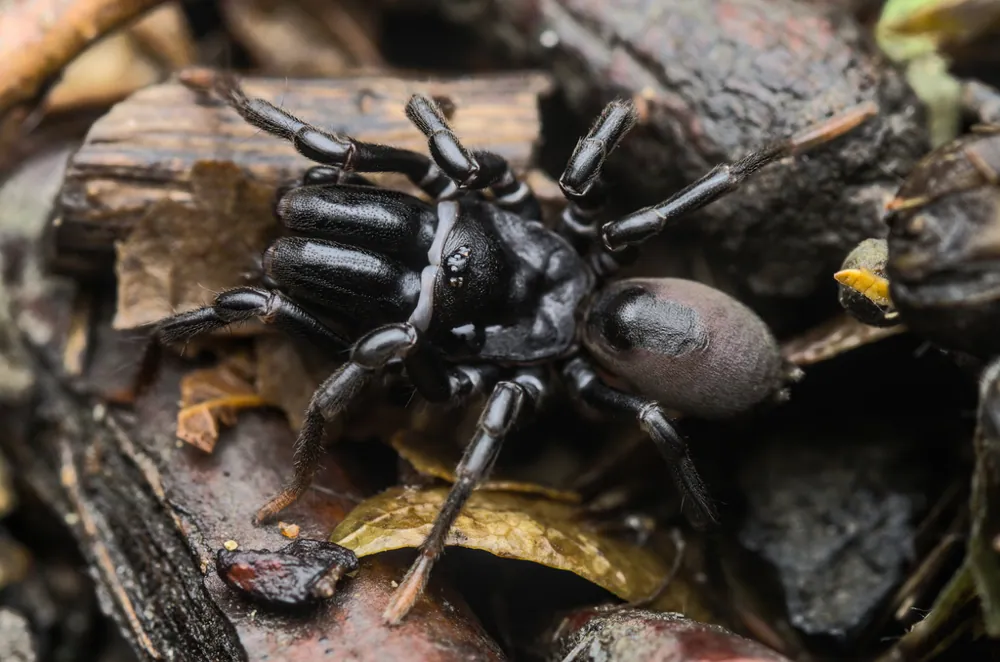
The European purseweb spider is a small, hidden spider that lives in the ground. It is found in mainland Europe, Great Britain and North Africa, and it is the only mygalomorph spider found in the Nordic countries and the United Kingdom. It is special because it builds a silk tube partly under the ground and catches insects that walk onto it.1

 Engeri y'okukitegeera
- Black or brownish in colour1
- Not particularly large: males are 7–9 mm and females are 10–15 mm long1
- Builds a silk tube that is partly underground, with the part above ground covered in leaves and other debris1
- Usually stays inside its web and does not leave except to mate1
- Young spiderlings are often very lightly coloured1
Kitera okutabulwa ne: It looks much like Atypus piceus. Spiderlings of the European purseweb spider are often very lightly coloured, and its three-part posterior spinnerets do not have a light blot, which helps tell them apart.1
Amaanyi g'obusagwa
Obusagwa buyita mu mannyo gaakyo amawanvu (fangs) oba mu mannyo amalala nga kiruma.
Kirina akabi kenkana wa eri abantu?
Akabi eri abantu: KitonoNga okubojja kw'enjuki oba okutono okusingawo. Kumpi tekirina kabi eri abantu. Bwe kiruma
- Naaza ekifo ekirumiddwa era okinyogoze. Funa obuyambi bw'abasawo singa obulumi bungi oba omuntu awulira bubi.
Bulijjo sooka kuba ennamba y'ebigwa bitalaze (112, 000, 911). Buno bulagirizi bwa bujjanjabi obusooka obwa bulijjo, si kuwabula kwa musawo. Obujjanjabi obusooka obw'omusingi
 Weekuume
- Tokwatako, tokwata wadde okusoomooza ensolo ey'omu nsiko, ne bw'eba ntono, era ne bw'eba erabika nga yeebase oba nga efudde.
- Gireke n'ebbanga. Bw'osisinkana emu, beera mukkakkamu, dda emabega mpola era gireke egende mu kkubo lyayo.
- Bw'emu ekuluma: beera mukkakkamu, totambula, kuba ennamba y'ebigwa bitalaze (112, 000, 911) oba tuuka mu ddwaliro mangu. Jjukira bwe yali efaanana, ekifaananyi kiyamba.
Tekikunoonya. Kikozesa obusagwa bwakyo okukwata emmere oba okwekuuma, era kyandisinze kwekweka. Ebirala ku kwekuuma
Wa mu nsi?
Kinene kyenkana wa?
Kiwanvu kyenkana wa?
 kimpi okusinga akagalo ko akatono
 kyandisobodde okudduka mita 100 mu sikonda 330 (omuntu asinga embiro yeetaaga 9,6)
European purseweb spider kinene kyenkana wa bw'ogeraageranya ne GGWE?
Kubala bwokka mu browser yo. Tewali kitterekebwa wadde okusindikibwa wonna.
Kidduka kyenkana wa?


Ebituufu
Its fangs point straight down rather than crossing, as in other mygalomorph spiders.1
Autumn is its mating season. The male enters the female's burrow, where they live together until the male dies soon after mating.1
It is a mygalomorph spider, and it is the only mygalomorph spider found in the Nordic countries and the United Kingdom.1
It becomes sexually mature at about 4 years old.1
Omumenyi w'enfumo
Enfumo: The European purseweb spider lives in Ireland.
Amazima: It was once listed for Ireland, based on a single silk tube found in 1896. This is now thought to be most likely from a plant nursery import, and the species is no longer recognised as living on the island.1
Ku bakugu mu busagwa
Ebituufu we biva
- Atypus affinis (Wikipedia (CC BY-SA 4.0))
- Atypus affinis (iNaturalist): amannya n'ensengeka y'ebika.
- Venom Wiki: omutendera gw'akabi, obunene obwa bulijjo n'okuteebereza kw'embiro bibyaffe. Laba engeri gye tubibalamu: Engeri gye tupimamu akabi.
Buli kituufu ku lupapula luno kirina ennamba eraga we kyava. Bwe tuba tukoze ensobi, tusonyiwe, tuli bayagazi ba nsolo, so si magazini ya ssaayansi. Tubuulire ku [email protected] tujja kugitereeza.
 Enjaba erumwa enjala! Venom Wiki pulojekiti ya muntu omu: ya bwereere, tewali birango era tewali bikulondoola. Akasiimo akatono kayamba okugikuuma ku yintaneti.Liisa enjaba
Ebirala okuva mu kibinja kye kimu: Tarantula ne funnel-web
 Gibraltar funnel-web spiderTarantula ne funnel-webKiruma bwokka
 Andalusian tarantulaTarantula ne funnel-webTekirina kabi
 Sydney funnel-web spiderTarantula ne funnel-webKitta
 Goliath birdeaterTarantula ne funnel-webKiruma bwokka
 Mexican redknee tarantulaTarantula ne funnel-webTekirina kabi
 Northern tree-dwelling funnel-web spiderTarantula ne funnel-webKitta
Era kibeera mu: Bulaaya
 Common European adderVipers n'essalambwaKyetaaga omusawo
 Spanish flyEnsolo endala ez'obutwaKyetaaga omusawoTokwatako
 Common waspEnjuki, ennumba n'ennumba enneneKiruma bwokka
 European hornetEnjuki, ennumba n'ennumba enneneKiruma bwokka
 Fire salamanderEbikere eby'obutwa, ebikere ebinene (toads) ne newtsKiruma bwokkaTokwatako
 Western honey beeEnjuki, ennumba n'ennumba enneneKiruma bwokka