
 Afirika
 Asiya
Asiya Bulaaya
 Amerika ey'Obukiikaddyo
 Awusitureeliya ne Oseyaniya
 Antakitika
 Oseyani ya Pasifiki
 Oseyani ya Atlantiki
 Oseyani y'e Buyindi
 Oseyani ya Arakitiki
 Ennyanja ya Mediterenia
 Ennyanja Emmyufu
 Ennyanja ya Karibiyani
 Ennyanja ya Korali
 Ennyanja ya China ey'Obukiikaddyo
 Ennyanja ya Bufilipino
 Ennyanja ya Andaman
 Ennyanja ey'Obukiikakkono (North Sea)
 Ennyanja ya Timor ne Arafura
 Ekikono kya Bengal
 Ekikono kya Kalifoniya
Fat-tailed scorpion
 Kibojja
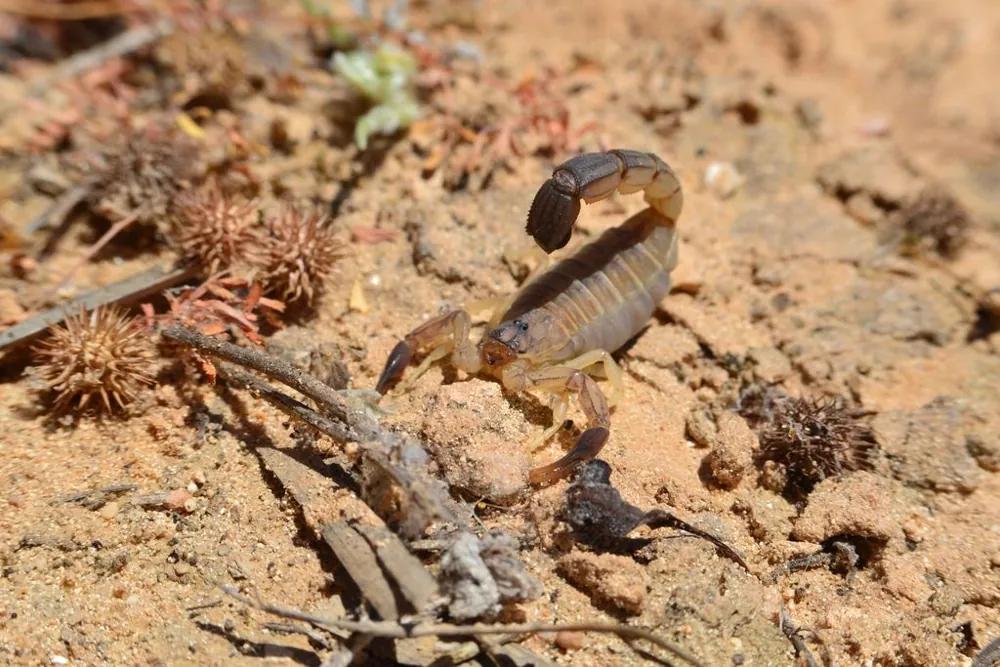
The fat-tailed scorpion is a hardy desert scorpion from North Africa. It can survive powerful sandstorms without digging a burrow. Its venom is among the most dangerous of any scorpion in the world, so it is important to know it by sight and keep well away from it.1



 Engeri y'okukitegeera
- It is a medium-sized scorpion that can grow up to 10 centimetres long.1
- It has a very thick, powerful tail.1
- Stripes run along the sides of its dome-shaped body.1
- Its armour is covered in tiny dome-shaped granules.1
- It is active at night and hides by day.1
Kitera okutabulwa ne: Generally similar scorpions from the Middle East and India were once thought to be this species. Recent studies treat them as different species.1
Amaanyi g'obusagwa
Obusagwa buyita mu ggwa lyakyo eribojja.
Obusagwa bwakyo bukola ki?
Its venom is very potent and is mainly made of neurotoxins (which attack the nerves), cardiotoxins (which harm the heart) and myotoxins (which damage muscle). It also contains hemotoxins, which affect the blood. Deaths in people usually occur through heart and breathing failure, and sometimes through bleeding in the brain, organ damage or shock.1
Kirina akabi kenkana wa eri abantu?
Akabi eri abantu: Kya kabi nnyoKisobola okutta omuntu atafunye bujjanjabi.It is one of the world's most dangerous scorpions, due to the strength of its venom and its aggressive temperament. It claims several lives each year.1
 Bwe kibojja
- Nyogoza ekifo ekibojjeddwa ne ayisi era omuntu muleke ateetambula. Funa obuyambi bw'abasawo mangu, naddala ku baana: enjaba ezimu zitta abaana.
Bulijjo sooka kuba ennamba y'ebigwa bitalaze (112, 000, 911). Buno bulagirizi bwa bujjanjabi obusooka obwa bulijjo, si kuwabula kwa musawo. Obujjanjabi obusooka obw'omusingi
 Weekuume
- Tokwatako, tokwata wadde okusoomooza ensolo ey'omu nsiko, ne bw'eba ntono, era ne bw'eba erabika nga yeebase oba nga efudde.
- Gireke n'ebbanga. Bw'osisinkana emu, beera mukkakkamu, dda emabega mpola era gireke egende mu kkubo lyayo.
- Bw'emu ekubojja: beera mukkakkamu, totambula, kuba ennamba y'ebigwa bitalaze (112, 000, 911) oba tuuka mu ddwaliro mangu. Jjukira bwe yali efaanana, ekifaananyi kiyamba.
Tekikunoonya. Kikozesa obusagwa bwakyo okukwata emmere oba okwekuuma, era kyandisinze kwekweka. Ebirala ku kwekuuma
Wa mu nsi?
Kinene kyenkana wa?
Kiwanvu kyenkana wa?
 kiwanvu nga bbulooka 3 ez'okuzannyisa mu lunyiriri
 kyandisobodde okudduka mita 100 mu sikonda 180 (omuntu asinga embiro yeetaaga 9,6)
Fat-tailed scorpion kinene kyenkana wa bw'ogeraageranya ne GGWE?
Kubala bwokka mu browser yo. Tewali kitterekebwa wadde okusindikibwa wonna.
Kidduka kyenkana wa?


Ebituufu
It can withstand sandstorms strong enough to strip paint off steel, and it does not dig burrows to shelter from them.1
Researchers have considered copying this surface texture for use on aeroplanes and helicopters.1
Its armour has dome-shaped granules about 10 micrometres high, and scientists think this texture helps protect it from sand.1
The lethal dose (LD50) of its venom is 0.32 mg per kg when injected under the skin.1
Its venom contains a toxin called AaTX1, which was first found in this species.1
Omumenyi w'enfumo
Enfumo: The fat-tailed scorpion lives across the Middle East and as far east as India.
Amazima: Older data suggested a wider range, but more recent studies have discredited this. It is found in North Africa.1
Ebituufu we biva
- Androctonus australis (Wikipedia (CC BY-SA 4.0))
- Androctonus australis (iNaturalist): amannya n'ensengeka y'ebika.
- Venom Wiki: omutendera gw'akabi, obunene obwa bulijjo n'okuteebereza kw'embiro bibyaffe. Laba engeri gye tubibalamu: Engeri gye tupimamu akabi.
Buli kituufu ku lupapula luno kirina ennamba eraga we kyava. Bwe tuba tukoze ensobi, tusonyiwe, tuli bayagazi ba nsolo, so si magazini ya ssaayansi. Tubuulire ku [email protected] tujja kugitereeza.
 Enjaba erumwa enjala! Venom Wiki pulojekiti ya muntu omu: ya bwereere, tewali birango era tewali bikulondoola. Akasiimo akatono kayamba okugikuuma ku yintaneti.Liisa enjaba
 Deathstalker
 Emperor scorpion
 Arabian fat-tailed scorpion
 Transvaal thick-tailed scorpion
 European yellow-tailed scorpion
 Flat rock scorpion
 Black mamba
 Egyptian cobra
 Puff adder
 Boomslang
 Gaboon viper
 Western honey bee