
 Afirika
 Asiya
Asiya Bulaaya
 Amerika ey'Obukiikaddyo
 Awusitureeliya ne Oseyaniya
 Antakitika
 Oseyani ya Pasifiki
 Oseyani ya Atlantiki
 Oseyani y'e Buyindi
 Oseyani ya Arakitiki
 Ennyanja ya Mediterenia
 Ennyanja Emmyufu
 Ennyanja ya Karibiyani
 Ennyanja ya Korali
 Ennyanja ya China ey'Obukiikaddyo
 Ennyanja ya Bufilipino
 Ennyanja ya Andaman
 Ennyanja ey'Obukiikakkono (North Sea)
 Ennyanja ya Timor ne Arafura
 Ekikono kya Bengal
 Ekikono kya Kalifoniya
Gaboon viper
 Kiruma
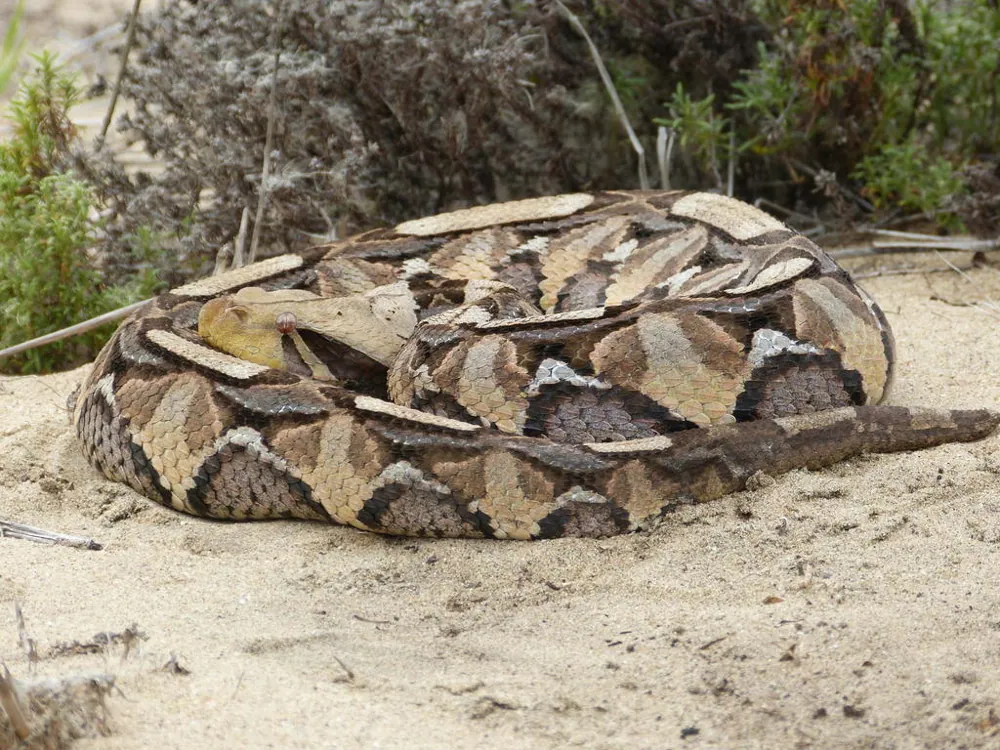
The Gaboon viper is a large, heavy snake with a striking pattern of pale and dark markings. It lives in the rainforests and savannas of sub-Saharan Africa. It is one of the most venomous snakes in the world, so knowing what it looks like matters.1


 Engeri y'okukitegeera
- A large, heavy, stout body, with a large triangular head and a neck much narrower than the head1
- A series of pale, rectangular blotches down the centre of the back, with dark hourglass markings edged in yellow1
- A white or cream head with a fine dark central line and a dark blue-black triangle behind and below each eye1
- Small raised 'horns' between the nostrils, which are tiny in this species1
- Its camouflage works well among dead leaves under trees, so it can be hard to see1
Kitera okutabulwa ne: The Congolese giant toad (Sclerophrys channingi) may be a mimic of this snake. Its head appears to resemble the viper's head, while its body is darker.1
Amaanyi g'obusagwa
Obusagwa buyita mu mannyo gaakyo amawanvu (fangs) oba mu mannyo amalala nga kiruma.
Obusagwa bwakyo bukola ki?
The venom is cytotoxic, which means it damages cells, and cardiotoxic, which means it harms the heart. Each bite can deliver a large amount of venom, because the snake does not release its grip after biting.1
Kirina akabi kenkana wa eri abantu?
Akabi eri abantu: Kya kabi nnyoKisobola okutta omuntu atafunye bujjanjabi.Bites are extremely rare, because the snake is seldom aggressive and lives mostly in rainforest areas. Most bites happen when people accidentally step on it. Even an average bite from an average-sized snake is potentially fatal.1
 Amawulire amalungi: abasawo balina eddagala (antivenom) oba obujjanjabi ku kino.1
Kikola ki nga kitidde?
When threatened it hisses loudly in a deep, steady rhythm and flattens its head slightly with each breath. It is unlikely to strike unless it is severely provoked.1
 Bwe kiruma
- Any bite should be treated as a serious medical emergency. Antivenom should be given as soon as possible to save the limb or the person's life.1
- Omuntu muleke ateetambula era ateefu, ekitundu ekirumiddwa kibeere ku buwanvu bw'omutima, ggyamu empeta n'ebintu ebinyweza, era omutwale mu ddwaliro mangu.
Bulijjo sooka kuba ennamba y'ebigwa bitalaze (112, 000, 911). Buno bulagirizi bwa bujjanjabi obusooka obwa bulijjo, si kuwabula kwa musawo. Obujjanjabi obusooka obw'omusingi
 Weekuume
- Tokwatako, tokwata wadde okusoomooza ensolo ey'omu nsiko, ne bw'eba ntono, era ne bw'eba erabika nga yeebase oba nga efudde.
- Gireke n'ebbanga. Bw'osisinkana emu, beera mukkakkamu, dda emabega mpola era gireke egende mu kkubo lyayo.
- Bw'emu ekuluma: beera mukkakkamu, totambula, kuba ennamba y'ebigwa bitalaze (112, 000, 911) oba tuuka mu ddwaliro mangu. Jjukira bwe yali efaanana, ekifaananyi kiyamba.
Tekikunoonya. Kikozesa obusagwa bwakyo okukwata emmere oba okwekuuma, era kyandisinze kwekweka. Ebirala ku kwekuuma
Wa mu nsi?
Kinene kyenkana wa?
Kiwanvu kyenkana wa?
Kizitowa kyenkana wa?
 kiwanvu nga kkapa ez'awaka 4 okuva ku nnyindo okutuuka ku mukira
 kiwanvu nga ndiizi 10 eziteekeddwa mu lunyiriri
 kyandisobodde okudduka mita 100 mu sikonda 90 (omuntu asinga embiro yeetaaga 9,6)
Gaboon viper kinene kyenkana wa bw'ogeraageranya ne GGWE?
Kubala bwokka mu browser yo. Tewali kitterekebwa wadde okusindikibwa wonna.
Kidduka kyenkana wa?


Ebituufu
A 1.8 m specimen caught in 1973 weighed 11.3 kg with an empty stomach. It is the heaviest venomous snake in Africa.1
Its eyes can move in unusual ways. If its head is turned 360°, one eye tilts up and the other tilts down.1
Although it is one of the fastest-striking snakes in the world, it usually tolerates handling and rarely bites or hisses.1
Unlike many African vipers, such as the puff adder, it does not release its grip after biting.1
Males fight by intertwining their necks and pushing. The winner pushes the other's head to the ground and raises his own head by 20–30 cm.1
Omumenyi w'enfumo
Enfumo: Because it is calm and tolerant, it is safe to handle.
Amazima: Some writers have described it as so docile it can be handled as freely as a harmless snake. This is absolutely not recommended: it is one of the fastest-striking snakes, and bites by bad-tempered individuals do occur.1
Ebituufu we biva
- Gaboon viper (Wikipedia (CC BY-SA 4.0))
- Bitis gabonica (iNaturalist): amannya n'ensengeka y'ebika.
- Venom Wiki: omutendera gw'akabi, obunene obwa bulijjo n'okuteebereza kw'embiro bibyaffe. Laba engeri gye tubibalamu: Engeri gye tupimamu akabi.
Buli kituufu ku lupapula luno kirina ennamba eraga we kyava. Bwe tuba tukoze ensobi, tusonyiwe, tuli bayagazi ba nsolo, so si magazini ya ssaayansi. Tubuulire ku [email protected] tujja kugitereeza.
 Enjaba erumwa enjala! Venom Wiki pulojekiti ya muntu omu: ya bwereere, tewali birango era tewali bikulondoola. Akasiimo akatono kayamba okugikuuma ku yintaneti.Liisa enjaba
 Puff adder
 Northeast African carpet viper
 West African carpet viper
 Rhinoceros viper
 West African Gaboon viper
 Horned adder
 Black mamba
 Deathstalker
 Egyptian cobra
 Boomslang
 Fat-tailed scorpion
 Western honey bee