
 Afirika
 Asiya
Asiya Bulaaya
 Amerika ey'Obukiikaddyo
 Awusitureeliya ne Oseyaniya
 Antakitika
 Oseyani ya Pasifiki
 Oseyani ya Atlantiki
 Oseyani y'e Buyindi
 Oseyani ya Arakitiki
 Ennyanja ya Mediterenia
 Ennyanja Emmyufu
 Ennyanja ya Karibiyani
 Ennyanja ya Korali
 Ennyanja ya China ey'Obukiikaddyo
 Ennyanja ya Bufilipino
 Ennyanja ya Andaman
 Ennyanja ey'Obukiikakkono (North Sea)
 Ennyanja ya Timor ne Arafura
 Ekikono kya Bengal
 Ekikono kya Kalifoniya
Fringed ornamental tarantula
 Kiruma
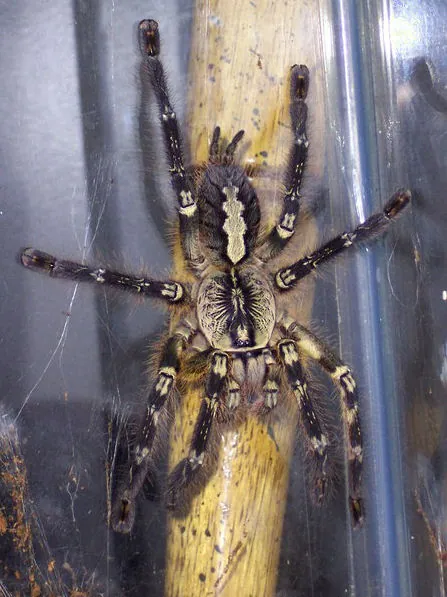
The fringed ornamental tarantula is a large spider that lives high in trees. It is found only in Sri Lanka, and its bright, patterned body makes it one of the most striking tarantulas. Its bite is considered medically significant, so it is worth knowing about.1

 Engeri y'okukitegeera
- The top of the body (carapace) is greenish yellow or purplish.1
- Females have yellow undersides, and the thighs of the third and fourth pairs of legs are black with a large blue-grey spot.1
- Males are greenish brown, and their markings are less prominent.1
- Females can reach a legspan of about 25 cm.1
Kitera okutabulwa ne: It is easily told apart from other tiger spiders by its greenish yellow or purplish top side.1
Amaanyi g'obusagwa
Obusagwa buyita mu mannyo gaakyo amawanvu (fangs) oba mu mannyo amalala nga kiruma.
Obusagwa bwakyo bukola ki?
The venom may cause intense pain and extreme muscle cramping. This is judged from the experiences of keepers who have been bitten by this species, rather than from recorded cases of human harm.1
Kirina akabi kenkana wa eri abantu?
Akabi eri abantu: Kya maanyiOkulumwa kwetaaga omusawo. Okufa kubaawo kitono nnyo.No death from a tarantula bite has ever been recorded. This species is still considered to have a medically significant bite because of the pain and cramping its venom may cause.1
 Bwe kiruma
- Naaza ekifo ekirumiddwa era okinyogoze. Funa obuyambi bw'abasawo singa obulumi bungi oba omuntu awulira bubi.
Bulijjo sooka kuba ennamba y'ebigwa bitalaze (112, 000, 911). Buno bulagirizi bwa bujjanjabi obusooka obwa bulijjo, si kuwabula kwa musawo. Obujjanjabi obusooka obw'omusingi
 Weekuume
- Tokwatako, tokwata wadde okusoomooza ensolo ey'omu nsiko, ne bw'eba ntono, era ne bw'eba erabika nga yeebase oba nga efudde.
- Gireke n'ebbanga. Bw'osisinkana emu, beera mukkakkamu, dda emabega mpola era gireke egende mu kkubo lyayo.
- Bw'emu ekuluma: beera mukkakkamu, totambula, kuba ennamba y'ebigwa bitalaze (112, 000, 911) oba tuuka mu ddwaliro mangu. Jjukira bwe yali efaanana, ekifaananyi kiyamba.
Tekikunoonya. Kikozesa obusagwa bwakyo okukwata emmere oba okwekuuma, era kyandisinze kwekweka. Ebirala ku kwekuuma
Wa mu nsi?
Kinene kyenkana wa?
Kiwanvu kyenkana wa?
 kiwanvu nga bbulooka 8 ez'okuzannyisa mu lunyiriri
 kyandisobodde okudduka mita 100 mu sikonda 170 (omuntu asinga embiro yeetaaga 9,6)
Fringed ornamental tarantula kinene kyenkana wa bw'ogeraageranya ne GGWE?
Kubala bwokka mu browser yo. Tewali kitterekebwa wadde okusindikibwa wonna.
Kidduka kyenkana wa?


Ebituufu
It may live in a mutually beneficial relationship with frogs such as Ramanella nagaoi, sharing tree holes that can contain eggs or juveniles from the spider, the frog, or both.1
In a related observation, a frog (Chiasmocleis ventrimaculata) and a different tarantula (Xenesthis immanis) were seen together, with the spider protecting the frog from predators and the frog guarding the spider's eggs from ants.1
When tree holes are scarce, several of these spiders may live together in the same tree.1
Its legspan is probably the second largest in its genus, behind Poecilotheria rufilata.1
Ebituufu we biva
- Poecilotheria ornata (Wikipedia (CC BY-SA 4.0))
- Poecilotheria ornata (iNaturalist): amannya n'ensengeka y'ebika.
- Venom Wiki: omutendera gw'akabi, obunene obwa bulijjo n'okuteebereza kw'embiro bibyaffe. Laba engeri gye tubibalamu: Engeri gye tupimamu akabi.
Buli kituufu ku lupapula luno kirina ennamba eraga we kyava. Bwe tuba tukoze ensobi, tusonyiwe, tuli bayagazi ba nsolo, so si magazini ya ssaayansi. Tubuulire ku [email protected] tujja kugitereeza.
 Enjaba erumwa enjala! Venom Wiki pulojekiti ya muntu omu: ya bwereere, tewali birango era tewali bikulondoola. Akasiimo akatono kayamba okugikuuma ku yintaneti.Liisa enjaba
Ebirala okuva mu kibinja kye kimu: Tarantula ne funnel-web
 Gooty sapphire tarantulaTarantula ne funnel-webKyetaaga omusawo
 Indian ornamental tarantulaTarantula ne funnel-webKyetaaga omusawo
 Cobalt blue tarantulaTarantula ne funnel-webKiruma bwokka
 Chinese bird spiderTarantula ne funnel-webKyetaaga omusawo
 Chinese black earth tiger tarantulaTarantula ne funnel-webKyetaaga omusawo
 Japanese funnel-web spiderTarantula ne funnel-webKyetaaga omusawo
 Deathstalker
 Indian cobra
 Indian saw-scaled viper
 King cobra
 Puff adder
 Essalambwa lya Russell