
 Afirika
 Asiya
Asiya Bulaaya
 Amerika ey'Obukiikaddyo
 Awusitureeliya ne Oseyaniya
 Antakitika
 Oseyani ya Pasifiki
 Oseyani ya Atlantiki
 Oseyani y'e Buyindi
 Oseyani ya Arakitiki
 Ennyanja ya Mediterenia
 Ennyanja Emmyufu
 Ennyanja ya Karibiyani
 Ennyanja ya Korali
 Ennyanja ya China ey'Obukiikaddyo
 Ennyanja ya Bufilipino
 Ennyanja ya Andaman
 Ennyanja ey'Obukiikakkono (North Sea)
 Ennyanja ya Timor ne Arafura
 Ekikono kya Bengal
 Ekikono kya Kalifoniya
Geography cone
 Kibojja
The geography cone is a predatory sea snail that lives on shallow tropical reefs in the Indo-Pacific. It hunts small fish. Its venom is strong enough to kill a person, which makes it one of the most dangerous cone snails.1


 Engeri y'okukitegeera
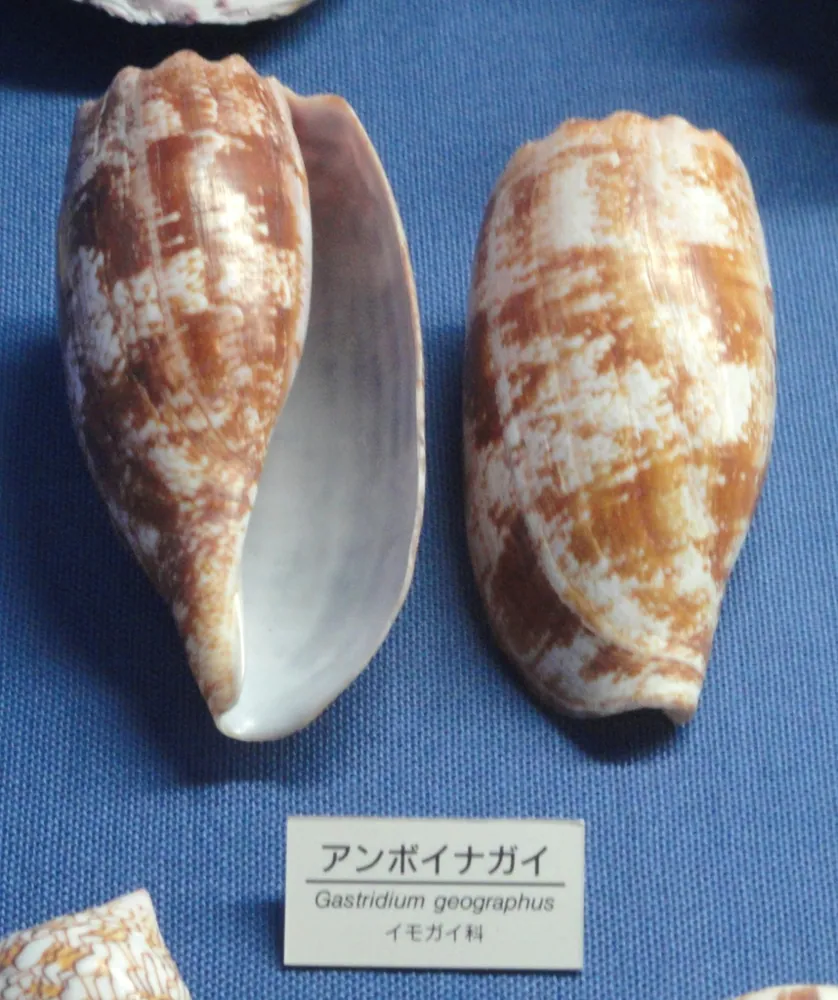
- Broad, thin shell that is cylindrically inflated, usually 10 to 15 cm long1
- Ground colour is pink or violet-white, sometimes reddish1
- Mottled pattern of chestnut or chocolate brown, usually forming two irregular bands1
- Wide pink or violet-white opening and numerous shoulder ridges or spines1
Kitera okutabulwa ne: Compared with other cone shells of a similar size, the geography cone has a noticeably wider, more convex middle and a flattened spire. Its walls are also thinner and lighter.1
Amaanyi g'obusagwa
Obusagwa buyita mu ggwa lyakyo eribojja.
Obusagwa bwakyo bukola ki?
Its venom is a complex mix of hundreds of different toxins, delivered through the harpoon-like tooth. It has the most toxic sting known among cone snails. Even the most venomous cone snails take about one to five hours to kill a healthy adult, but medical care must still be prompt.1
Kirina akabi kenkana wa eri abantu?
Akabi eri abantu: KittaEmu ku nsolo ezisinga akabi mu nsi.There are reports of about 36 human deaths over the past 300 years. Live specimens should be handled with extreme caution.1
Kikola ki nga kitidde?
Most of the venom's toxic compounds are believed to be used for defence rather than feeding.1
 Bwe kibojja
- There is no antivenom for a cone snail sting. Treatment consists of keeping the victim alive until the symptoms wear off, so prompt medical care is essential.1
- Okunyiga n'okunyweza ekitundu (pressure immobilisation): zinga bandeeji egolomoka ennywevu ku kifo ekirumiddwa, oluvannyuma ogende waggulu ku kitundu kyonna, kinyweze n'omuti (splint), era omuntu muleke ateetambulira ddala okutuusa obuyambi lwe butuuka.
- Blue-ringed octopus oba cone snail esobola okuyimiriza omuntu okussa ng'akyategeera: kuba essimu okufuna obuyambi era beera mwetegefu okumufuuwamu omukka (rescue breaths) okutuusa ambulensi lw'etuuka n'ekwata omulimu.
Bulijjo sooka kuba ennamba y'ebigwa bitalaze (112, 000, 911). Buno bulagirizi bwa bujjanjabi obusooka obwa bulijjo, si kuwabula kwa musawo. Obujjanjabi obusooka obw'omusingi
 Weekuume
- Tokwatako, tokwata wadde okusoomooza ensolo ey'omu nsiko, ne bw'eba ntono, era ne bw'eba erabika nga yeebase oba nga efudde.
- Gireke n'ebbanga. Bw'osisinkana emu, beera mukkakkamu, dda emabega mpola era gireke egende mu kkubo lyayo.
- Bw'emu ekubojja: beera mukkakkamu, totambula, kuba ennamba y'ebigwa bitalaze (112, 000, 911) oba tuuka mu ddwaliro mangu. Jjukira bwe yali efaanana, ekifaananyi kiyamba.
Tekikunoonya. Kikozesa obusagwa bwakyo okukwata emmere oba okwekuuma, era kyandisinze kwekweka. Ebirala ku kwekuuma
Wa mu nsi?
Kinene kyenkana wa?
Kiwanvu kyenkana wa?
 kiwanvu nga bbulooka 5 ez'okuzannyisa mu lunyiriri
 kirwawo okusinga ekkovu ly'omu nnimiro
Geography cone kinene kyenkana wa bw'ogeraageranya ne GGWE?
Kubala bwokka mu browser yo. Tewali kitterekebwa wadde okusindikibwa wonna.
Kidduka kyenkana wa?

Ebituufu
Its venom contains a form of insulin, which it uses to stun fish. Once the venom passes through a fish's gills, the fish goes into hypoglycaemic shock (a dangerous drop in blood sugar).1
Apart from the tulip cone snail, no other known living thing is known to use its own biological insulin as a weapon.1
Research shows that some proteins from cone snail venom can be up to 10,000 times more effective than morphine as painkillers, without morphine's addictive properties and side effects.1
Of the venom's 100 to 200 toxic peptides, only 15 to 20 are used for feeding.1
Adult geography cones can fall prey to sea turtles, rays, birds and human shell collectors.1
Omumenyi w'enfumo
Enfumo: The nickname 'cigarette snail' means a sting gives you just enough time to smoke a cigarette before you die.
Amazima: This is a gallows humour exaggeration. Even the most venomous cone snails take about one to five hours to kill a healthy human.1
Ku bakugu mu busagwa
Ebituufu we biva
- Conus geographus (Wikipedia (CC BY-SA 4.0))
- Conus geographus (iNaturalist): amannya n'ensengeka y'ebika.
- Venom Wiki: omutendera gw'akabi, obunene obwa bulijjo n'okuteebereza kw'embiro bibyaffe. Laba engeri gye tubibalamu: Engeri gye tupimamu akabi.
Buli kituufu ku lupapula luno kirina ennamba eraga we kyava. Bwe tuba tukoze ensobi, tusonyiwe, tuli bayagazi ba nsolo, so si magazini ya ssaayansi. Tubuulire ku [email protected] tujja kugitereeza.
 Enjaba erumwa enjala! Venom Wiki pulojekiti ya muntu omu: ya bwereere, tewali birango era tewali bikulondoola. Akasiimo akatono kayamba okugikuuma ku yintaneti.Liisa enjaba
Ebirala okuva mu kibinja kye kimu: Cone snail ne octopus
 Greater blue-ringed octopusCone snail ne octopusKitta
 Southern blue-ringed octopusCone snail ne octopusKitta
 Blue sea dragonCone snail ne octopusKiruma bwokka
 Common octopusCone snail ne octopusTekirina kabi
 Giant Pacific octopusCone snail ne octopusTekirina kabi
 Blue-lined octopusCone snail ne octopusKitta
Era kibeera mu: Oseyani y'e Buyindi
 Australian box jellyfishJellyfish n'ebibojja eby'ennyanjaKittaTokwatako
 Hawksbill sea turtleEnsolo endala ez'obutwaKisobola okutta
 Irukandji jellyfishJellyfish n'ebibojja eby'ennyanjaKisobola okuttaTokwatako
 Reef stonefishEbyennyanja eby'obusagwaKisobola okuttaTokwatako
 Crown-of-thorns starfishSea urchin, sea star ne firewormKyetaaga omusawoTokwatako
 Portuguese man o' warJellyfish n'ebibojja eby'ennyanjaKyetaaga omusawoTokwatako