
 Afirika
 Asiya
Asiya Bulaaya
 Amerika ey'Obukiikaddyo
 Awusitureeliya ne Oseyaniya
 Antakitika
 Oseyani ya Pasifiki
 Oseyani ya Atlantiki
 Oseyani y'e Buyindi
 Oseyani ya Arakitiki
 Ennyanja ya Mediterenia
 Ennyanja Emmyufu
 Ennyanja ya Karibiyani
 Ennyanja ya Korali
 Ennyanja ya China ey'Obukiikaddyo
 Ennyanja ya Bufilipino
 Ennyanja ya Andaman
 Ennyanja ey'Obukiikakkono (North Sea)
 Ennyanja ya Timor ne Arafura
 Ekikono kya Bengal
 Ekikono kya Kalifoniya
Crown-of-thorns starfish
 Amaggwa ag'obusagwa
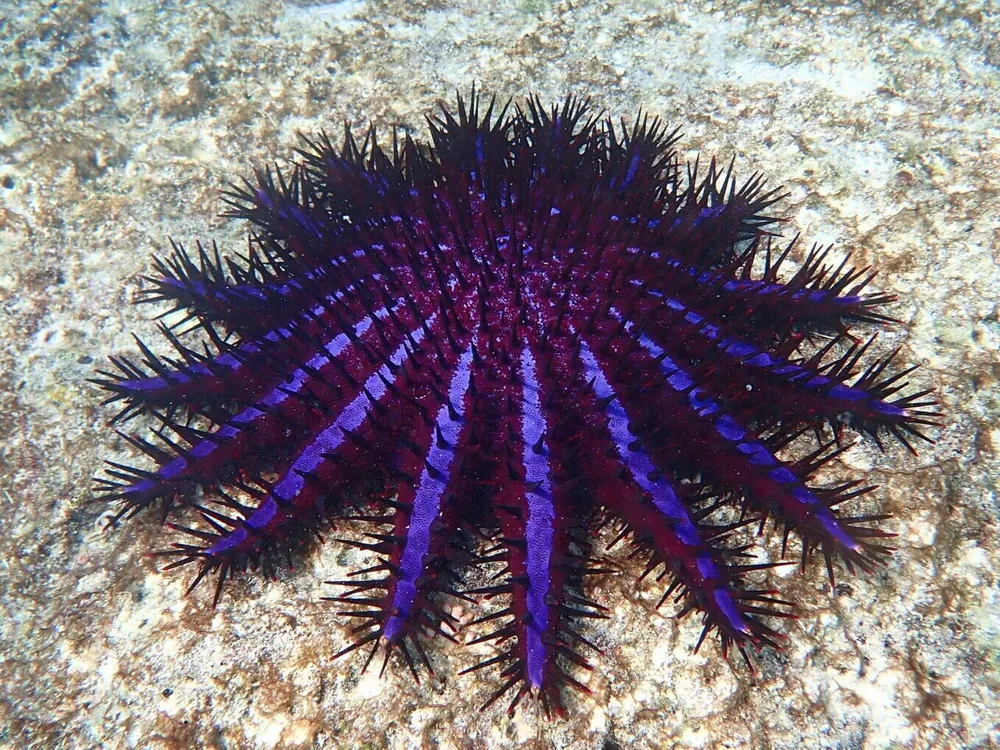
The crown-of-thorns starfish is a large starfish with long, sharp spines that look like a crown of thorns. It lives on coral reefs across the Indo-Pacific, from the Red Sea to the west coast of Central America, and it is most common around Australia. It feeds on hard coral, so it can change the reefs it lives on.1

 Engeri y'okukitegeera
- Adults are normally 25 to 35 cm across.1
- Up to 21 arms, with long, stiff, very sharp spines that are 4 to 5 cm long on the top and sides of the arms.1
- Colour varies with diet or region: purple, purple-blue, reddish grey or brown with red spine tips, or green with yellow spine tips.1
- The body is flexible and can bend and twist around coral surfaces.1
Kitera okutabulwa ne: A close relative, Acanthaster brevispinus, lives on soft sea floors at moderate depths rather than on coral reefs. The two are considered sibling species.1
Amaanyi g'obusagwa
Amaggwa amasongovu ge galimu obusagwa. Okukirinnyako oba okukikwata kiruma.
Obusagwa bwakyo bukola ki?
The spines do not inject venom. When they pierce skin, tissue containing saponins (detergent-like chemicals) is left in the wound. In humans this causes a sharp, stinging pain that can last several hours, persistent bleeding, and nausea and swelling that may last a week or more.1
Kirina akabi kenkana wa eri abantu?
Akabi eri abantu: Kya maanyiAmaggwa gaakyo bwe gakufumita, genda eri omusawo. Okufa kubaawo kitono nnyo.The spines can cause sharp pain, long-lasting bleeding, nausea and swelling. Brittle spines can break off and stay in the tissue.1
 Amaggwa gaakyo bwe gakufumita
- Spines that become embedded in the tissue must be removed surgically.1
- Teeka ekiwundu mu mazzi agookya, agookya nga omuntu bw'asobola okugumiikiriza nga tegamwokya, era funa obuyambi bw'abasawo okuggyamu amaggwa. Togasimamu ggwe kennyini.
Bulijjo sooka kuba ennamba y'ebigwa bitalaze (112, 000, 911). Buno bulagirizi bwa bujjanjabi obusooka obwa bulijjo, si kuwabula kwa musawo. Obujjanjabi obusooka obw'omusingi
 Weekuume
- Tokwatako, tokwata wadde okusoomooza ensolo ey'omu nsiko, ne bw'eba ntono, era ne bw'eba erabika nga yeebase oba nga efudde.
- Gireke n'ebbanga. Bw'osisinkana emu, beera mukkakkamu, dda emabega mpola era gireke egende mu kkubo lyayo.
- Amaggwa gaayo bwe gakufumita: beera mukkakkamu, totambula, kuba ennamba y'ebigwa bitalaze (112, 000, 911) oba tuuka mu ddwaliro mangu. Jjukira bwe yali efaanana, ekifaananyi kiyamba.
Tekikunoonya. Kikozesa obusagwa bwakyo okukwata emmere oba okwekuuma, era kyandisinze kwekweka. Ebirala ku kwekuuma
Wa mu nsi?
Kinene kyenkana wa?
Kiwanvu kyenkana wa?
 kiwanvu nga bbulooka 11 ez'okuzannyisa mu lunyiriri
 kirwawo okusinga ekkovu ly'omu nnimiro
Crown-of-thorns starfish kinene kyenkana wa bw'ogeraageranya ne GGWE?
Kubala bwokka mu browser yo. Tewali kitterekebwa wadde okusindikibwa wonna.
Kidduka kyenkana wa?

.jpg)
Ebituufu
An individual starfish can consume up to 6 square metres of living coral reef per year.1
When taken out of water, its soft body ruptures and collapses, but its spines can recover their shape if it is put back in the water while still alive.1
Its body contains detergent-like saponins, so keeping starfish in small volumes of water with aeration produces large amounts of foam.1
It is one of the largest starfish in the world.1
It has lost the usual five-fold symmetry of starfish as it grew more arms, although it begins life with five-fold symmetry.1
Omumenyi w'enfumo
Enfumo: Its spines inject venom like a snake or stinging animal.
Amazima: It has no mechanism for injecting toxin. Its spines pierce skin and leave saponin-containing tissue in the wound.1
Ku bakugu mu busagwa
- Erinnya erya ssaayansi
- Acanthaster planci
- Ekibinja
- Sea urchin, sea star ne fireworm
- Amaka
- Acanthasteridae2
- Ensengeka
- Valvatida
- Ssemazinga
- Oseyani y'e Buyindi, Oseyani ya Pasifiki, Ennyanja Emmyufu, Ennyanja ya Korali, Ennyanja ya Bufilipino, Ennyanja ya China ey'Obukiikaddyo, Ennyanja ya Andaman, Ennyanja ya Arabiya n'Ekikono kya Perusiya, Ennyanja ya Timor ne Arafura, Ekikono kya Bengal, Oseyani
- Abaana abawere
- It releases vast amounts of eggs and sperm (gametes) during mass spawning events in summer, and the eggs contain saponins similar to those in adults.1
- Akabi eri abantu
- 3 / 5: Kya maanyi3
Ebituufu we biva
- Crown-of-thorns starfish (Wikipedia (CC BY-SA 4.0))
- Acanthaster planci (iNaturalist): amannya n'ensengeka y'ebika.
- Venom Wiki: omutendera gw'akabi, obunene obwa bulijjo n'okuteebereza kw'embiro bibyaffe. Laba engeri gye tubibalamu: Engeri gye tupimamu akabi.
Buli kituufu ku lupapula luno kirina ennamba eraga we kyava. Bwe tuba tukoze ensobi, tusonyiwe, tuli bayagazi ba nsolo, so si magazini ya ssaayansi. Tubuulire ku [email protected] tujja kugitereeza.
 Enjaba erumwa enjala! Venom Wiki pulojekiti ya muntu omu: ya bwereere, tewali birango era tewali bikulondoola. Akasiimo akatono kayamba okugikuuma ku yintaneti.Liisa enjaba
Ebirala okuva mu kibinja kye kimu: Sea urchin, sea star ne fireworm
 Flower urchinSea urchin, sea star ne firewormKisobola okutta
 Fire urchinSea urchin, sea star ne firewormKyetaaga omusawoTokwatako
 Bearded firewormSea urchin, sea star ne firewormKiruma bwokkaTokwatako
 Black long-spined urchinSea urchin, sea star ne firewormKiruma bwokkaTokwatako
 BloodwormSea urchin, sea star ne firewormKiruma bwokka
 Bobbit wormSea urchin, sea star ne firewormKiruma bwokka
Era kibeera mu: Oseyani y'e Buyindi
 Australian box jellyfishJellyfish n'ebibojja eby'ennyanjaKittaTokwatako
 Geography coneCone snail ne octopusKitta
 Greater blue-ringed octopusCone snail ne octopusKitta
 Southern blue-ringed octopusCone snail ne octopusKitta
 Hawksbill sea turtleEnsolo endala ez'obutwaKisobola okutta
 Irukandji jellyfishJellyfish n'ebibojja eby'ennyanjaKisobola okuttaTokwatako