
 Afirika
 Asiya
Asiya Bulaaya
 Amerika ey'Obukiikaddyo
 Awusitureeliya ne Oseyaniya
 Antakitika
 Oseyani ya Pasifiki
 Oseyani ya Atlantiki
 Oseyani y'e Buyindi
 Oseyani ya Arakitiki
 Ennyanja ya Mediterenia
 Ennyanja Emmyufu
 Ennyanja ya Karibiyani
 Ennyanja ya Korali
 Ennyanja ya China ey'Obukiikaddyo
 Ennyanja ya Bufilipino
 Ennyanja ya Andaman
 Ennyanja ey'Obukiikakkono (North Sea)
 Ennyanja ya Timor ne Arafura
 Ekikono kya Bengal
 Ekikono kya Kalifoniya
Greater blue-ringed octopus
 Kiruma
The greater blue-ringed octopus is a small sea creature that lives in the warm shallow waters of the Indo-West Pacific, including around Australia. It is one of the most venomous marine animals in the world, so knowing what it looks like matters.1



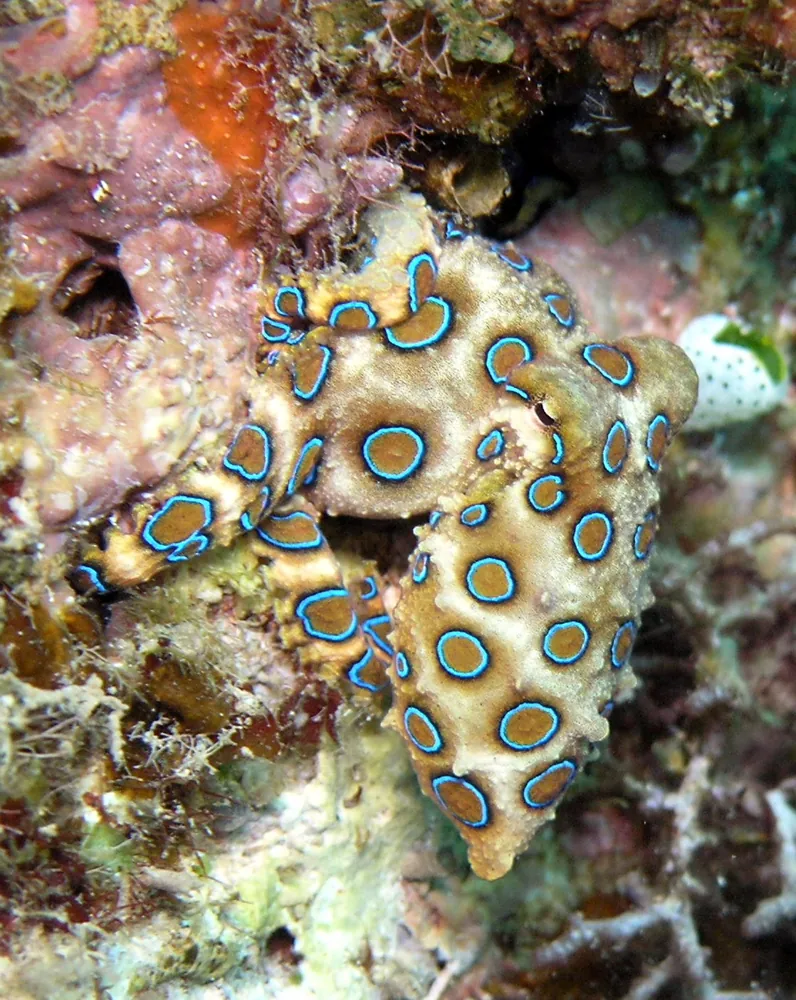
 Engeri y'okukitegeera
- A small octopus, up to 10 cm with its arms included, weighing about 80 grams on average.1
- Electric blue rings, about 7 to 8 mm across, roughly 60 of them, spread over its whole skin.1
- The rings flash iridescent blue as a warning signal, each flash lasting about a third of a second.1
- Its body colour varies from yellow ochre to light brown, or whitish when inactive.1
- Blue lines run through its eyes.1
Amaanyi g'obusagwa
Obusagwa buyita mu mannyo gaakyo amawanvu (fangs) oba mu mannyo amalala nga kiruma.
Obusagwa bwakyo bukola ki?
Its venom contains tetrodotoxin (TTX), a powerful neurotoxin, which is a poison that attacks the nerves. It paralyses the muscles needed for movement, and in people it can lead to death through respiratory paralysis, which means the breathing muscles stop working. Symptoms include tingling and numbness of the face and lips, sweating, severe headaches, dizziness, speech problems, weakness and vomiting. Symptoms can appear between 15 minutes and four hours after a bite, and the victim stays conscious throughout.1
Kirina akabi kenkana wa eri abantu?
Akabi eri abantu: KittaEmu ku nsolo ezisinga akabi mu nsi.The bite is capable of being fatal to humans. The bite is painless, so a person may not notice it. Children are more sensitive to the toxin. Death can occur between 20 minutes and 24 hours after symptoms begin.1
Kikola ki nga kitidde?
It flashes its blue rings as a warning to predators, and it uses its venom to defend itself.1
 Bwe kiruma
- Okunyiga n'okunyweza ekitundu (pressure immobilisation): zinga bandeeji egolomoka ennywevu ku kifo ekirumiddwa, oluvannyuma ogende waggulu ku kitundu kyonna, kinyweze n'omuti (splint), era omuntu muleke ateetambulira ddala okutuusa obuyambi lwe butuuka.
- Blue-ringed octopus oba cone snail esobola okuyimiriza omuntu okussa ng'akyategeera: kuba essimu okufuna obuyambi era beera mwetegefu okumufuuwamu omukka (rescue breaths) okutuusa ambulensi lw'etuuka n'ekwata omulimu.
Bulijjo sooka kuba ennamba y'ebigwa bitalaze (112, 000, 911). Buno bulagirizi bwa bujjanjabi obusooka obwa bulijjo, si kuwabula kwa musawo. Obujjanjabi obusooka obw'omusingi
 Weekuume
- Tokwatako, tokwata wadde okusoomooza ensolo ey'omu nsiko, ne bw'eba ntono, era ne bw'eba erabika nga yeebase oba nga efudde.
- Gireke n'ebbanga. Bw'osisinkana emu, beera mukkakkamu, dda emabega mpola era gireke egende mu kkubo lyayo.
- Bw'emu ekuluma: beera mukkakkamu, totambula, kuba ennamba y'ebigwa bitalaze (112, 000, 911) oba tuuka mu ddwaliro mangu. Jjukira bwe yali efaanana, ekifaananyi kiyamba.
Tekikunoonya. Kikozesa obusagwa bwakyo okukwata emmere oba okwekuuma, era kyandisinze kwekweka. Ebirala ku kwekuuma
Wa mu nsi?
Kinene kyenkana wa?
Kiwanvu kyenkana wa?
 kiwanvu nga bbulooka 3 ez'okuzannyisa mu lunyiriri
 kyandisobodde okuwuga obuwanvu bw'ekidiba ekinene (m 50) mu sikonda 7,2
Greater blue-ringed octopus kinene kyenkana wa bw'ogeraageranya ne GGWE?
Kubala bwokka mu browser yo. Tewali kitterekebwa wadde okusindikibwa wonna.
Kidduka kyenkana wa?

Ebituufu
The greater blue-ringed octopus is one of the most venomous marine animals in the world, despite being small.1
Its venom contains tetrodotoxin, the same toxin found in pufferfish.1
There is no known antidote or antitoxin for tetrodotoxin, and the toxin does not break down when heated or boiled.1
Its blue rings are a warning signal to predators, showing that it is highly venomous.1
Males die after mating, and females die after guarding their eggs because they refuse to eat.1
Omumenyi w'enfumo
Enfumo: A small octopus is harmless.
Amazima: Despite its small size, its bite can be deadly to humans.1
Ku bakugu mu busagwa
- Erinnya erya ssaayansi
- Hapalochlaena lunulata
- Ekibinja
- Cone snail ne octopus
- Amaka
- Octopodidae2
- Ensengeka
- Octopoda
- Ssemazinga
- Oseyani y'e Buyindi, Oseyani ya Pasifiki, Ennyanja ya Korali, Ennyanja ya Bufilipino, Ennyanja ya Timor ne Arafura, Oseyani
- Abaana abawere
- The female lays 50 to 100 eggs, which she carries under her arms for about a month. The young hatch as tiny planktonic paralarvae, about the size of a pea.1
- Obuwangaazi
- nga emyaka 21
- Akabi eri abantu
- 5 / 5: Kitta3
Ebituufu we biva
- Greater blue-ringed octopus (Wikipedia (CC BY-SA 4.0))
- Hapalochlaena lunulata (iNaturalist): amannya n'ensengeka y'ebika.
- Venom Wiki: omutendera gw'akabi, obunene obwa bulijjo n'okuteebereza kw'embiro bibyaffe. Laba engeri gye tubibalamu: Engeri gye tupimamu akabi.
Buli kituufu ku lupapula luno kirina ennamba eraga we kyava. Bwe tuba tukoze ensobi, tusonyiwe, tuli bayagazi ba nsolo, so si magazini ya ssaayansi. Tubuulire ku [email protected] tujja kugitereeza.
 Enjaba erumwa enjala! Venom Wiki pulojekiti ya muntu omu: ya bwereere, tewali birango era tewali bikulondoola. Akasiimo akatono kayamba okugikuuma ku yintaneti.Liisa enjaba
Ebirala okuva mu kibinja kye kimu: Cone snail ne octopus
 Geography cone
 Southern blue-ringed octopus
 Blue sea dragon
 Common octopus
 Giant Pacific octopus
 Blue-lined octopus
Era kibeera mu: Oseyani y'e Buyindi
 Australian box jellyfishJellyfish n'ebibojja eby'ennyanjaKittaTokwatako
 Hawksbill sea turtleEnsolo endala ez'obutwaKisobola okutta
 Irukandji jellyfishJellyfish n'ebibojja eby'ennyanjaKisobola okuttaTokwatako
 Reef stonefishEbyennyanja eby'obusagwaKisobola okuttaTokwatako
 Crown-of-thorns starfishSea urchin, sea star ne firewormKyetaaga omusawoTokwatako
 Portuguese man o' warJellyfish n'ebibojja eby'ennyanjaKyetaaga omusawoTokwatako