
 Afirika
 Asiya
Asiya Bulaaya
 Amerika ey'Obukiikaddyo
 Awusitureeliya ne Oseyaniya
 Antakitika
 Oseyani ya Pasifiki
 Oseyani ya Atlantiki
 Oseyani y'e Buyindi
 Oseyani ya Arakitiki
 Ennyanja ya Mediterenia
 Ennyanja Emmyufu
 Ennyanja ya Karibiyani
 Ennyanja ya Korali
 Ennyanja ya China ey'Obukiikaddyo
 Ennyanja ya Bufilipino
 Ennyanja ya Andaman
 Ennyanja ey'Obukiikakkono (North Sea)
 Ennyanja ya Timor ne Arafura
 Ekikono kya Bengal
 Ekikono kya Kalifoniya
McMahon's viper
 Kiruma
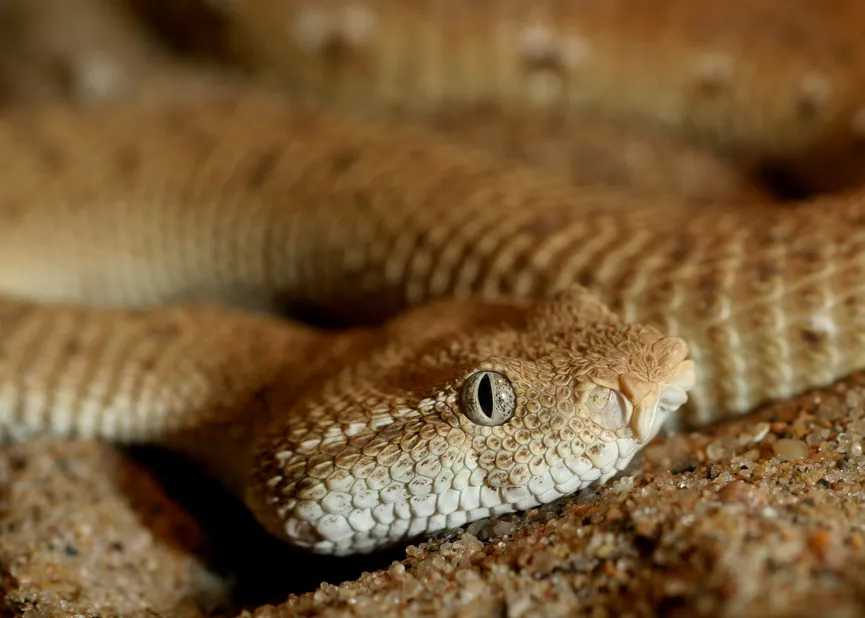
McMahon's viper is a small, venomous snake that lives in the sandy deserts of Balochistan, near the borders of Iran, Pakistan and Afghanistan. It is well known for its habit of sinking into loose sand so that only its snout and eyes stay uncovered. Scientists have also studied a protein from its venom for its possible use against melanoma, a type of skin cancer.1



 Engeri y'okukitegeera
- Reddish to yellowish brown body with a regular series of 20 to 25 dark spots, each bordered partly or fully with white scales1
- A white stripe runs from the back of the eye to the corner of the mouth1
- Large, broad, flat, wedge-shaped head that is clearly distinct from the neck1
- Short tail with a yellow tip and distinct crossbands1
- Adults are under 1 m (39 in) in total length, tail included1
Amaanyi g'obusagwa
Obusagwa buyita mu mannyo gaakyo amawanvu (fangs) oba mu mannyo amalala nga kiruma.
Obusagwa bwakyo bukola ki?
Relatively few data are available on its venom. The species is regarded as potentially dangerous, and its venom is said to be similar to that of snakes in the genus Echis. A venom protein called eristostatin has been reported to help in the fight against melanoma.1
Kirina akabi kenkana wa eri abantu?
Akabi eri abantu: Kya maanyiOkulumwa kwetaaga omusawo. Okufa kubaawo kitono nnyo.It is regarded as a potentially dangerous species. It is described as bad-tempered, hissing very loudly and deeply, and it will strike aggressively when threatened.1
Kikola ki nga kitidde?
It hisses very loudly and deeply, raises the front of its body off the ground in a loop and strikes aggressively. It may also sink into sand and cover its head, leaving only its snout and eyes uncovered.1
 Bwe kiruma
- Omuntu muleke ateetambula era ateefu, ekitundu ekirumiddwa kibeere ku buwanvu bw'omutima, ggyamu empeta n'ebintu ebinyweza, era omutwale mu ddwaliro mangu.
Bulijjo sooka kuba ennamba y'ebigwa bitalaze (112, 000, 911). Buno bulagirizi bwa bujjanjabi obusooka obwa bulijjo, si kuwabula kwa musawo. Obujjanjabi obusooka obw'omusingi
 Weekuume
- Tokwatako, tokwata wadde okusoomooza ensolo ey'omu nsiko, ne bw'eba ntono, era ne bw'eba erabika nga yeebase oba nga efudde.
- Gireke n'ebbanga. Bw'osisinkana emu, beera mukkakkamu, dda emabega mpola era gireke egende mu kkubo lyayo.
- Bw'emu ekuluma: beera mukkakkamu, totambula, kuba ennamba y'ebigwa bitalaze (112, 000, 911) oba tuuka mu ddwaliro mangu. Jjukira bwe yali efaanana, ekifaananyi kiyamba.
Tekikunoonya. Kikozesa obusagwa bwakyo okukwata emmere oba okwekuuma, era kyandisinze kwekweka. Ebirala ku kwekuuma
Wa mu nsi?
Kinene kyenkana wa?
Kiwanvu kyenkana wa?
 kiwanvu nga ndiizi 4 eziteekeddwa mu lunyiriri
 kyandisobodde okudduka mita 100 mu sikonda 110 (omuntu asinga embiro yeetaaga 9,6)
McMahon's viper kinene kyenkana wa bw'ogeraageranya ne GGWE?
Kubala bwokka mu browser yo. Tewali kitterekebwa wadde okusindikibwa wonna.
Kidduka kyenkana wa?


Ebituufu
A protein in its venom, called eristostatin, has been reported to help in the fight against melanoma.1
It can sink down into loose sand using a rocking or wave-like motion, then shake its head to cover it with sand.1
Its enlarged nasorostral scales are thought to keep sand out of its nostrils.1
It moves by sidewinding when crossing loose sand or when alarmed.1
Its short tail is prehensile, and it sometimes climbs into bushes with it.1
Ebituufu we biva
- Eristicophis (Wikipedia (CC BY-SA 4.0))
- Venom Wiki: omutendera gw'akabi, obunene obwa bulijjo n'okuteebereza kw'embiro bibyaffe. Laba engeri gye tubibalamu: Engeri gye tupimamu akabi.
Buli kituufu ku lupapula luno kirina ennamba eraga we kyava. Bwe tuba tukoze ensobi, tusonyiwe, tuli bayagazi ba nsolo, so si magazini ya ssaayansi. Tubuulire ku [email protected] tujja kugitereeza.
 Enjaba erumwa enjala! Venom Wiki pulojekiti ya muntu omu: ya bwereere, tewali birango era tewali bikulondoola. Akasiimo akatono kayamba okugikuuma ku yintaneti.Liisa enjaba
 Indian saw-scaled viper
 Puff adder
 Essalambwa lya Russell
 Common European adder
 Eastern Russell's viper
 Northeast African carpet viper
 Deathstalker
 Indian cobra
 King cobra
 Asian giant hornet
 Komodo dragon
 Spanish fly