
 Afirika
 Asiya
Asiya Bulaaya
 Amerika ey'Obukiikaddyo
 Awusitureeliya ne Oseyaniya
 Antakitika
 Oseyani ya Pasifiki
 Oseyani ya Atlantiki
 Oseyani y'e Buyindi
 Oseyani ya Arakitiki
 Ennyanja ya Mediterenia
 Ennyanja Emmyufu
 Ennyanja ya Karibiyani
 Ennyanja ya Korali
 Ennyanja ya China ey'Obukiikaddyo
 Ennyanja ya Bufilipino
 Ennyanja ya Andaman
 Ennyanja ey'Obukiikakkono (North Sea)
 Ennyanja ya Timor ne Arafura
 Ekikono kya Bengal
 Ekikono kya Kalifoniya
Palestine viper
 Kiruma
The Palestine viper is a venomous snake found in the Levant, the region around the eastern Mediterranean. It is considered a leading cause of snakebite within its range, so knowing what it looks like is important. It is also special because it lays eggs, unlike most other vipers.1
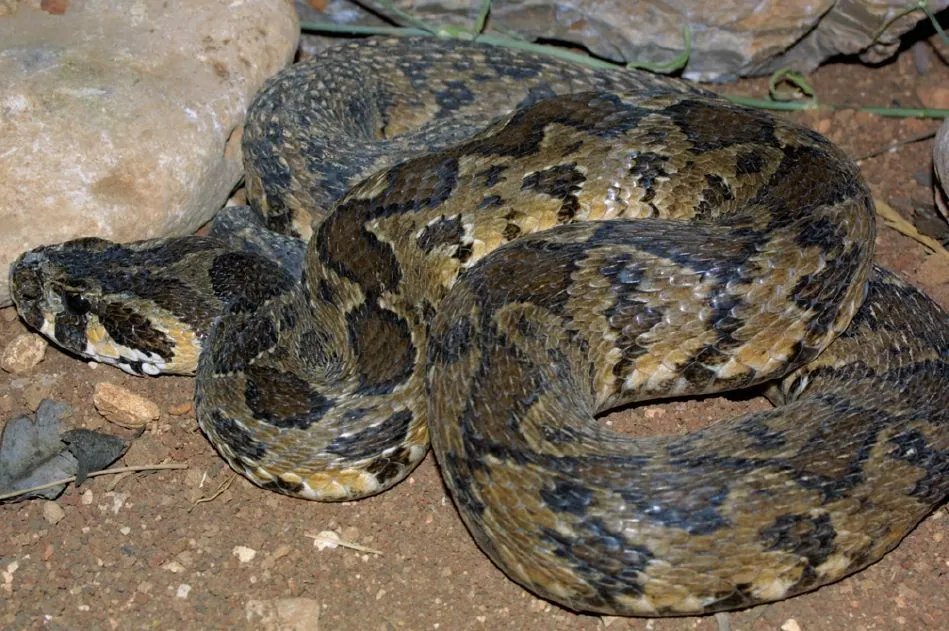
 Engeri y'okukitegeera
- The head is triangular and clearly separate from the neck, covered in small scales.1
- The upper body has large dark, diamond-shaped (rhomboid) blotches, sometimes forming a zig-zag pattern.1
- It usually measures 70 to 90 cm in total length (body plus tail), and can reach 130 cm.1
Kitera okutabulwa ne: The harmless coin-marked snake lives in the same areas and is similar in length, colouring and defensive behaviour, so people often confuse the two. This resemblance is probably a case of Batesian mimicry, where a harmless animal copies a dangerous one.1
Amaanyi g'obusagwa
Obusagwa buyita mu mannyo gaakyo amawanvu (fangs) oba mu mannyo amalala nga kiruma.
Obusagwa bwakyo bukola ki?
Its venom contains several groups of active compounds, including neurotoxins (which attack the nerves) and hemorrhagins (which damage blood vessels and cause bleeding). Other compounds include angioneurin growth factors and integrin inhibitors. Its LD50, a standard measure of how toxic a venom is, is 0.34 mg/kg.1
Kirina akabi kenkana wa eri abantu?
Akabi eri abantu: Kya kabi nnyoKisobola okutta omuntu atafunye bujjanjabi.It is considered a leading cause of snakebite within its range. About 0.5% to 2% of people who are bitten die. At least 7 people are reported to have died from its bite in Israel in the 21st century so far.1
 Amawulire amalungi: abasawo balina eddagala (antivenom) oba obujjanjabi ku kino.1
 Bwe kiruma
- Omuntu muleke ateetambula era ateefu, ekitundu ekirumiddwa kibeere ku buwanvu bw'omutima, ggyamu empeta n'ebintu ebinyweza, era omutwale mu ddwaliro mangu.
Bulijjo sooka kuba ennamba y'ebigwa bitalaze (112, 000, 911). Buno bulagirizi bwa bujjanjabi obusooka obwa bulijjo, si kuwabula kwa musawo. Obujjanjabi obusooka obw'omusingi
 Weekuume
- Tokwatako, tokwata wadde okusoomooza ensolo ey'omu nsiko, ne bw'eba ntono, era ne bw'eba erabika nga yeebase oba nga efudde.
- Gireke n'ebbanga. Bw'osisinkana emu, beera mukkakkamu, dda emabega mpola era gireke egende mu kkubo lyayo.
- Bw'emu ekuluma: beera mukkakkamu, totambula, kuba ennamba y'ebigwa bitalaze (112, 000, 911) oba tuuka mu ddwaliro mangu. Jjukira bwe yali efaanana, ekifaananyi kiyamba.
Tekikunoonya. Kikozesa obusagwa bwakyo okukwata emmere oba okwekuuma, era kyandisinze kwekweka. Ebirala ku kwekuuma
Wa mu nsi?
Kinene kyenkana wa?
Kiwanvu kyenkana wa?
 kiwanvu nga kkapa ez'awaka 2,5 okuva ku nnyindo okutuuka ku mukira
 kiwanvu nga ndiizi 7 eziteekeddwa mu lunyiriri
 kyandisobodde okudduka mita 100 mu sikonda 100 (omuntu asinga embiro yeetaaga 9,6)
Palestine viper kinene kyenkana wa bw'ogeraageranya ne GGWE?
Kubala bwokka mu browser yo. Tewali kitterekebwa wadde okusindikibwa wonna.
Kidduka kyenkana wa?


Ebituufu
In the 1991 Gulf War, the code phrase "Nahash Tsefa" (Viper Snake) was broadcast on radio and TV to tell Israelis to put on their gas masks during missile attacks from Iraq.1
In 2018 it was chosen as the national snake of Israel, after a public campaign.1
The Israeli Air Force named its Bell AH-1 Cobra helicopter Tzefa, and the IDF's paratroopers battalion #202 is called the Tzefa Battalion.1
Some modern scholars think the tsefa snake mentioned in the Hebrew Bible is this species.1
A list of venomous snakes in the Brooklyn Papyrus, from the first millennium BC in ancient Egypt, probably includes it.1
Ku bakugu mu busagwa
- Erinnya erya ssaayansi
- Daboia palaestinae
- Ekibinja
- Vipers n'essalambwa
- Amaka
- Viperidae2
- Ensengeka
- Squamata
- Ssemazinga
- Asiya
- Abaana abawere
- Unlike most vipers, which give birth to live young, it lays eggs around August. The eggs hatch 1.5 to 2 months later, and the young can already bite and kill prey.1
- Kiri kitya mu nsiko
- Least Concern1
- Akabi eri abantu
- 4 / 5: Kya kabi nnyo3
Ebituufu we biva
- Daboia palaestinae (Wikipedia (CC BY-SA 4.0))
- Daboia palaestinae (iNaturalist): amannya n'ensengeka y'ebika.
- Venom Wiki: omutendera gw'akabi, obunene obwa bulijjo n'okuteebereza kw'embiro bibyaffe. Laba engeri gye tubibalamu: Engeri gye tupimamu akabi.
Buli kituufu ku lupapula luno kirina ennamba eraga we kyava. Bwe tuba tukoze ensobi, tusonyiwe, tuli bayagazi ba nsolo, so si magazini ya ssaayansi. Tubuulire ku [email protected] tujja kugitereeza.
 Enjaba erumwa enjala! Venom Wiki pulojekiti ya muntu omu: ya bwereere, tewali birango era tewali bikulondoola. Akasiimo akatono kayamba okugikuuma ku yintaneti.Liisa enjaba
 Indian saw-scaled viper
 Puff adder
 Essalambwa lya Russell
 Common European adder
 Eastern Russell's viper
 Northeast African carpet viper
 Deathstalker
 Indian cobra
 King cobra
 Asian giant hornet
 Komodo dragon
 Spanish fly