
 Afirika
 Asiya
Asiya Bulaaya
 Amerika ey'Obukiikaddyo
 Awusitureeliya ne Oseyaniya
 Antakitika
 Oseyani ya Pasifiki
 Oseyani ya Atlantiki
 Oseyani y'e Buyindi
 Oseyani ya Arakitiki
 Ennyanja ya Mediterenia
 Ennyanja Emmyufu
 Ennyanja ya Karibiyani
 Ennyanja ya Korali
 Ennyanja ya China ey'Obukiikaddyo
 Ennyanja ya Bufilipino
 Ennyanja ya Andaman
 Ennyanja ey'Obukiikakkono (North Sea)
 Ennyanja ya Timor ne Arafura
 Ekikono kya Bengal
 Ekikono kya Kalifoniya
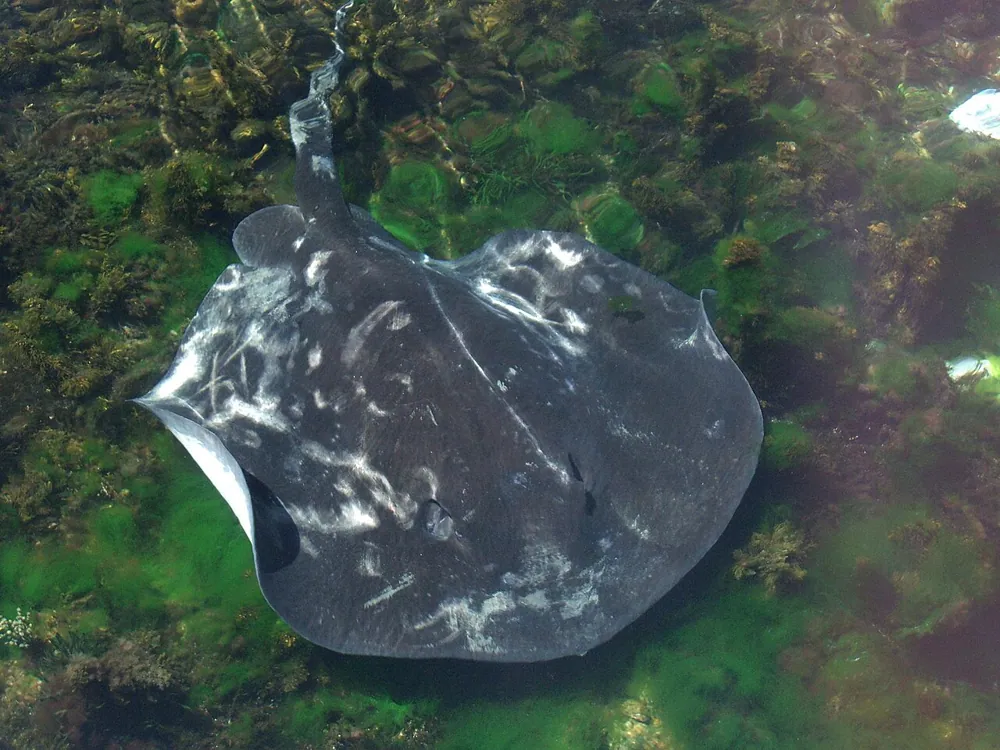
Short-tail stingray
 Kibojja
The short-tail stingray is one of the largest stingrays in the world. It lives in temperate seas off southern Africa, southern Australia and New Zealand, mostly on or near the sea floor. It is not aggressive, but its long venomous sting can cause a serious wound if the ray is startled.1



 Engeri y'okukitegeera
- Diamond-shaped, heavy disc that is smooth, with no scales (dermal denticles) on the disc even in adults1
- Plain grey-brown back, darkening towards the tail and above the eyes, with a line of white pores on either side of the head1
- Whitish underside, darkening towards the edges of the fins1
- Tail usually shorter than the disc, thick at the base, with one or two serrated stinging spines about halfway along it1
- Adults have a row of large, spear-like thorns in front of the sting1
Kitera okutabulwa ne: The pitted stingray (Dasyatis matsubarai) of the northwestern Pacific looks similar but is smaller. Records of this species from northern Australia and Thailand are thought to be other rays that were misidentified.1
Amaanyi g'obusagwa
Obusagwa buyita mu ggwa lyakyo eribojja.
Obusagwa bwakyo bukola ki?
Its sting is venomous. The mucous sheath covering the sting contains a toxin that causes necrosis, which means the death of body tissue. The most dangerous injuries involve damage to a vital organ, heavy blood loss, or secondary infection (sepsis) or tetanus.1
Kirina akabi kenkana wa eri abantu?
Akabi eri abantu: Kya kabi nnyoKisobola okutta omuntu atafunye bujjanjabi.The short-tail stingray is not aggressive, but if startled or harassed it can inflict a serious and even fatal wound. Its sting can be over 30 cm long and can penetrate most footwear, including kevlar bootees. It is responsible for most stingray injuries off New Zealand, including the death of Australian naturalist Steve Irwin, who was pierced in the chest by its barbed tail.1
Kikola ki nga kitidde?
When threatened, it raises its tail over its back like a scorpion, and a startled ray can leap through the water and strike with its tail.1
 Bwe kibojja
- Teeka ekiwundu mu mazzi agookya, agookya nga omuntu bw'asobola okugumiikiriza nga tegamwokya (gagezese n'omukono gwo), okumala eddakiika 30 okutuuka ku 90. Funa obuyambi bw'abasawo, naddala ku stonefish ne stingray.
Bulijjo sooka kuba ennamba y'ebigwa bitalaze (112, 000, 911). Buno bulagirizi bwa bujjanjabi obusooka obwa bulijjo, si kuwabula kwa musawo. Obujjanjabi obusooka obw'omusingi
 Weekuume
- Tokwatako, tokwata wadde okusoomooza ensolo ey'omu nsiko, ne bw'eba ntono, era ne bw'eba erabika nga yeebase oba nga efudde.
- Gireke n'ebbanga. Bw'osisinkana emu, beera mukkakkamu, dda emabega mpola era gireke egende mu kkubo lyayo.
- Bw'emu ekubojja: beera mukkakkamu, totambula, kuba ennamba y'ebigwa bitalaze (112, 000, 911) oba tuuka mu ddwaliro mangu. Jjukira bwe yali efaanana, ekifaananyi kiyamba.
Tekikunoonya. Kikozesa obusagwa bwakyo okukwata emmere oba okwekuuma, era kyandisinze kwekweka. Ebirala ku kwekuuma
Wa mu nsi?
Kinene kyenkana wa?
Kiwanvu kyenkana wa?
Kizitowa kyenkana wa?
 kiwanvu nga mbwa 4 okuva ku nnyindo okutuuka ku mukira
 kiwanvu nga ndiizi 24 eziteekeddwa mu lunyiriri
 kyandisobodde okuwuga obuwanvu bw'ekidiba ekinene (m 50) mu sikonda 6
Short-tail stingray kinene kyenkana wa bw'ogeraageranya ne GGWE?
Kubala bwokka mu browser yo. Tewali kitterekebwa wadde okusindikibwa wonna.
Kidduka kyenkana wa?


Ebituufu
It can flap its pectoral fins with enough force to make a loud audible 'bang' in the water, although it is usually slow-moving.1
It is one of the largest stingrays in the world, and reliable observers off New Zealand have reported individuals almost 3 m across.1
Captive experiments suggest it can detect magnetic fields, which may help it navigate.1
Every summer, large groups gather under the rocky archways of the Poor Knights Islands off New Zealand, where both mating and birthing have been seen.1
Captive females have been observed mating with up to three different males in succession.1
Ku bakugu mu busagwa
- Erinnya erya ssaayansi
- Bathytoshia brevicaudata
- Ekibinja
- Ebyennyanja eby'obusagwa
- Amaka
- Dasyatidae2
- Ensengeka
- Myliobatiformes
- Ssemazinga
- Oseyani y'e Buyindi, Oseyani ya Pasifiki, Ennyanja ya Korali, Oseyani
- Abaana abawere
- It gives birth to live young. Females usually have litters of 6 to 10 pups in summer, and newborns measure 32 to 36 cm across.1
- Kiri kitya mu nsiko
- Least Concern (IUCN)1
- Akabi eri abantu
- 4 / 5: Kya kabi nnyo3
Ebituufu we biva
- Short-tail stingray (Wikipedia (CC BY-SA 4.0))
- Bathytoshia brevicaudata (iNaturalist): amannya n'ensengeka y'ebika.
- Venom Wiki: omutendera gw'akabi, obunene obwa bulijjo n'okuteebereza kw'embiro bibyaffe. Laba engeri gye tubibalamu: Engeri gye tupimamu akabi.
Buli kituufu ku lupapula luno kirina ennamba eraga we kyava. Bwe tuba tukoze ensobi, tusonyiwe, tuli bayagazi ba nsolo, so si magazini ya ssaayansi. Tubuulire ku [email protected] tujja kugitereeza.
 Enjaba erumwa enjala! Venom Wiki pulojekiti ya muntu omu: ya bwereere, tewali birango era tewali bikulondoola. Akasiimo akatono kayamba okugikuuma ku yintaneti.Liisa enjaba
Ebirala okuva mu kibinja kye kimu: Ebyennyanja eby'obusagwa
 Reef stonefishEbyennyanja eby'obusagwaKisobola okuttaTokwatako
 Red lionfishEbyennyanja eby'obusagwaKyetaaga omusawoTokwatako
 Estuarine stonefishEbyennyanja eby'obusagwaKisobola okuttaTokwatako
 Striped eel catfishEbyennyanja eby'obusagwaKisobola okuttaTokwatako
 Bluespotted ribbontail rayEbyennyanja eby'obusagwaKyetaaga omusawo
 Common stingrayEbyennyanja eby'obusagwaKyetaaga omusawo
Era kibeera mu: Oseyani y'e Buyindi
 Australian box jellyfishJellyfish n'ebibojja eby'ennyanjaKittaTokwatako
 Geography coneCone snail ne octopusKitta
 Greater blue-ringed octopusCone snail ne octopusKitta
 Southern blue-ringed octopusCone snail ne octopusKitta
 Hawksbill sea turtleEnsolo endala ez'obutwaKisobola okutta
 Irukandji jellyfishJellyfish n'ebibojja eby'ennyanjaKisobola okuttaTokwatako