
 Afirika
 Asiya
Asiya Bulaaya
 Amerika ey'Obukiikaddyo
 Awusitureeliya ne Oseyaniya
 Antakitika
 Oseyani ya Pasifiki
 Oseyani ya Atlantiki
 Oseyani y'e Buyindi
 Oseyani ya Arakitiki
 Ennyanja ya Mediterenia
 Ennyanja Emmyufu
 Ennyanja ya Karibiyani
 Ennyanja ya Korali
 Ennyanja ya China ey'Obukiikaddyo
 Ennyanja ya Bufilipino
 Ennyanja ya Andaman
 Ennyanja ey'Obukiikakkono (North Sea)
 Ennyanja ya Timor ne Arafura
 Ekikono kya Bengal
 Ekikono kya Kalifoniya
Tube web spider
 Kiruma
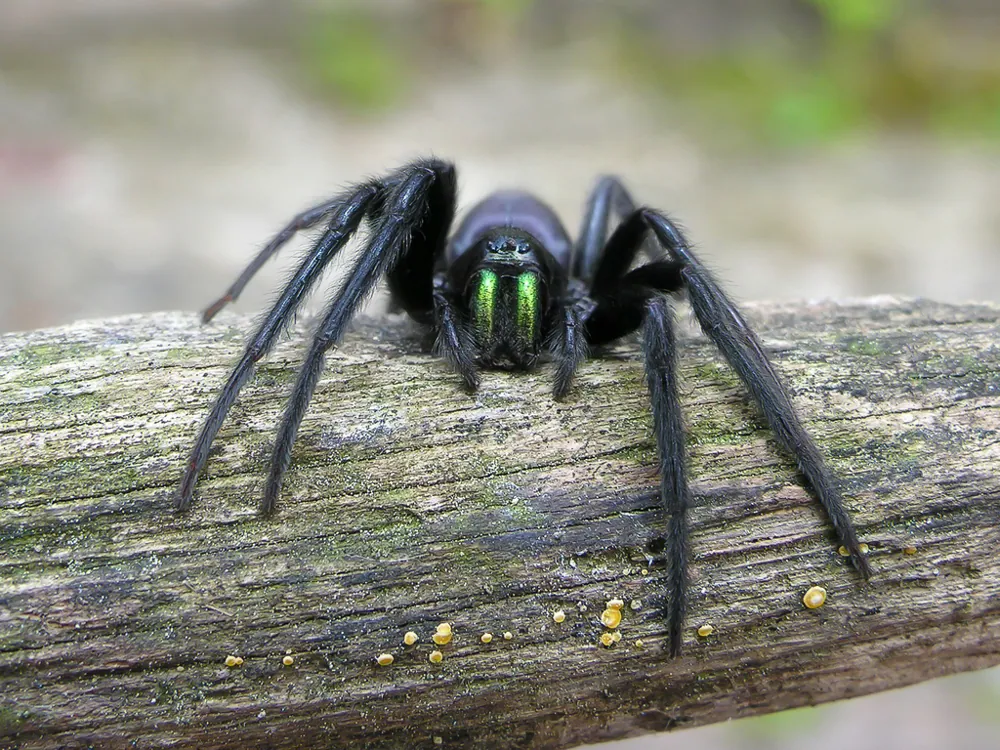
The tube web spider is a dark spider that builds a tube-shaped web in cracks in walls and buildings. It began in the Mediterranean region but has spread to many towns in southern Britain and other parts of the world. Its bite is reported to be very painful, so it is worth knowing what it looks like.1


 Engeri y'okukitegeera
- Adults are a uniform black, sometimes with a green shine, especially on the fangs.1
- Young spiders (subadults) have a greyish abdomen with a marking.1
- It makes a tubular web with six or more silk lines radiating out from the entrance.1
- Adults are seen from June to November.1
- Females can reach a body length of 22 mm, and males up to 15 mm.1
Amaanyi g'obusagwa
Obusagwa buyita mu mannyo gaakyo amawanvu (fangs) oba mu mannyo amalala nga kiruma.
Obusagwa bwakyo bukola ki?
The venom contains two neurotoxins, which attack the nerves, and one insecticide. The venom reduces the rate and amount of sodium inactivation, a process in nerve cells. The bite is reported to feel like a deep injection, and the pain can last for several hours.1
Kirina akabi kenkana wa eri abantu?
Akabi eri abantu: Kya bulumiKisobola okuluma ddala, naye kumpi tekiba kya kabi kinene.The bite is reported to be extremely painful, but it is also said to feel like a bee sting, which places it at 2 on the Schmidt sting pain index. The bite has no lasting effects.1
Kikola ki nga kitidde?
When disturbed while feeding, it retreats further into its tube.1
 Bwe kiruma
- Naaza ekifo ekirumiddwa era okiteekeko ayisi olw'obulumi. Funa obuyambi bw'abasawo singa obulumi bungi, busaasaana oba omuntu awulira bubi.
Bulijjo sooka kuba ennamba y'ebigwa bitalaze (112, 000, 911). Buno bulagirizi bwa bujjanjabi obusooka obwa bulijjo, si kuwabula kwa musawo. Obujjanjabi obusooka obw'omusingi
 Weekuume
- Tokwatako, tokwata wadde okusoomooza ensolo ey'omu nsiko, ne bw'eba ntono, era ne bw'eba erabika nga yeebase oba nga efudde.
- Gireke n'ebbanga. Bw'osisinkana emu, beera mukkakkamu, dda emabega mpola era gireke egende mu kkubo lyayo.
- Bw'emu ekuluma: beera mukkakkamu, totambula, kuba ennamba y'ebigwa bitalaze (112, 000, 911) oba tuuka mu ddwaliro mangu. Jjukira bwe yali efaanana, ekifaananyi kiyamba.
Tekikunoonya. Kikozesa obusagwa bwakyo okukwata emmere oba okwekuuma, era kyandisinze kwekweka. Ebirala ku kwekuuma
Wa mu nsi?
Kinene kyenkana wa?
Kiwanvu kyenkana wa?
 kiwanvu nga pepa kiripu
 kyandisobodde okudduka mita 100 mu sikonda 360 (omuntu asinga embiro yeetaaga 9,6)
Tube web spider kinene kyenkana wa bw'ogeraageranya ne GGWE?
Kubala bwokka mu browser yo. Tewali kitterekebwa wadde okusindikibwa wonna.
Kidduka kyenkana wa?


Ebituufu
A population in Westminster Abbey has been proposed as a new subspecies, because its fangs are a brighter green and its members are significantly smaller than other European populations.1
Specimens have been found in Exeter Cathedral as far back as 1890.1
Females lay eggs in the bricks of south-facing structures during winter, so a female seen in September or October may already have laid eggs for the next spring.1
It is the largest European segestriid spider.1
In Britain it was probably introduced via seaports, with records going back at least to 1845.1
Ku bakugu mu busagwa
Ebituufu we biva
- Segestria florentina (Wikipedia (CC BY-SA 4.0))
- Segestria florentina (iNaturalist): amannya n'ensengeka y'ebika.
- Venom Wiki: omutendera gw'akabi, obunene obwa bulijjo n'okuteebereza kw'embiro bibyaffe. Laba engeri gye tubibalamu: Engeri gye tupimamu akabi.
Buli kituufu ku lupapula luno kirina ennamba eraga we kyava. Bwe tuba tukoze ensobi, tusonyiwe, tuli bayagazi ba nsolo, so si magazini ya ssaayansi. Tubuulire ku [email protected] tujja kugitereeza.
 Enjaba erumwa enjala! Venom Wiki pulojekiti ya muntu omu: ya bwereere, tewali birango era tewali bikulondoola. Akasiimo akatono kayamba okugikuuma ku yintaneti.Liisa enjaba
Ebirala okuva mu kibinja kye kimu: Nnabbubi
 Mediterranean black widow
 Diving bell spider
 European yellow sac spider
 Noble false widow
 Tarantula wolf spider
 Daddy long-legs spider
Era kibeera mu: Bulaaya
 Common European adderVipers n'essalambwaKyetaaga omusawo
 Spanish flyEnsolo endala ez'obutwaKyetaaga omusawoTokwatako
 Common waspEnjuki, ennumba n'ennumba enneneKiruma bwokka
 European hornetEnjuki, ennumba n'ennumba enneneKiruma bwokka
 Fire salamanderEbikere eby'obutwa, ebikere ebinene (toads) ne newtsKiruma bwokkaTokwatako
 Western honey beeEnjuki, ennumba n'ennumba enneneKiruma bwokka