
 Afrika
 Azia
Azia Erópa
Erópa Amerika ya Sude
 Australia & Océanie
 Antarctique
 Océan Pacifique
 Océan Atlantique
 Océan Indien
 Océan Arctique
 Mer Méditerranée
 Mer Rouge
 Mer des Caraïbes
 Mer de Corail
 Mer de Chine méridionale
 Mer des Philippines
 Mer d'Andaman
 Mer du Nord
 Mer de Timor & Mer d'Arafura
 Golfe du Bengale
 Golfe de Californie
Coastal taipan
 Kosua
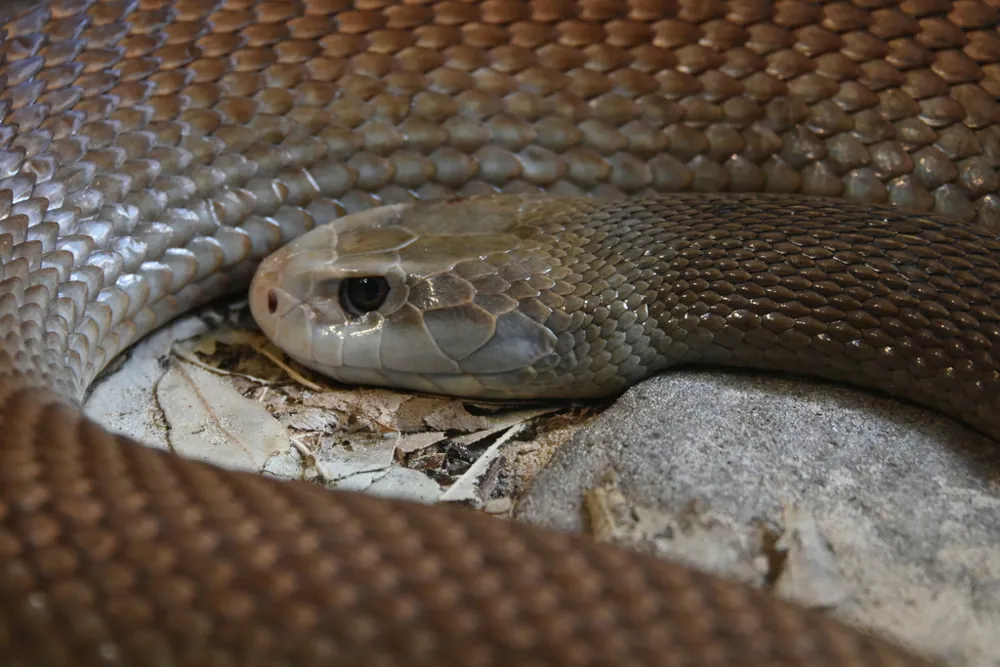
KosuaThe coastal taipan is one of the most feared snakes in Australia. It is a large, fast snake with a powerful venom, and it lives along the coasts of northern and eastern Australia and on the island of New Guinea. It is one of the reasons snake bite safety matters so much in these areas.1



 Ndenge ya koyeba yango
- Light olive or reddish-brown upperparts, sometimes dark grey to black1
- Paler sides and a creamy-white to pale yellow belly, often marked with orange or pink flecks1
- Long, narrow head with an angular brow and a lighter-coloured face1
- Large, round, light brown or hazel eyes with large pupils1
- Typically about 2.0 m long as an adult, with a slender body1
Bakosanaka yango mbala mingi na: It is often confused with the eastern brown snake, northern brown snake and king brown snake. The coastal taipan has a larger head and a narrow neck, and a lighter face and snout. In the other species, the head and neck are the same width.1
Makasi ya venin
Venin ebimaka na nzela ya mino na yango ntango esui.
Venin na yango esalaka nini?
Its venom is mainly neurotoxic, which means it attacks the nerves, and it is also coagulopathic, which means it disturbs blood clotting. In a recorded bite case, the victim became unwell within 15 to 30 minutes, with drooping eyelids, nausea and difficulty breathing. Some victims have also lost their sense of smell for a time.1
Likama na yango mpo na bato ezali boni?
Likama mpo na bato: Ekoki kobomaMoko ya banyama ya likama koleka na mokili.It is considered one of the most dangerous snakes in the region and is classified by the World Health Organization as a snake of medical importance. Several deaths were recorded from its bites in the 1930s and 1940s, and more were added later as historical cases.1
 Nsango malamu: ba monganga bazali na nkisi (antivenin) to bosalisi mpo na yango.1
Esalaka nini ntango ebangi?
It tends to avoid confrontation but becomes highly defensive if provoked.1
 Soki esui
- Any suspected bite needs urgent medical care. In one recorded case, the bitten man was taken to hospital, where he was given fluids and tiger snake antivenom, and he recovered after 19 days in hospital.1
- Immobilisation na pression: zinga bande élastique makasi likolo ya esika esui, sima mata na yango na lokolo to loboko mobimba, tia attelle, mpe tika moto aningana ata moke te kino lisalisi ekoya.
- Sukola esika esui te: na lopitalo bakoki kotala venin oyo etikali na loposo mpo na kopona antivenin oyo ebongi.
Benga ntango nyonso nimero ya urgence liboso (112, 000, 911). Oyo ezali toli ya lisalisi ya liboso, ezali toli ya monganga te. Makambo ya moboko ya lisalisi ya liboso
 Zala na libateli
- Ata mokolo moko te, simba, kanga to silikisa nyama ya zamba te, ata ya moke, mpe ata soki emonani lokola elali to ekufi.
- Tika yango esika. Soki okutani na moko, zala kimia, zonga sima malembe mpe tika ekende nzela na yango.
- Soki moko esui yo: zala kimia, ningana te, benga nimero ya urgence na yo (112, 000, 911) to kende na lopitalo noki. Kanisa ndenge ezalaki, foto esalisaka.
Ezali koluka yo te. Esalelaka venin na yango mpo na kokanga bilei to komibatela, mpe elingaka mingi kobombama. Makambo mosusu mpo na komibatela
Monene na yango boni?
Molai na yango boni?
Kilo na yango boni?
 molai lokola bambwa 3, zolo kino mokila
 molai lokola bitabe 16 oyo etiami moko na sima ya mosusu
 pene na kilo ya pusu ya ndako
 ekoki kopota metre 100 na sekonde 41 (moto ya mbangu koleka asengaka 9,6)
Coastal taipan azali monene boni soki tokokanisi na YO?
Kaka ba calcul na navigateur na yo. Eloko moko te ebombamaka to etindamaka esika moko.
Mbangu na yango boni?


Makambo ya solo
The longest recorded coastal taipan was 2.9 m long and weighed 6.5 kg, and larger specimens of up to 3.3 m are widely believed to exist.1
Its hunting method, freezing, striking and releasing prey, is similar to that of the African black mamba.1
It is the second-longest venomous snake in Australia, after the king brown snake.1
Newly hatched young grow quickly, reaching about 1.0 m in their first year.1
It may have become more common since cane toads were introduced to Australia in 1935.1
Solo to lokuta?
Lokuta: The snake hides in trees and drops onto people, and it chases people for hours.
Solo: Stories of it hiding in trees and dropping on victims were spread in newspapers and books, but snake handlers say it is shy and avoids confrontation. It only becomes highly defensive when provoked.1
Mpo na ba expert ya venin
- Kombo ya siansi
- Oxyuranus scutellatus
- Ebota
- Banyoka ya Australia
- Libota
- Elapidae2
- Molongo
- Squamata
- Bakontina
- Australia & Océanie
- Bana
- It lays a clutch of 7 to 20 eggs. The eggs take 60 to 80 days to hatch, and the young are 30 to 34 cm long.1
- Ndenge ezali kobika na zamba
- Least Concern (IUCN)1
- Likama mpo na bato
- 5 / 5: Ekoki koboma3
Esika makambo euti
- Coastal taipan (Wikipedia (CC BY-SA 4.0))
- Oxyuranus scutellatus (iNaturalist): bankombo mpe classification.
- Venom Wiki: niveau ya likama, monene ya momesano mpe kokanisa ya mbangu ezali ya biso moko. Tala ndenge tolukaka yango: Ndenge tomekaka likama.
Likambo nyonso na lokasa oyo ezali na nimero oyo elakisi source na yango. Soki tosali libunga, limbisa biso, tozali bato oyo balingaka banyama, zulunale ya siansi te. Yebisa biso na [email protected] mpe tokobongisa yango.
 Scorpion azali na nzala! Venom Wiki ezali mosala ya moto moko: ya ofele, pibilisite te mpe trackers te. Mwa mbongo moke ya kosalisa esalisaka mpo ete etikala na internet.Pesa scorpion bilei
Mosusu ya ebota moko: Banyoka ya Australia
 Common death adderBanyoka ya AustraliaEkoki koboma
 Eastern brown snakeBanyoka ya AustraliaEkoki koboma
 Taipan ya kati ya AustralieBanyoka ya AustraliaEkoki koboma
 Nyoka-nkɔ́iBanyoka ya AustraliaEkoki koboma
 Collett's snakeBanyoka ya AustraliaEkoki koboma
 Desert death adderBanyoka ya AustraliaEkoki koboma
Ezalaka mpe na: Australia & Océanie
 Sydney funnel-web spiderBa mygale & ba funnel-webEkoki koboma
 Redback spiderBa tandambulaEsengeli monganga
 Brown tree snakeBanyoka ya mino ya venin na simaEpesaka kaka pasi
 Hooded pitohuiBanyama mosusu ya poisonEpesaka kaka pasiKosimba te
 PlatypusBa mammifère ya veninEpesaka kaka pasi
 Northern tree-dwelling funnel-web spiderBa mygale & ba funnel-webEkoki koboma