
 Afrika
 Azia
Azia Erópa
Erópa Amerika ya Sude
 Australia & Océanie
 Antarctique
 Océan Pacifique
 Océan Atlantique
 Océan Indien
 Océan Arctique
 Mer Méditerranée
 Mer Rouge
 Mer des Caraïbes
 Mer de Corail
 Mer de Chine méridionale
 Mer des Philippines
 Mer d'Andaman
 Mer du Nord
 Mer de Timor & Mer d'Arafura
 Golfe du Bengale
 Golfe de Californie
Eastern brown snake
 Kosua
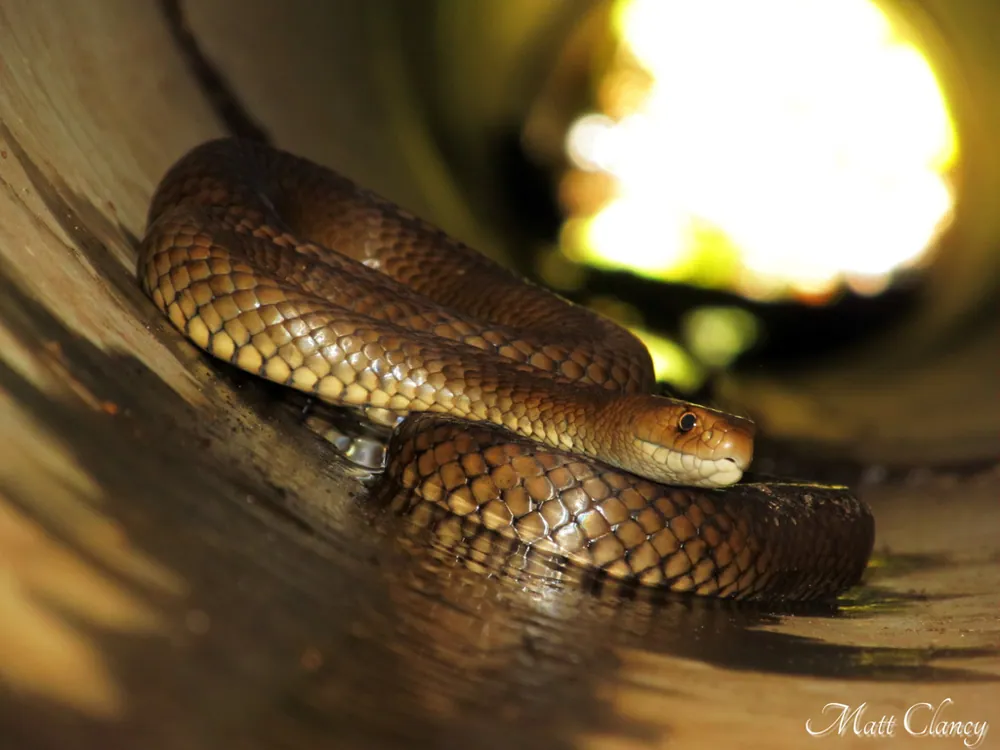
KosuaThe eastern brown snake is a slender snake that lives across eastern and central Australia and in southern New Guinea. It is one of the most venomous land snakes in the world, so it is important to know what it looks like. It often lives near farms and the edges of towns, where it hunts house mice.1

 Ndenge ya koyeba yango
- Slender build, with no clear line between the head and neck.1
- Upper parts range from pale brown to black, and sometimes orange or russet.1
- Underside is pale cream or yellow, often with orange, brown or dark grey blotches.1
- Young snakes usually have a black head and may have dark bands or a pattern across the body. These markings fade as the snake grows.1
- Inside of the mouth is flesh-pink.1
Bakosanaka yango mbala mingi na: Large eastern brown snakes are often confused with mulga snakes, which share their habitat in many areas; they can be told apart by head size. Its yellowish underparts separate it from the dugite and peninsula brown snake, which are entirely brown or have grey underparts. Young eastern brown snakes have head markings similar to red-naped snakes, grey snakes, Dwyer's snakes and curl snakes.1
Makasi ya venin
Venin ebimaka na nzela ya mino na yango ntango esui.
Venin na yango esalaka nini?
Its venom mainly affects the circulatory system, which carries blood around the body. The main effects are coagulopathy (a problem with blood clotting), haemorrhage (bleeding), cardiovascular collapse (the heart and blood vessels failing) and cardiac arrest (the heart stopping). One of the main components is pseutarin-C, a prothrombinase complex that breaks down prothrombin, a substance needed for blood to clot.1
Likama na yango mpo na bato ezali boni?
Likama mpo na bato: Ekoki kobomaMoko ya banyama ya likama koleka na mokili.It is considered the world's second-most venomous land snake after the inland taipan, based on laboratory tests in mice.1
 Soki esui
- Immobilisation na pression: zinga bande élastique makasi likolo ya esika esui, sima mata na yango na lokolo to loboko mobimba, tia attelle, mpe tika moto aningana ata moke te kino lisalisi ekoya.
- Sukola esika esui te: na lopitalo bakoki kotala venin oyo etikali na loposo mpo na kopona antivenin oyo ebongi.
Benga ntango nyonso nimero ya urgence liboso (112, 000, 911). Oyo ezali toli ya lisalisi ya liboso, ezali toli ya monganga te. Makambo ya moboko ya lisalisi ya liboso
 Zala na libateli
- Ata mokolo moko te, simba, kanga to silikisa nyama ya zamba te, ata ya moke, mpe ata soki emonani lokola elali to ekufi.
- Tika yango esika. Soki okutani na moko, zala kimia, zonga sima malembe mpe tika ekende nzela na yango.
- Soki moko esui yo: zala kimia, ningana te, benga nimero ya urgence na yo (112, 000, 911) to kende na lopitalo noki. Kanisa ndenge ezalaki, foto esalisaka.
Ezali koluka yo te. Esalelaka venin na yango mpo na kokanga bilei to komibatela, mpe elingaka mingi kobombama. Makambo mosusu mpo na komibatela
Monene na yango boni?
Molai na yango boni?
 molai lokola ba pusu ya ndako 5, zolo kino mokila
 molai lokola bitabe 13 oyo etiami moko na sima ya mosusu
 ekoki kopota metre 100 na sekonde 46 (moto ya mbangu koleka asengaka 9,6)
Eastern brown snake azali monene boni soki tokokanisi na YO?
Kaka ba calcul na navigateur na yo. Eloko moko te ebombamaka to etindamaka esika moko.
Mbangu na yango boni?


Makambo ya solo
In December 2023, an eastern brown snake paused a match at the Brisbane International tennis tournament for 40 minutes until a professional snake catcher removed it.1
In winter, it brumates (goes into a state of rest like hibernation). Groups have been found sheltering under concrete slabs of houses in Sydney.1
Its fangs are small compared with other Australian venomous snakes, averaging 2.8 mm and reaching up to 4 mm in larger specimens.1
Within its genus, it has the largest number of chromosomes, at 38 in its cells.1
Local Aboriginal peoples in Sydney, the Illawarra and the Wiradjuri region had their own names for it, and the Dharawal and Awabakal held ceremonies for it.1
Solo to lokuta?
Lokuta: Young and adult brown snakes are different species.
Solo: Early scientists thought they were different because their markings differ. Later research showed that the markings of young snakes fade as they grow, and all these forms are the same species.1
Esika makambo euti
- Eastern brown snake (Wikipedia (CC BY-SA 4.0))
- Pseudonaja textilis (iNaturalist): bankombo mpe classification.
- Venom Wiki: niveau ya likama, monene ya momesano mpe kokanisa ya mbangu ezali ya biso moko. Tala ndenge tolukaka yango: Ndenge tomekaka likama.
Likambo nyonso na lokasa oyo ezali na nimero oyo elakisi source na yango. Soki tosali libunga, limbisa biso, tozali bato oyo balingaka banyama, zulunale ya siansi te. Yebisa biso na [email protected] mpe tokobongisa yango.
 Scorpion azali na nzala! Venom Wiki ezali mosala ya moto moko: ya ofele, pibilisite te mpe trackers te. Mwa mbongo moke ya kosalisa esalisaka mpo ete etikala na internet.Pesa scorpion bilei
Mosusu ya ebota moko: Banyoka ya Australia
 Coastal taipan
 Common death adder
 Taipan ya kati ya Australie
 Nyoka-nkɔ́i
 Collett's snake
 Desert death adder
Ezalaka mpe na: Australia & Océanie
 Sydney funnel-web spiderBa mygale & ba funnel-webEkoki koboma
 Redback spiderBa tandambulaEsengeli monganga
 Brown tree snakeBanyoka ya mino ya venin na simaEpesaka kaka pasi
 Hooded pitohuiBanyama mosusu ya poisonEpesaka kaka pasiKosimba te
 PlatypusBa mammifère ya veninEpesaka kaka pasi
 Northern tree-dwelling funnel-web spiderBa mygale & ba funnel-webEkoki koboma