
 Afrika
 Azia
Azia Erópa
Erópa Amerika ya Sude
 Australia & Océanie
 Antarctique
 Océan Pacifique
 Océan Atlantique
 Océan Indien
 Océan Arctique
 Mer Méditerranée
 Mer Rouge
 Mer des Caraïbes
 Mer de Corail
 Mer de Chine méridionale
 Mer des Philippines
 Mer d'Andaman
 Mer du Nord
 Mer de Timor & Mer d'Arafura
 Golfe du Bengale
 Golfe de Californie
Greater blue-ringed octopus
 Kosua
KosuaThe greater blue-ringed octopus is a small sea creature that lives in the warm shallow waters of the Indo-West Pacific, including around Australia. It is one of the most venomous marine animals in the world, so knowing what it looks like matters.1



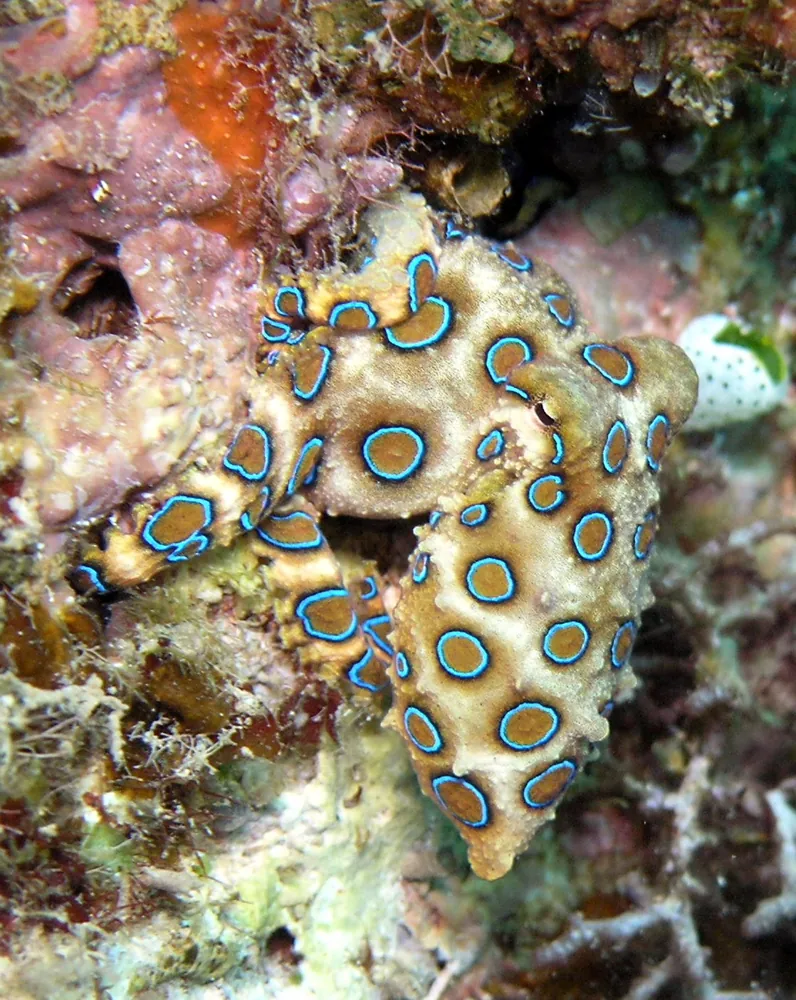
 Ndenge ya koyeba yango
- A small octopus, up to 10 cm with its arms included, weighing about 80 grams on average.1
- Electric blue rings, about 7 to 8 mm across, roughly 60 of them, spread over its whole skin.1
- The rings flash iridescent blue as a warning signal, each flash lasting about a third of a second.1
- Its body colour varies from yellow ochre to light brown, or whitish when inactive.1
- Blue lines run through its eyes.1
Makasi ya venin
Venin ebimaka na nzela ya mino na yango ntango esui.
Venin na yango esalaka nini?
Its venom contains tetrodotoxin (TTX), a powerful neurotoxin, which is a poison that attacks the nerves. It paralyses the muscles needed for movement, and in people it can lead to death through respiratory paralysis, which means the breathing muscles stop working. Symptoms include tingling and numbness of the face and lips, sweating, severe headaches, dizziness, speech problems, weakness and vomiting. Symptoms can appear between 15 minutes and four hours after a bite, and the victim stays conscious throughout.1
Likama na yango mpo na bato ezali boni?
Likama mpo na bato: Ekoki kobomaMoko ya banyama ya likama koleka na mokili.The bite is capable of being fatal to humans. The bite is painless, so a person may not notice it. Children are more sensitive to the toxin. Death can occur between 20 minutes and 24 hours after symptoms begin.1
Esalaka nini ntango ebangi?
It flashes its blue rings as a warning to predators, and it uses its venom to defend itself.1
 Soki esui
- Immobilisation na pression: zinga bande élastique makasi likolo ya esika esui, sima mata na yango na lokolo to loboko mobimba, tia attelle, mpe tika moto aningana ata moke te kino lisalisi ekoya.
- Pieuvre ya anneaux bleus to escargot cône ekoki kopekisa moto kopema wana azali naino na makanisi (alali te): benga lisalisi mpe bongisama mpo na kopesa ye mpema (bouche-à-bouche) kino ambulance ekozwa mokumba.
Benga ntango nyonso nimero ya urgence liboso (112, 000, 911). Oyo ezali toli ya lisalisi ya liboso, ezali toli ya monganga te. Makambo ya moboko ya lisalisi ya liboso
 Zala na libateli
- Ata mokolo moko te, simba, kanga to silikisa nyama ya zamba te, ata ya moke, mpe ata soki emonani lokola elali to ekufi.
- Tika yango esika. Soki okutani na moko, zala kimia, zonga sima malembe mpe tika ekende nzela na yango.
- Soki moko esui yo: zala kimia, ningana te, benga nimero ya urgence na yo (112, 000, 911) to kende na lopitalo noki. Kanisa ndenge ezalaki, foto esalisaka.
Ezali koluka yo te. Esalelaka venin na yango mpo na kokanga bilei to komibatela, mpe elingaka mingi kobombama. Makambo mosusu mpo na komibatela
Wapi na mokili?
Monene na yango boni?
Molai na yango boni?
 molai lokola ba brique ya masano 3 na molongo
 ekoki kobeta mai molai ya piscine monene (50 m) na sekonde 7,2
Greater blue-ringed octopus azali monene boni soki tokokanisi na YO?
Kaka ba calcul na navigateur na yo. Eloko moko te ebombamaka to etindamaka esika moko.
Mbangu na yango boni?


Makambo ya solo
The greater blue-ringed octopus is one of the most venomous marine animals in the world, despite being small.1
Its venom contains tetrodotoxin, the same toxin found in pufferfish.1
There is no known antidote or antitoxin for tetrodotoxin, and the toxin does not break down when heated or boiled.1
Its blue rings are a warning signal to predators, showing that it is highly venomous.1
Males die after mating, and females die after guarding their eggs because they refuse to eat.1
Solo to lokuta?
Lokuta: A small octopus is harmless.
Solo: Despite its small size, its bite can be deadly to humans.1
Mpo na ba expert ya venin
- Kombo ya siansi
- Hapalochlaena lunulata
- Ebota
- Ba escargot cône & ba pieuvre
- Libota
- Octopodidae2
- Molongo
- Octopoda
- Bakontina
- Océan Indien, Océan Pacifique, Mer de Corail, Mer des Philippines, Mer de Timor & Mer d'Arafura, Ba océan
- Bana
- The female lays 50 to 100 eggs, which she carries under her arms for about a month. The young hatch as tiny planktonic paralarvae, about the size of a pea.1
- Molai ya bomoi
- pene na mibu 21
- Likama mpo na bato
- 5 / 5: Ekoki koboma3
Esika makambo euti
- Greater blue-ringed octopus (Wikipedia (CC BY-SA 4.0))
- Hapalochlaena lunulata (iNaturalist): bankombo mpe classification.
- Venom Wiki: niveau ya likama, monene ya momesano mpe kokanisa ya mbangu ezali ya biso moko. Tala ndenge tolukaka yango: Ndenge tomekaka likama.
Likambo nyonso na lokasa oyo ezali na nimero oyo elakisi source na yango. Soki tosali libunga, limbisa biso, tozali bato oyo balingaka banyama, zulunale ya siansi te. Yebisa biso na [email protected] mpe tokobongisa yango.
 Scorpion azali na nzala! Venom Wiki ezali mosala ya moto moko: ya ofele, pibilisite te mpe trackers te. Mwa mbongo moke ya kosalisa esalisaka mpo ete etikala na internet.Pesa scorpion bilei
Mosusu ya ebota moko: Ba escargot cône & ba pieuvre
 Geography coneBa escargot cône & ba pieuvreEkoki koboma
 Southern blue-ringed octopusBa escargot cône & ba pieuvreEkoki koboma
 Blue sea dragonBa escargot cône & ba pieuvreEpesaka kaka pasi
 Common octopusBa escargot cône & ba pieuvreEzangi likama
 Giant Pacific octopusBa escargot cône & ba pieuvreEzangi likama
 Blue-lined octopusBa escargot cône & ba pieuvreEkoki koboma
Ezalaka mpe na: Océan Indien
 Australian box jellyfishBa méduse & banyama ya mbu oyo etubakaEkoki kobomaKosimba te
 Hawksbill sea turtleBanyama mosusu ya poisonEkoki koboma
 Irukandji jellyfishBa méduse & banyama ya mbu oyo etubakaEkoki kobomaKosimba te
 Reef stonefishMbisi ya veninEkoki kobomaKosimba te
 Crown-of-thorns starfishBa oursin, ba étoile ya mbu & ba verEsengeli mongangaKosimba te
 Portuguese man o' warBa méduse & banyama ya mbu oyo etubakaEsengeli mongangaKosimba te