
 Afrika
 Azia
Azia Erópa
Erópa Amerika ya Sude
 Australia & Océanie
 Antarctique
 Océan Pacifique
 Océan Atlantique
 Océan Indien
 Océan Arctique
 Mer Méditerranée
 Mer Rouge
 Mer des Caraïbes
 Mer de Corail
 Mer de Chine méridionale
 Mer des Philippines
 Mer d'Andaman
 Mer du Nord
 Mer de Timor & Mer d'Arafura
 Golfe du Bengale
 Golfe de Californie
Crown-of-thorns starfish
 Ba nsende ya venin
The crown-of-thorns starfish is a large starfish with long, sharp spines that look like a crown of thorns. It lives on coral reefs across the Indo-Pacific, from the Red Sea to the west coast of Central America, and it is most common around Australia. It feeds on hard coral, so it can change the reefs it lives on.1

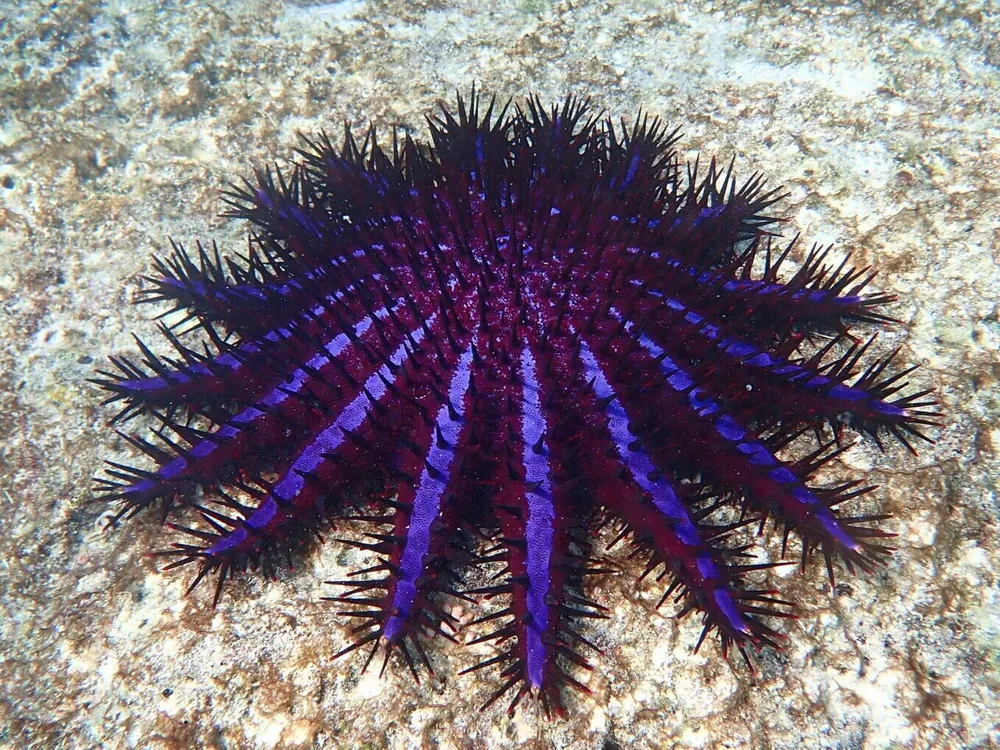
 Ndenge ya koyeba yango
- Adults are normally 25 to 35 cm across.1
- Up to 21 arms, with long, stiff, very sharp spines that are 4 to 5 cm long on the top and sides of the arms.1
- Colour varies with diet or region: purple, purple-blue, reddish grey or brown with red spine tips, or green with yellow spine tips.1
- The body is flexible and can bend and twist around coral surfaces.1
Bakosanaka yango mbala mingi na: A close relative, Acanthaster brevispinus, lives on soft sea floors at moderate depths rather than on coral reefs. The two are considered sibling species.1
Makasi ya venin
Ba nsende ya songe ememaka venin. Konyata yango to kosimba yango epesaka pasi.
Venin na yango esalaka nini?
The spines do not inject venom. When they pierce skin, tissue containing saponins (detergent-like chemicals) is left in the wound. In humans this causes a sharp, stinging pain that can last several hours, persistent bleeding, and nausea and swelling that may last a week or more.1
Likama na yango mpo na bato ezali boni?
Likama mpo na bato: Ya makasiSoki ba nsende na yango etubi yo, kende epai ya monganga. Kokufa ezalaka mpenza mbala moke.The spines can cause sharp pain, long-lasting bleeding, nausea and swelling. Brittle spines can break off and stay in the tissue.1
 Soki ba nsende na yango etubi yo
- Spines that become embedded in the tissue must be removed surgically.1
- Tia mpota na mai ya moto, ya moto ndenge moto akoki kondima kozanga kozika, mpe luka lisalisi ya monganga mpo na kolongola ba nsende. Kotimola mpota yo moko mpo na koluka yango te.
Benga ntango nyonso nimero ya urgence liboso (112, 000, 911). Oyo ezali toli ya lisalisi ya liboso, ezali toli ya monganga te. Makambo ya moboko ya lisalisi ya liboso
 Zala na libateli
- Ata mokolo moko te, simba, kanga to silikisa nyama ya zamba te, ata ya moke, mpe ata soki emonani lokola elali to ekufi.
- Tika yango esika. Soki okutani na moko, zala kimia, zonga sima malembe mpe tika ekende nzela na yango.
- Soki ba nsende na yango etubi yo: zala kimia, ningana te, benga nimero ya urgence na yo (112, 000, 911) to kende na lopitalo noki. Kanisa ndenge ezalaki, foto esalisaka.
Ezali koluka yo te. Esalelaka venin na yango mpo na kokanga bilei to komibatela, mpe elingaka mingi kobombama. Makambo mosusu mpo na komibatela
Wapi na mokili?
Monene na yango boni?
Molai na yango boni?
 molai lokola ba brique ya masano 11 na molongo
 malembe koleka escargot ya elanga
Crown-of-thorns starfish azali monene boni soki tokokanisi na YO?
Kaka ba calcul na navigateur na yo. Eloko moko te ebombamaka to etindamaka esika moko.
Mbangu na yango boni?

.jpg)
Makambo ya solo
An individual starfish can consume up to 6 square metres of living coral reef per year.1
When taken out of water, its soft body ruptures and collapses, but its spines can recover their shape if it is put back in the water while still alive.1
Its body contains detergent-like saponins, so keeping starfish in small volumes of water with aeration produces large amounts of foam.1
It is one of the largest starfish in the world.1
It has lost the usual five-fold symmetry of starfish as it grew more arms, although it begins life with five-fold symmetry.1
Solo to lokuta?
Lokuta: Its spines inject venom like a snake or stinging animal.
Solo: It has no mechanism for injecting toxin. Its spines pierce skin and leave saponin-containing tissue in the wound.1
Mpo na ba expert ya venin
- Kombo ya siansi
- Acanthaster planci
- Ebota
- Ba oursin, ba étoile ya mbu & ba ver
- Libota
- Acanthasteridae2
- Molongo
- Valvatida
- Bakontina
- Océan Indien, Océan Pacifique, Mer Rouge, Mer de Corail, Mer des Philippines, Mer de Chine méridionale, Mer d'Andaman, Mer d'Arabie & Golfe Persique, Mer de Timor & Mer d'Arafura, Golfe du Bengale, Ba océan
- Bana
- It releases vast amounts of eggs and sperm (gametes) during mass spawning events in summer, and the eggs contain saponins similar to those in adults.1
- Likama mpo na bato
- 3 / 5: Ya makasi3
Esika makambo euti
- Crown-of-thorns starfish (Wikipedia (CC BY-SA 4.0))
- Acanthaster planci (iNaturalist): bankombo mpe classification.
- Venom Wiki: niveau ya likama, monene ya momesano mpe kokanisa ya mbangu ezali ya biso moko. Tala ndenge tolukaka yango: Ndenge tomekaka likama.
Likambo nyonso na lokasa oyo ezali na nimero oyo elakisi source na yango. Soki tosali libunga, limbisa biso, tozali bato oyo balingaka banyama, zulunale ya siansi te. Yebisa biso na [email protected] mpe tokobongisa yango.
 Scorpion azali na nzala! Venom Wiki ezali mosala ya moto moko: ya ofele, pibilisite te mpe trackers te. Mwa mbongo moke ya kosalisa esalisaka mpo ete etikala na internet.Pesa scorpion bilei
Mosusu ya ebota moko: Ba oursin, ba étoile ya mbu & ba ver
 Flower urchinBa oursin, ba étoile ya mbu & ba verEkoki koboma
 Fire urchinBa oursin, ba étoile ya mbu & ba verEsengeli mongangaKosimba te
 Bearded firewormBa oursin, ba étoile ya mbu & ba verEpesaka kaka pasiKosimba te
 Black long-spined urchinBa oursin, ba étoile ya mbu & ba verEpesaka kaka pasiKosimba te
 BloodwormBa oursin, ba étoile ya mbu & ba verEpesaka kaka pasi
 Bobbit wormBa oursin, ba étoile ya mbu & ba verEpesaka kaka pasi
Ezalaka mpe na: Océan Indien
 Australian box jellyfishBa méduse & banyama ya mbu oyo etubakaEkoki kobomaKosimba te
 Geography coneBa escargot cône & ba pieuvreEkoki koboma
 Greater blue-ringed octopusBa escargot cône & ba pieuvreEkoki koboma
 Southern blue-ringed octopusBa escargot cône & ba pieuvreEkoki koboma
 Hawksbill sea turtleBanyama mosusu ya poisonEkoki koboma
 Irukandji jellyfishBa méduse & banyama ya mbu oyo etubakaEkoki kobomaKosimba te