
 Afrika
 Azia
Azia Erópa
Erópa Amerika ya Sude
 Australia & Océanie
 Antarctique
 Océan Pacifique
 Océan Atlantique
 Océan Indien
 Océan Arctique
 Mer Méditerranée
 Mer Rouge
 Mer des Caraïbes
 Mer de Corail
 Mer de Chine méridionale
 Mer des Philippines
 Mer d'Andaman
 Mer du Nord
 Mer de Timor & Mer d'Arafura
 Golfe du Bengale
 Golfe de Californie
Lace monitor
 Kosua
KosuaThe lace monitor is a large lizard that lives in eastern Australia, and it can grow up to 2 metres long. It is a skilled climber that often lives in trees, and it is one of the country's biggest monitor lizards. It is also known as the tree goanna.1



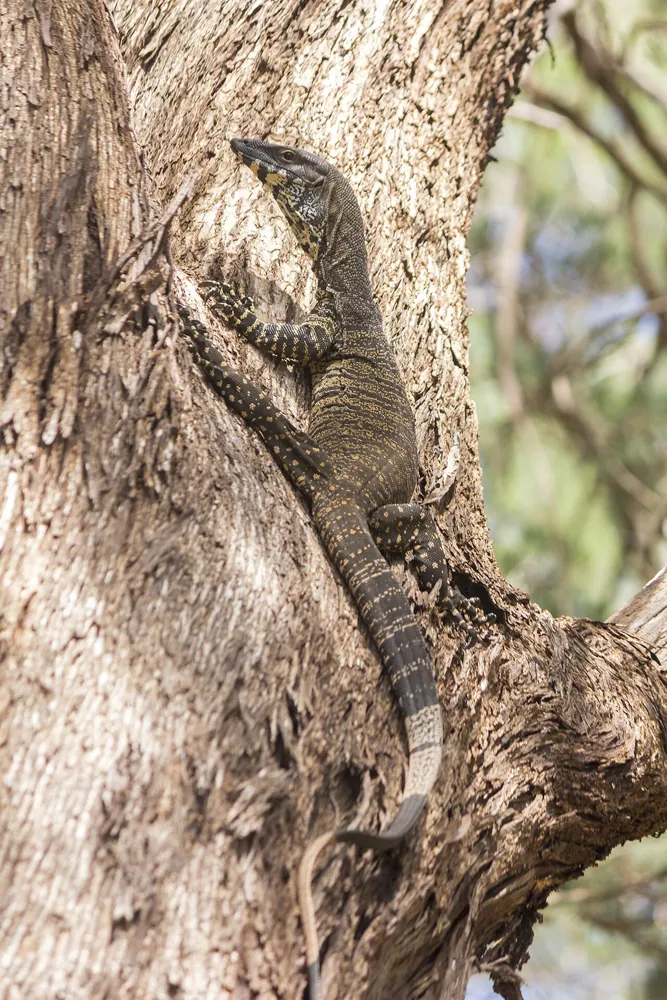
 Ndenge ya koyeba yango
- The main form is dark grey to dull bluish-black with scattered cream-coloured spots.1
- The head is black, and the snout has prominent black and yellow bands that extend under the chin and neck.1
- The tail has narrow black and cream bands that get wider towards the tip.1
- Bell's form has a yellow-brown or yellow base colour with fine black mottling and broad black or dark brown bands from the shoulders to the tail.1
- Juveniles have more defined banding, with five narrow black bands on the neck and eight on the body.1
Makasi ya venin
Venin ebimaka na nzela ya mino na yango ntango esui.
Venin na yango esalaka nini?
Lace monitors have venom glands, and their venom is similar to snake venom, but it is not strong enough to cause serious harm. A bite on the hand can cause swelling within minutes, localised disruption of blood clotting (the blood clots less well in that area), and shooting pain up to the elbow. This pain can often last for several hours.1
Likama na yango mpo na bato ezali boni?
Likama mpo na bato: Epesaka pasiEkoki kopesa pasi mingi, kasi pene na ntango nyonso ezalaka likambo monene te.Its venom is not enough to cause serious harm. Scientists have cautioned that calling these lizards venomous overestimates the medical risk to bite victims.1
Esalaka nini ntango ebangi?
When disturbed, lace monitors retreat to a nearby tree.1
 Soki esui
- Sukola mpota, tika moto azala kimia mpe luka lisalisi ya monganga.
Benga ntango nyonso nimero ya urgence liboso (112, 000, 911). Oyo ezali toli ya lisalisi ya liboso, ezali toli ya monganga te. Makambo ya moboko ya lisalisi ya liboso
 Zala na libateli
- Ata mokolo moko te, simba, kanga to silikisa nyama ya zamba te, ata ya moke, mpe ata soki emonani lokola elali to ekufi.
- Tika yango esika. Soki okutani na moko, zala kimia, zonga sima malembe mpe tika ekende nzela na yango.
- Soki moko esui yo: zala kimia, ningana te, benga nimero ya urgence na yo (112, 000, 911) to kende na lopitalo noki. Kanisa ndenge ezalaki, foto esalisaka.
Ezali koluka yo te. Esalelaka venin na yango mpo na kokanga bilei to komibatela, mpe elingaka mingi kobombama. Makambo mosusu mpo na komibatela
Monene na yango boni?
Molai na yango boni?
Kilo na yango boni?
 molai lokola ba pusu ya ndako 4, zolo kino mokila
 molai lokola bitabe 11 oyo etiami moko na sima ya mosusu
 ekoki kopota metre 100 na sekonde 22 (moto ya mbangu koleka asengaka 9,6)
Lace monitor azali monene boni soki tokokanisi na YO?
Kaka ba calcul na navigateur na yo. Eloko moko te ebombamaka to etindamaka esika moko.
Mbangu na yango boni?

Makambo ya solo
Populations near rubbish tips were thirty five times greater than in natural forest, and individuals were around twice as heavy.1
Lace monitors quickly learned to avoid cane toads after they had been poisoned by them.1
One lace monitor was recorded climbing a brick wall to find shelter during a thunderstorm.1
Its closest living relative is the Komodo dragon.1
Solo to lokuta?
Lokuta: Bites from monitors were thought to be dangerous mainly because of infection from bacteria in their mouths.
Solo: Researchers found in 2005 that the immediate effects of bites were more likely caused by venom.1
Mpo na ba expert ya venin
- Kombo ya siansi
- Varanus varius
- Ebota
- Ba lézard ya venin
- Libota
- Varanidae2
- Molongo
- Squamata
- Bakontina
- Australia & Océanie
- Bana
- Females lay an average of eight eggs, and up to 12, in active termite nests on the ground or in trees. The eggs hatch 6 to 7 months later.1
- Molai ya bomoi
- pene na mibu 201
- Ndenge ezali kobika na zamba
- Least Concern1
- Likama mpo na bato
- 2 / 5: Epesaka pasi3
Esika makambo euti
- Lace monitor (Wikipedia (CC BY-SA 4.0))
- Varanus varius (iNaturalist): bankombo mpe classification.
- Venom Wiki: niveau ya likama, monene ya momesano mpe kokanisa ya mbangu ezali ya biso moko. Tala ndenge tolukaka yango: Ndenge tomekaka likama.
Likambo nyonso na lokasa oyo ezali na nimero oyo elakisi source na yango. Soki tosali libunga, limbisa biso, tozali bato oyo balingaka banyama, zulunale ya siansi te. Yebisa biso na [email protected] mpe tokobongisa yango.
 Scorpion azali na nzala! Venom Wiki ezali mosala ya moto moko: ya ofele, pibilisite te mpe trackers te. Mwa mbongo moke ya kosalisa esalisaka mpo ete etikala na internet.Pesa scorpion bilei
Mosusu ya ebota moko: Ba lézard ya venin
 Perentie
 Spiny-tailed monitor
 Yellow-spotted monitor
 Mitchell's water monitor
 Komodo dragon
 Gila monster
,_photographed_in_the_Kindra_State_Forest.jpg)
Ezalaka mpe na: Australia & Océanie
 Coastal taipanBanyoka ya AustraliaEkoki koboma
 Common death adderBanyoka ya AustraliaEkoki koboma
 Eastern brown snakeBanyoka ya AustraliaEkoki koboma
 Taipan ya kati ya AustralieBanyoka ya AustraliaEkoki koboma
 Sydney funnel-web spiderBa mygale & ba funnel-webEkoki koboma
 Nyoka-nkɔ́iBanyoka ya AustraliaEkoki koboma