
 Africa
 Asia
Asia Ulaya
Ulaya Amereka ya Kumwera
 Australia ndi Oceania
 Antarctica
 Nyanja ya Pacific
 Nyanja ya Atlantic
 Nyanja ya Indian
 Nyanja ya Arctic
 Nyanja ya Mediterranean
 Nyanja Yofiira
 Nyanja ya Caribbean
 Nyanja ya Coral
 Nyanja ya South China
 Nyanja ya Philippine
 Nyanja ya Andaman
 Nyanja ya Kumpoto (North Sea)
 Nyanja ya Timor ndi Arafura
 Nyanja ya Bengal
 Gulf ya California
Redtail coral snake
 Imaluma
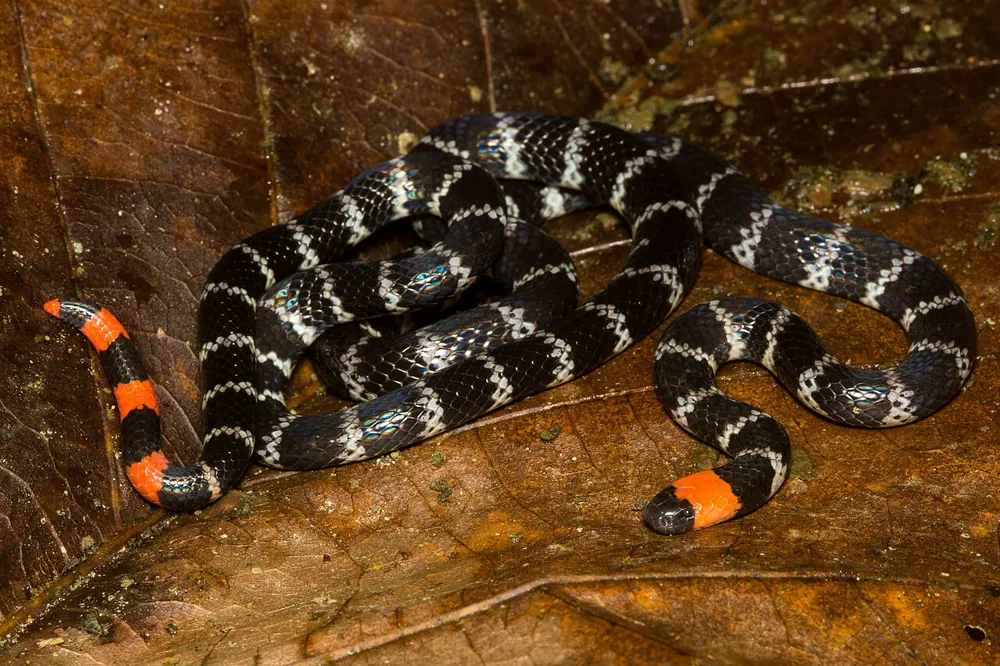
The red-tailed coral snake is a small venomous snake from Central and northern South America. It is common in farming areas of Colombia, so people living there may meet it. Its venom attacks the nerves and muscles, which makes it one of the more dangerous snakes in its region.1



 Mmene ungaizindikirire
- Has a cylindrical body and quite small eyes with a rounded head.1
- Black body rings, numbering from 34 to 84, are separated by narrow yellow or white rings.1
- The second ring on the head and 3 or 4 of the tail rings are red.1
- Can reach a total length of 140.6 cm, including the tail.1
- Mostly active at dusk and at night.1
Mphamvu ya ululu
Ululu umatuluka kudzera m'mano ake ikaluma.
Ululu wake umachita chiyani?
Its venom is neurotoxic, which means it attacks the nerves. It blocks the signals that tell muscles to contract, which can lead to muscle weakness and paralysis. Local pain and tingling can appear within minutes of a bite. In severe cases, nerve symptoms such as drooping eyelids, slurred speech, drowsiness and weakness in the limbs can develop within 30 minutes to 1 to 2 hours, and breathing can stop.1
Ndi yoopsa bwanji kwa anthu?
Ngozi kwa anthu: Yoopsa kwambiriIngathe kupha munthu amene sanalandire chithandizo.Its venom is potentially deadly. Scientists milked an average of 7 mg of dry venom from this snake, which is more than the estimated lethal dose for an adult human of 4 to 6 mg.1
 Ikaluma
- Munthuyo akhale chete ndi wodekha ndipo mufikitse kuchipatala mwachangu, ngakhale polumidwapo pakuoneka pang'ono: zizindikiro zingayambe patapita maola.
Nthawi zonse yamba wayimbira nambala yadzidzidzi (112, 000, 911). Awa ndi malangizo wamba a chithandizo choyamba, osati malangizo a dokotala. Zoyambira za chithandizo choyamba
 Khala wotetezeka
- Usakhudze, kugwira kapena kuseweretsa nyama yakuthengo, ngakhale yaing'ono, ndipo ngakhale ikuoneka ngati yagona kapena yafa.
- Ipatse malo. Ukakumana nayo, khala chete, bwerera m'mbuyo pang'onopang'ono ndipo uilole ipite njira yake.
- Ikakuluma: khala chete, usasunthe, imbira nambala yadzidzidzi (112, 000, 911) kapena pita kuchipatala mwachangu. Kumbukira m'mene inkaonekera, chithunzi chimathandiza.
Sikufuna kukuvulaza. Imagwiritsa ntchito ululu wake kugwira chakudya kapena kudziteteza, ndipo imakonda kwambiri kubisala. Zambiri za kukhala wotetezeka
Kuti padziko lapansi?
Ndi yaikulu bwanji?
Ndi yaitali bwanji?
 yaitali ngati amphaka apakhomo 3 mphuno ndi mchira motsatizana
 yaitali ngati nthochi 8 zoyalidwa motsatizana
 ingathamange mamita 100 m'masekondi 71 (munthu wothamanga kwambiri amafunika 9.6)
Redtail coral snake ndi yaikulu bwanji poyerekeza ndi IWE?
Ndi masamu chabe mu msakatuli wako. Palibe chomwe chimasungidwa kapena kutumizidwa kwina.
Imathamanga bwanji?


Mfundo
It has between 34 and 84 black body rings, so no two snakes look exactly the same in ring count.1
Its venom is about 60% three-finger toxins, about 30% phospholipase A2, and about 10% other toxins.1
In dry spells it may shelter several centimetres underground, and in heavy rain it comes to the surface or into thick leaf litter.1
The most abundant toxin in its venom is called mipartoxin-I.1
Za akatswiri a ululu
Kumene mfundo zimachokera
- Micrurus mipartitus (Wikipedia (CC BY-SA 4.0))
- Micrurus mipartitus (iNaturalist): mayina ndi magulu a sayansi.
- Venom Wiki: mlingo wa ngozi, kukula wamba ndi kuyerekeza kwa liwiro ndi zathu. Ona mmene timazipezera: Mmene timayezera ngozi.
Mfundo iliyonse patsamba lino ili ndi nambala yosonyeza kochokera. Ngati talakwitsa, pepani, ndife okonda nyama, osati magazini a sayansi. Tiuze pa [email protected] ndipo tikonza.
 Chinkhanira chili ndi njala! Venom Wiki ndi ntchito ya munthu mmodzi: yaulere, yopanda zotsatsa ndi zokutsatira. Mphatso yaing'ono imathandiza kuti ikhalebe pa intaneti.Dyetsa chinkhanira
Zina za gulu lomwelo: Njoka za coral
 Eastern coral snake
 Central American coral snake
 Texas coral snake
 Sonoran coral snake
 Allen's coral snake
 Amazonian coral snake
Imakhalanso ku: Amereka ya Kumpoto
 TerciopeloNjoka za pit viperYakupha
 Eastern diamondback rattlesnakeNjoka za rattlesnakeIngathe kupha
 Eyelash viperNjoka za pit viperIngathe kupha
 Timber rattlesnakeNjoka za rattlesnakeIngathe kupha
 Western diamondback rattlesnakeNjoka za rattlesnakeIngathe kupha
 Arizona bark scorpionZinkhaniraIkufuna dokotala