
 Africa
 Asia
Asia Ulaya
Ulaya Amereka ya Kumwera
 Australia ndi Oceania
 Antarctica
 Nyanja ya Pacific
 Nyanja ya Atlantic
 Nyanja ya Indian
 Nyanja ya Arctic
 Nyanja ya Mediterranean
 Nyanja Yofiira
 Nyanja ya Caribbean
 Nyanja ya Coral
 Nyanja ya South China
 Nyanja ya Philippine
 Nyanja ya Andaman
 Nyanja ya Kumpoto (North Sea)
 Nyanja ya Timor ndi Arafura
 Nyanja ya Bengal
 Gulf ya California
Terciopelo
 Imaluma
The terciopelo is a large pit viper, one of the biggest vipers in the world. It lives from north-east Mexico through Central America to northern South America. It is important to know because it causes more envenomated snakebites than any other snake in its range.1



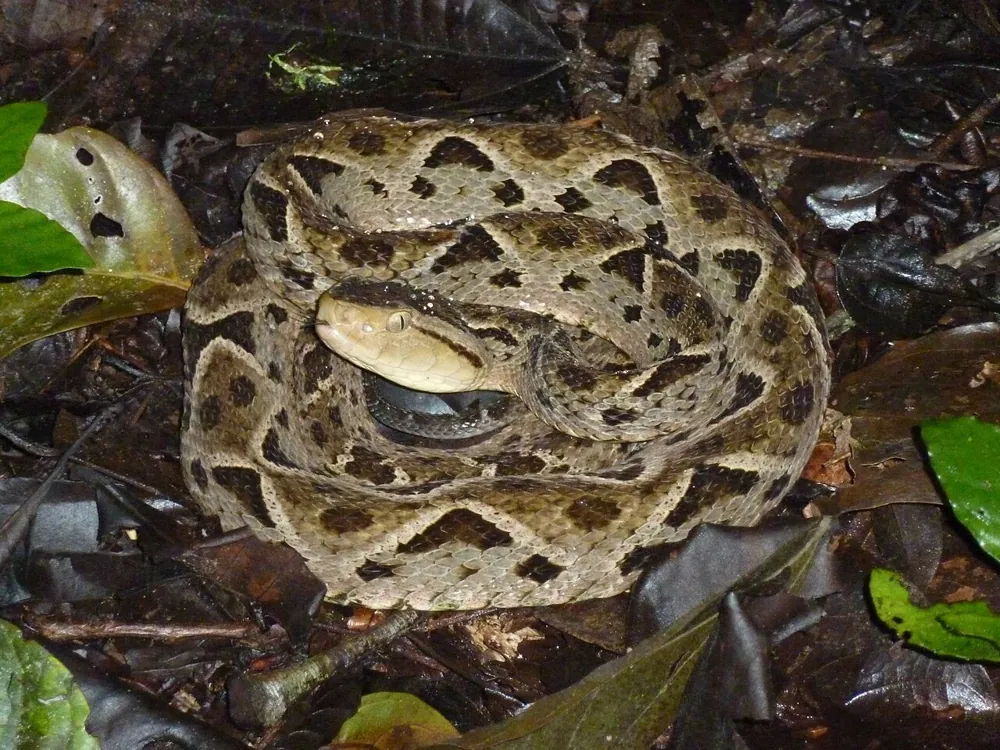
 Mmene ungaizindikirire
- Broad, flattened head that is clearly set apart from the neck1
- Light to dark brown, olive, grey or nearly black body1
- Often a yellowish zig-zag line on each side of the body1
- Dark triangles with pale edges along the sides of the body1
- Pale yellow, cream or whitish grey underside with dark blotches1
Nthawi zambiri imasokonezedwa ndi: Bothrops atrox is similar in colour, but it usually has yellow or rust-like tones and rectangular or trapezoidal blotches. The terciopelo is often more uniformly brown or grey, with the zig-zag pattern on its sides.1
Mphamvu ya ululu
Ululu umatuluka kudzera m'mano ake ikaluma.
Ndi yoopsa bwanji kwa anthu?
Ngozi kwa anthu: YakuphaImodzi mwa nyama zoopsa kwambiri padziko lonse.It is considered one of the most dangerous snakes in its range because it is large, has big fangs and a potent venom, and lives close to people. It is responsible for the most envenomated snakebites within its range. Bites usually happen only when the snake is cornered, pursued or threatened.1
Imachita chiyani ikachita mantha?
When cornered or threatened, it may perform an S-shaped coiled display and can be very defensive, sometimes suddenly reversing direction to attack.1
 Ikaluma
- Munthuyo akhale chete ndi wodekha, chiwalo cholumidwacho chikhale pamlingo wa mtima, chotsa mphete ndi zinthu zothina, ndipo mufikitse kuchipatala mwachangu.
Nthawi zonse yamba wayimbira nambala yadzidzidzi (112, 000, 911). Awa ndi malangizo wamba a chithandizo choyamba, osati malangizo a dokotala. Zoyambira za chithandizo choyamba
 Khala wotetezeka
- Usakhudze, kugwira kapena kuseweretsa nyama yakuthengo, ngakhale yaing'ono, ndipo ngakhale ikuoneka ngati yagona kapena yafa.
- Ipatse malo. Ukakumana nayo, khala chete, bwerera m'mbuyo pang'onopang'ono ndipo uilole ipite njira yake.
- Ikakuluma: khala chete, usasunthe, imbira nambala yadzidzidzi (112, 000, 911) kapena pita kuchipatala mwachangu. Kumbukira m'mene inkaonekera, chithunzi chimathandiza.
Sikufuna kukuvulaza. Imagwiritsa ntchito ululu wake kugwira chakudya kapena kudziteteza, ndipo imakonda kwambiri kubisala. Zambiri za kukhala wotetezeka
Kuti padziko lapansi?
Ndi yaikulu bwanji?
Ndi yaitali bwanji?
Ndi yolemera bwanji?
 yaitali ngati agalu 2,5 mphuno ndi mchira motsatizana
 yaitali ngati nthochi 14 zoyalidwa motsatizana
 yolemera pafupifupi ngati mphaka wapakhomo
 ingathamange mamita 100 m'masekondi 86 (munthu wothamanga kwambiri amafunika 9.6)
Terciopelo ndi yaikulu bwanji poyerekeza ndi IWE?
Ndi masamu chabe mu msakatuli wako. Palibe chomwe chimasungidwa kapena kutumizidwa kwina.
Imathamanga bwanji?


Mfundo
Juveniles can lure prey by waving brightly coloured tail tips. Only males have bright tail tips, though both sexes show this behaviour.1
It is one of the largest vipers in the world, and it is often called 'the ultimate pit-viper' by herpetologists.1
Females are much bigger than males. The two sexes are born the same size, but females grow much faster from about 7 to 12 months of age.1
Its home range is small for a pit viper, averaging between about 3.7 and 6 hectares.1
Kuthetsa nthano zabodza
Nthano yabodza: Fer-de-lance is the name of one single snake species.
Zoona: The name fer-de-lance has been used informally for several Bothrops species, including this one. Herpetologists now prefer the name terciopelo for Bothrops asper.1
Kumene mfundo zimachokera
- Bothrops asper (Wikipedia (CC BY-SA 4.0))
- Bothrops asper (iNaturalist): mayina ndi magulu a sayansi.
- Venom Wiki: mlingo wa ngozi, kukula wamba ndi kuyerekeza kwa liwiro ndi zathu. Ona mmene timazipezera: Mmene timayezera ngozi.
Mfundo iliyonse patsamba lino ili ndi nambala yosonyeza kochokera. Ngati talakwitsa, pepani, ndife okonda nyama, osati magazini a sayansi. Tiuze pa [email protected] ndipo tikonza.
 Chinkhanira chili ndi njala! Venom Wiki ndi ntchito ya munthu mmodzi: yaulere, yopanda zotsatsa ndi zokutsatira. Mphatso yaing'ono imathandiza kuti ikhalebe pa intaneti.Dyetsa chinkhanira
Zina za gulu lomwelo: Njoka za pit viper
 Eyelash viper
 Golden lancehead
 South American bushmaster
 Cottonmouth
 Eastern copperhead
 Common lancehead
Imakhalanso ku: Amereka ya Kumpoto
 Eastern coral snakeNjoka za coralIngathe kupha
 Eastern diamondback rattlesnakeNjoka za rattlesnakeIngathe kupha
 Timber rattlesnakeNjoka za rattlesnakeIngathe kupha
 Western diamondback rattlesnakeNjoka za rattlesnakeIngathe kupha
 Arizona bark scorpionZinkhaniraIkufuna dokotala
 Brown recluseAkangaudeIkufuna dokotala