
 Afrikaa
 Eeshiyaa
 Awurooppaa
 Ameerikaa Kibbaa
 Awustiraaliyaa fi Oshiyaaniyaa
 Antaarkitikaa
 Garba Paasifikii
 Garba Atlaantikii
 Garba Hindii
 Garba Arkitikii
 Galaana Meditiraaniyaa
 Galaana Diimaa
 Galaana Kaariibiyaan
 Galaana Kooraal
 Galaana Chaayinaa Kibbaa
 Galaana Filippiinsii
 Galaana Andamaan
 Galaana Kaabaa
 Galaana Timoor fi Araafuuraa
 Galaana Bengaal
 Galaana Kaaliforniyaa
Iberian ribbed newt
 Qoccoo summii qabanNyaata: FoonSummaa'aa, summii qabeessa (ciniinee ykn iddee) miti
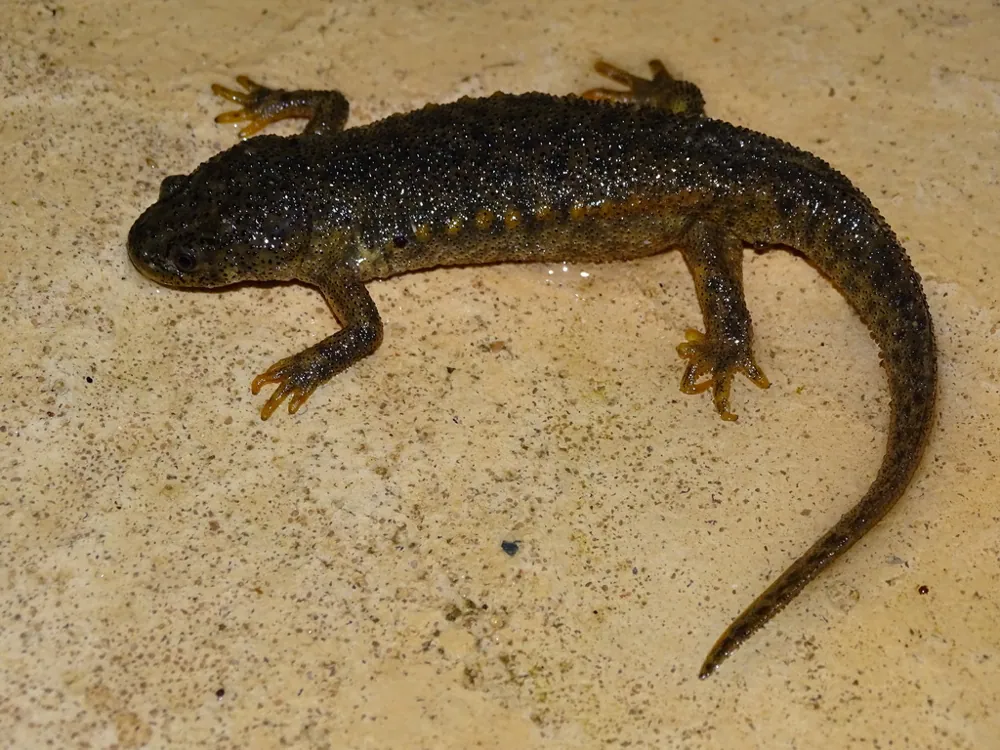
The Iberian ribbed newt is a salamander that lives in ponds and wells in Spain, Portugal and northern Morocco. It is the largest European newt species. When threatened, it can push its sharp ribs out through its skin, which gives it a way to defend itself against predators.1



 Akkaataa itti beekamu
- Dark grey on its back and lighter grey on its belly, with small rust-coloured spots1
- Usually 8 to 10 orange, wart-like bumps (tubercles) running down each side of the body1
- Flat, spade-shaped head and a long tail, about half of its body length1
- Males are more slender and usually smaller than females1
- Larvae have bushy external gills and paler colours than adults1
Yeroo baay'ee kan itti wal fakkeessan: It is sometimes confused with the Iberian newt (Lissotriton boscai), a different species with a similar common name.1
Humna summii
Qoccoon qara qaban summii baatu. Irra ejjechuun ykn qabachuun ni dhukkubsa.
Summiin isaa (ciniinnaa ykn iddiin) maal godha?
When threatened, the newt releases a milky, thick poison from glands on its neck, back, sides and tail as its ribs push out. The poison coats the ribs, which can pierce the skin of a predator's mouth and inject toxins.1
Namootaaf hammam balaa qaba?
Balaa namootaaf: SalphaaAkka iddii kanniisaa ykn sanaa gadi. Namootaaf gonkumaa jechuun ni danda'ama miidhaa hin qabu.The rib defence is completely harmless to humans. The ribs cause only little harm to the newt itself, and its skin quickly heals without infection.1
Yeroo sodaatu maal godha?
It tries to run away from predators first. If it cannot escape, it pushes its sharp ribs through its sides and releases poison.1
 Yoo qoccoon isaa si waraane
- Yoo namni tokko tuqe: harka sirriitti dhiqi, ija ykn afaan hin tuqin. Yoo daa'imni ykn horiin manaa arrabaan saame ykn nyaate: giddugala summii ykn lakkoofsa balaa tasaa bilbili.
Yeroo hunda dursa lakkoofsa balaa tasaa kee bilbili (112, 000, 911). Kun qajeelfama gargaarsa jalqabaa waliigalaa ti, gorsa yaalaa miti. Bu'uura gargaarsa jalqabaa
 Nageenyaan turi
- Bineensa bosonaa gonkumaa hin tuqin, hin qabin, hin tuttuqin, xiqqaa ta'us, rafe ykn du'e fakkaatus.
- Iddoo itti kenni. Yoo tokko wajjin wal argite, tasgabbaa'i, suuta duubatti deebi'iitii karaa isaa akka deemu dhiisi.
- Yoo qoccoon isaa si waraane: tasgabbaa'i, sochii malee turi, lakkoofsa balaa tasaa kee (112, 000, 911) bilbili ykn dafii hospitaala ga'i. Maal akka fakkaatu yaadadhu, suuraan ni gargaara.
Si miidhuuf si hin barbaadu. Summii isaa nyaata qabachuuf ykn of eeguuf fayyadama, dhokachuu immoo baay'ee filata. Waa'ee nageenyaa dabalataan
Addunyaa keessaa eessatti?
Hammam guddaa dha?
Dheerinni isaa hammam?
 akka bilookii taphaa 9 tarree tokkoon dheerata
Iberian ribbed newt SI wajjin yoo wal bira qabamu hammam guddaa dha?
Herrega qofa barsiisaa kee keessatti. Homtuu hin olkaa'amu, eessayyuu hin ergamu.
Hammam ariifata?


Dhugaawwan
Its ribs can push through its skin to act as a defence, a primitive and rudimentary form of envenomation.1
It is a model animal for regeneration research. It can regrow lost limbs, injured heart tissue, brain cells, eye lenses and parts of its spinal cord.1
This newt has been sent into space on at least six missions, starting in 1985.1
In genetic males and females, temperature can override sex chromosomes. Some ZW larvae reared at 32 °C (90 °F) become functional males.1
Its immune system, rib-coated collagen and antimicrobial peptides let the pierced skin heal quickly without infection.1
Females can keep live sperm in their cloaca for up to five months.1
Soba diigaa
Soba: The newt's ribs and poison are dangerous to people.
Dhugaa: The ribs and poison are a defence against predators. The rib defence is completely harmless to humans.1
Ogeeyyii summiitiif
- Maqaa saayinsii
- Pleurodeles waltl
- Garee
- Raacha summaa'aa, raacha lafaa fi newt
- Maatii
- Salamandridae2
- Tartiiba
- Caudata
- Ardiiwwan
- Awurooppaa, Afrikaa
- Ilmoolee
- The young are born in water as larvae, breathing through gills. They lose their gills as their limbs grow and can then live on land as well as in water.1
- Bosona keessatti haala akkamii keessa jira
- Least Concern (IUCN, assessed October 2020)1
- Balaa namootaaf
- 1 / 5: Salphaa3
Dhugaawwan eessaa dhufu
- Iberian ribbed newt (Wikipedia (CC BY-SA 4.0))
- Pleurodeles waltl (iNaturalist): maqaa fi ramaddii.
- Venom Wiki: sadarkaan balaa, guddinni idilee fi tilmaamni ariitii kan keenya. Akkamitti akka hojjennu ilaali: Balaa akkamitti madaalla.
Dhugaan fuula kana irra jiru hundi lakkoofsa madda isaatti si qajeelchu qaba. Yoo waan tokko dogoggorre, dhiifama, nuti jaallattoota bineensotaa ti malee joornaalii saayinsii miti. [email protected] irratti nutti himi, ni sirreessina.
 Iskoorpiyooniin beela'eera! Venom Wiki pirojektii nama tokkoo ti: bilisa, beeksisa fi hordoftuu malee. Gumaachi xiqqaan interneetii irratti akka turu gargaara.Iskoorpiyoonii nyaachisi
Garee wal fakkaataa irraa dabalataan: Raacha summaa'aa, raacha lafaa fi newt
 Fire salamanderRaacha summaa'aa, raacha lafaa fi newtNi dhukkubsa qofaHin tuqin
 Common toadRaacha summaa'aa, raacha lafaa fi newtNi dhukkubsa qofaHin tuqin
 European fire-bellied toadRaacha summaa'aa, raacha lafaa fi newtMiidhaa hin qabu
 Golden mantellaRaacha summaa'aa, raacha lafaa fi newtMiidhaa hin qabu
 Natterjack toadRaacha summaa'aa, raacha lafaa fi newtMiidhaa hin qabu
 Tomato frogRaacha summaa'aa, raacha lafaa fi newtMiidhaa hin qabu
Akkasumas kan jiraatu: Awurooppaa
 Common European adderBofoota viper fi adderDoktora barbaada
 Spanish flyBineensota summaa'oo birooDoktora barbaadaHin tuqin
 Common waspKanniisa fi hurrii (wasp fi hornet)Ni dhukkubsa qofa
 European hornetKanniisa fi hurrii (wasp fi hornet)Ni dhukkubsa qofa
 Western honey beeKanniisa fi hurrii (wasp fi hornet)Ni dhukkubsa qofa
 Blunt-nosed viperBofoota viper fi adderNi ajjeesuu danda'a