
 Africa
 Asia
Asia Europa
 America dal Sid
 Australia ed Oceania
 Antarctica
 Ocean Pacific
 Ocean Atlantic
 Ocean Indic
 Ocean Arctic
 Mar Mediterran
 Mar Cotschen
 Mar Caribic
 Mar da Coral
 Mar da la China dal Sid
 Mar da las Filippinas
 Mar d'Andaman
 Mar dal Nord
 Mar da Timor e d'Arafura
 Golf dal Bengal
 Golf da California
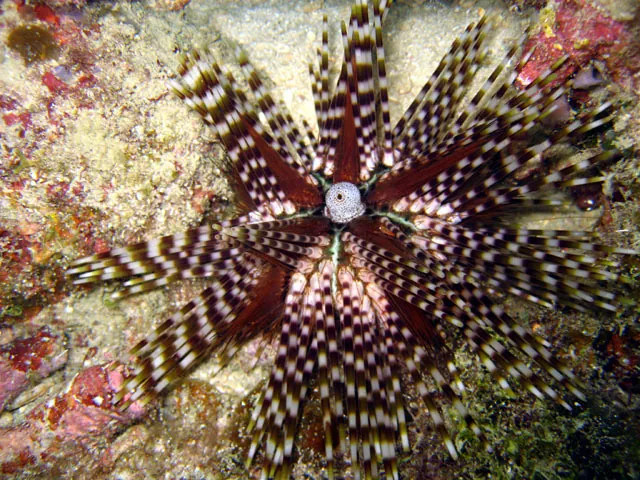
Banded sea urchin
 Spinas tissientadas
The banded sea urchin is a spiny sea animal that lives on tropical reefs and in lagoons across the Indo-Pacific. It is active at night and hides in cracks or under rocks during the day. Its thin spines can deliver a sting, although the sting is not dangerous.1
 Co renconuscher el
- It has a slightly oval shell (test) about 5 cm across.1
- It has two kinds of spines: short, slender spines that run from yellow to dark, and longer, thicker spines that are often banded with light and dark colour.1
- The longer spines reach 10 to 15 cm and can be blunt and hollow.1
- Five bare zones in a star pattern show on the middle of the shell, and these can look blue.1
Savens confundì cun: Dark forms can look like Diadema setosum or Diadema savignyi. Diadema savignyi is bigger, more uniformly black, and has five white spots on top of its shell and an orange ring around its anus. The most common mix-up is Echinothrix diadema, which can have banded spines when young. Echinothrix diadema has a very small, all-black anal papilla and blue-sheened spines, and its spines do not crush easily, unlike the spines of the banded sea urchin.1
Forza dal tissi
Spinas pizzadas portan il tissi. Sch'ins passa sin el u al piglia, fa quai mal.
Tge fa ses tissi?
The thinner, short spines are venomous, meaning they deliver venom through a sting. The sting is nasty, but the venom is not dangerous.1
Quant privlus è el per umans?
Privel per umans: DolurusQuai po far propi mal, ma i n'è bunamain mai grav.The thinner spines are venomous but not dangerous.1
 Sche sias spinas ta furan
- Metta la plaja en aua chauda, uschè chauda sco che la persuna po supportar senza sa brischar, e tschertga agid medicinal per allontanar las spinas. N'emprova betg da las chavar ora sez.
Clama adina l'emprim tes numer d'urgenza (112, 000, 911). Quai è in cussegl general d'emprim agid, betg in cussegl medicinal. Basa da l'emprim agid
 Resta en segirezza
- Na tutga, na piglia e na tizza mai in animal selvadi, gnanc in pitschen, ed era sch'el para da durmir u d'esser mort.
- Dà spazi a l'animal. Sche ti scuntras in, resta calm, va plaun enavos e lascha ir el per sia via.
- Sche sias spinas ta furan: resta calm, na ta mova betg, clama tes numer d'urgenza (112, 000, 911) u va spert en in ospital. Ta regorda co ch'el veseva or, ina foto gida.
El n'ha betg quai sin tai. El dovra ses tissi per pigliar nutriment u per sa defender, e sa zuppa bler pli gugent. Dapli davart la segirezza
Nua sin il mund?
Quant grond è el?
Quant lung è el?
 uschè lung sco 5 bluccs da construcziun in suenter l'auter
 pli plaun ch'ina lindorna da curtin
Quant grond è Banded sea urchin cumpareglià cun TAI?
Mo matematica en tes navigatur. Nagut na vegn memorisà u tramess.
Quant svelt è el?

Fatgs
Its anal papilla is large and whitish with black and white dots, and a ring of visual receptors around it gives it basic vision.1
Young cardinal fish from the family Apogonidae often hide among the spines for protection.1
In Hawaii, this sea urchin often carries a symbiotic crab, Echinoecus pentagonus, that lives with it.1
It is active at night and spends the day hidden in crevices or under rocks.1
Da nua che vegnan ils fatgs
- Echinothrix calamaris (Wikipedia (CC BY-SA 4.0))
- Echinothrix calamaris (iNaturalist): nums e classificaziun.
- Venom Wiki: il stgalim da privel, la grondezza tipica e la stima da la sveltezza èn noss agens. Guarda co che nus als calculain: Co che nus valitain il privel.
Mintga fatg sin questa pagina ha in numer che renvia a sia funtauna. Sche nus avain fatg in sbagl, perstgisa, nus essan fans d'animals, betg ina revista scientifica. Scriva a nus a [email protected] e nus curregin.
 Il scorpiun ha fom! Venom Wiki è in project d'ina suletta persuna: gratuit, senza reclama e senza trackers. In pitschen bunamaun gida a tegnair el online.Pavlar il scorpiun
Dapli da la medema gruppa: Ritschs, stailas e verms
 Crown-of-thorns starfishRitschs, stailas e vermsDovra in mediBetg tutgar
 Flower urchinRitschs, stailas e vermsPo mazzar
 Fire urchinRitschs, stailas e vermsDovra in mediBetg tutgar
 Bearded firewormRitschs, stailas e vermsFa mo malBetg tutgar
 Black long-spined urchinRitschs, stailas e vermsFa mo malBetg tutgar
 BloodwormRitschs, stailas e vermsFa mo mal
Viva era en: Ocean Indic
 Australian box jellyfishMedusas ed autras creaturas da mar che piztganMortalBetg tutgar
 Geography coneLindornas conicas e polipsMortal
 Greater blue-ringed octopusLindornas conicas e polipsMortal
 Southern blue-ringed octopusLindornas conicas e polipsMortal
 Hawksbill sea turtleAuters animals tossicsPo mazzar
 Irukandji jellyfishMedusas ed autras creaturas da mar che piztganPo mazzarBetg tutgar