
 Africa
 Asia
Asia Europa
 America dal Sid
 Australia ed Oceania
 Antarctica
 Ocean Pacific
 Ocean Atlantic
 Ocean Indic
 Ocean Arctic
 Mar Mediterran
 Mar Cotschen
 Mar Caribic
 Mar da Coral
 Mar da la China dal Sid
 Mar da las Filippinas
 Mar d'Andaman
 Mar dal Nord
 Mar da Timor e d'Arafura
 Golf dal Bengal
 Golf da California
Dinosaur ant
 Piztgadas
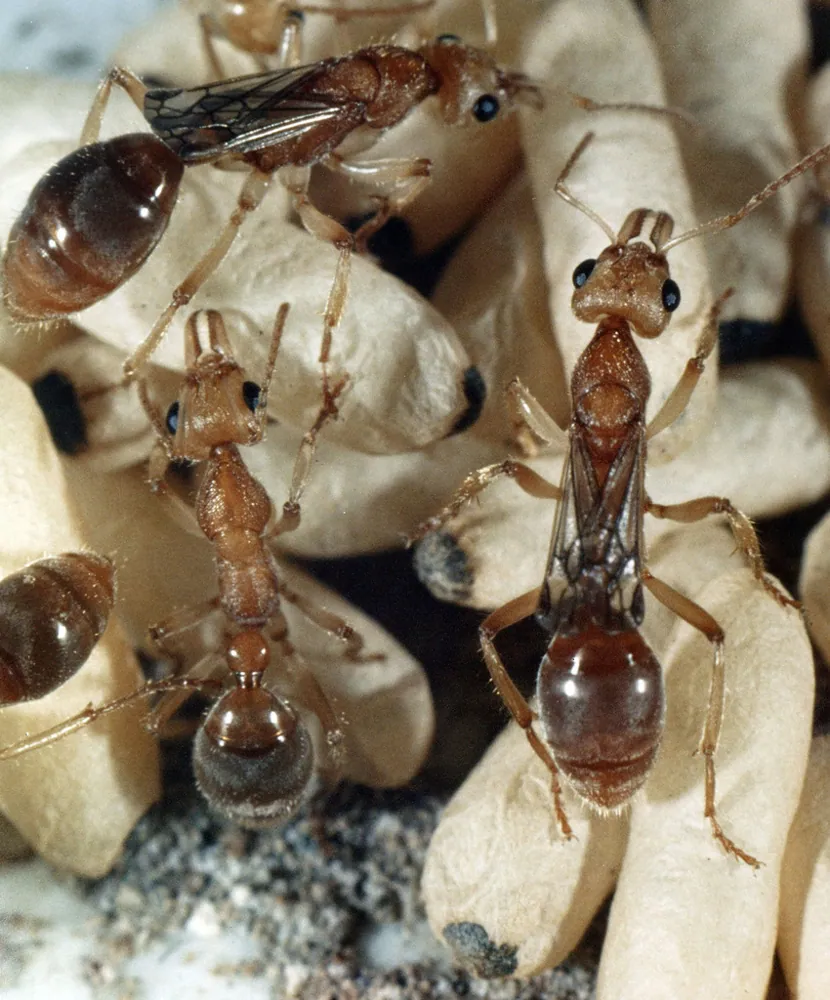
The dinosaur ant is one of the rarest ants in the world. It is the only species in its genus and lives in woodland in South Australia. Scientists call it a 'living fossil' because its body is so old-fashioned.1
 Co renconuscher el
- Medium-sized ant, 9.7 to 11 mm long.1
- Mandibles (jaws), clypeus (part of the 'face'), antennae and legs are pale yellow.1
- Body hairs are yellow, long and abundant on the body, and shorter on the antennae and legs.1
- Workers are strictly nocturnal, active mainly at night, and forage alone.1
Savens confundì cun: It shows similar features to Myrmecia and somewhat resembles weaver ants (Oecophylla). The fourth abdominal segment of Myrmecia is tubulate (tube-shaped), but in the dinosaur ant it is non-tubulated, which helps separate the two.1
Forza dal tissi
Il tissi vegn or tras in aguigl.
Quant privlus è el per umans?
Privel per umans: LevSco ina piztgada d'avieul u main. Practicamain nunprivlus per umans.It has a long, retractable sting at the rear of the abdomen, which can give people a painful sting.1
Tge fa el, cura ch'el ha tema?
It uses its retractable sting when threatened, and workers release chemical alarm signals.1
 Sch'el piztga
- Lava e sfradenta las piztgadas.
- Sche la persuna ha difficultads da respirar, unfladiras da la fatscha u da la gula, u sch'ella sa senta sco da svanir, è quai ina urgenza allergica: clama tes numer d'urgenza.
Clama adina l'emprim tes numer d'urgenza (112, 000, 911). Quai è in cussegl general d'emprim agid, betg in cussegl medicinal. Basa da l'emprim agid
 Resta en segirezza
- Na tutga, na piglia e na tizza mai in animal selvadi, gnanc in pitschen, ed era sch'el para da durmir u d'esser mort.
- Dà spazi a l'animal. Sche ti scuntras in, resta calm, va plaun enavos e lascha ir el per sia via.
- Sch'in tal animal ta piztga: resta calm, na ta mova betg, clama tes numer d'urgenza (112, 000, 911) u va spert en in ospital. Ta regorda co ch'el veseva or, ina foto gida.
El n'ha betg quai sin tai. El dovra ses tissi per pigliar nutriment u per sa defender, e sa zuppa bler pli gugent. Dapli davart la segirezza
Quant grond è el?
Quant lung è el?
 uschè pitschen ch'el po seser sin tia ungla
Quant grond è Dinosaur ant cumpareglià cun TAI?
Mo matematica en tes navigatur. Nagut na vegn memorisà u tramess.
Quant svelt è el?


Fatgs
Scientists regard it as the most plesiomorphic (old-fashioned) ant alive, and it is called a 'living fossil'.1
Poochera is perhaps the only town in the world that relies on ant-based tourism.1
After its first collection in 1931, it was not seen again until 1977, when it was found about 1,300 km from the original site.1
It is the only known ant species with both a sting and a 'waist', meaning it has no postpetiole between the first and second gastral segments.1
Queens have non-functional, stubby wings, while male wings are long and fully developed.1
Per experts da tissi
- Num scientific
- Nothomyrmecia macrops
- Gruppa
- Furmiclas
- Famiglia
- Formicidae2
- Urden
- Hymenoptera
- Continents
- Australia ed Oceania
- Poppins
- The queen mates with one or more males, then hunts for food while the brood develops. Eggs are subspherical and non-adhesive. Two queens may found a colony together, but only one remains after the first workers are raised.1
- Co ch'i va ad el en la natira
- Critically Endangered1
- Privel per umans
- 1 / 5: Lev3
Da nua che vegnan ils fatgs
- Nothomyrmecia (Wikipedia (CC BY-SA 4.0))
- Nothomyrmecia macrops (iNaturalist): nums e classificaziun.
- Venom Wiki: il stgalim da privel, la grondezza tipica e la stima da la sveltezza èn noss agens. Guarda co che nus als calculain: Co che nus valitain il privel.
Mintga fatg sin questa pagina ha in numer che renvia a sia funtauna. Sche nus avain fatg in sbagl, perstgisa, nus essan fans d'animals, betg ina revista scientifica. Scriva a nus a [email protected] e nus curregin.
 Il scorpiun ha fom! Venom Wiki è in project d'ina suletta persuna: gratuit, senza reclama e senza trackers. In pitschen bunamaun gida a tegnair el online.Pavlar il scorpiun
 Bulldog ant
 Jack jumper ant
 Green weaver ant
 Black-banded jumper ant
 Giant bull ant
 Green-head ant
 Coastal taipan
 Common death adder
 Eastern brown snake
 Inland taipan
 Sydney funnel-web spider
 Tiger snake