
 Africa
 Asia
Asia Europa
 America dal Sid
 Australia ed Oceania
 Antarctica
 Ocean Pacific
 Ocean Atlantic
 Ocean Indic
 Ocean Arctic
 Mar Mediterran
 Mar Cotschen
 Mar Caribic
 Mar da Coral
 Mar da la China dal Sid
 Mar da las Filippinas
 Mar d'Andaman
 Mar dal Nord
 Mar da Timor e d'Arafura
 Golf dal Bengal
 Golf da California
Estuarine stonefish
 Spinas tissientadas
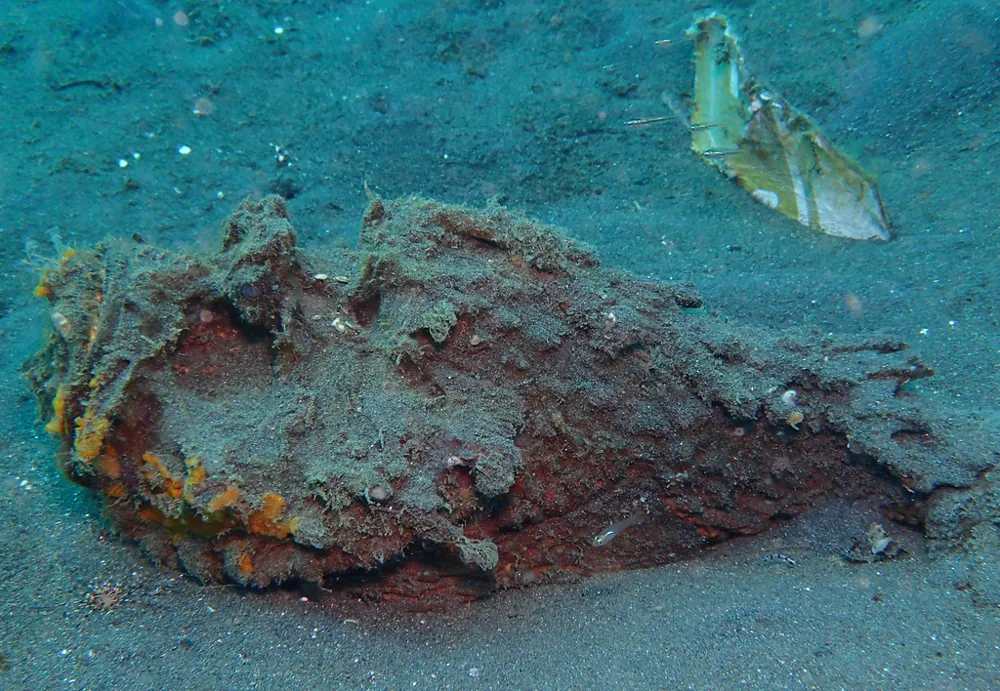
The estuarine stonefish is a fish that looks like a stone lying on the seabed. It lives in shallow reefs and estuaries across the Indo-Pacific, including northern Australia. It is considered one of the most dangerous venomous fish in the world, so it is important to know what it looks like.1



 Co renconuscher el
- Drab brownish-grey, reddish or greenish-brown colour1
- Skin has no scales and is covered in warts, often with filamentous algae growing on it1
- Head is flattened, with small eyes set high and pointing upwards, and a deep pit behind and under each eye1
- Large, almost vertical mouth with fringing cirri on the lips1
- Camouflaged to look like a stone resting on the bottom; it has no bright warning colours1
- Grows to a maximum of 60 cm1
Forza dal tissi
Spinas pizzadas portan il tissi. Sch'ins passa sin el u al piglia, fa quai mal.
Tge fa ses tissi?
Each fin spine has two venom-producing glands. The venom affects the cardiovascular and neuromuscular systems. The sting is extremely painful and has been known to be lethal.1
Quant privlus è el per umans?
Privel per umans: Fitg privlusEl po mazzar ina persuna che na survegn nagin tractament.It is considered one of the most dangerous venomous fishes. Stings are extremely painful and have been known to be fatal. Since European settlement, there have been no recorded deaths in Australia from stonefish venom, but deaths have been recorded elsewhere in its range.1
 Bunas novitads: ils medis han in medicament (antiserum) u in tractament per quai.1
Tge fa el, cura ch'el ha tema?
When disturbed, it erects its venomous spines, which inject venom if the fish is stepped on.1
 Sche sias spinas ta furan
- Antivenom can be given after envenomation. Immersing the sting wound in hot water can be used to denature the venom.1
- Metta la plaja en aua chauda, uschè chauda sco che la persuna po supportar senza sa brischar (emprova cun tes agen maun), durant 30 fin 90 minutas. Tschertga agid medicinal, surtut tar peschs crap e rajas.
Clama adina l'emprim tes numer d'urgenza (112, 000, 911). Quai è in cussegl general d'emprim agid, betg in cussegl medicinal. Basa da l'emprim agid
 Resta en segirezza
- Na tutga, na piglia e na tizza mai in animal selvadi, gnanc in pitschen, ed era sch'el para da durmir u d'esser mort.
- Dà spazi a l'animal. Sche ti scuntras in, resta calm, va plaun enavos e lascha ir el per sia via.
- Sche sias spinas ta furan: resta calm, na ta mova betg, clama tes numer d'urgenza (112, 000, 911) u va spert en in ospital. Ta regorda co ch'el veseva or, ina foto gida.
El n'ha betg quai sin tai. El dovra ses tissi per pigliar nutriment u per sa defender, e sa zuppa bler pli gugent. Dapli davart la segirezza
Nua sin il mund?
Quant grond è el?
Quant lung è el?
 uschè lung sco 3 bananas ina suenter l'autra
 pudess nudar la lunghezza d'in grond bassin (50 m) en 90 secundas
Quant grond è Estuarine stonefish cumpareglià cun TAI?
Mo matematica en tes navigatur. Nagut na vegn memorisà u tramess.
Quant svelt è el?


Fatgs
It can tolerate being out of the water for up to 24 hours.1
It scoops out a shallow hollow in the seabed with its large pectoral fins and curls its tail around its body to hide.1
It is camouflaged to look like a stone, unlike many venomous animals that use bright warning colours.1
Females are larger than males.1
Destructur da mits
Mit: The species name horrida refers to its dangerous spines.
Vardad: The name means "dreadful" or "frightful" and alludes to its appearance, not its venomous spines.1
Da nua che vegnan ils fatgs
- Synanceia horrida (Wikipedia (CC BY-SA 4.0))
- Synanceia horrida (iNaturalist): nums e classificaziun.
- Venom Wiki: il stgalim da privel, la grondezza tipica e la stima da la sveltezza èn noss agens. Guarda co che nus als calculain: Co che nus valitain il privel.
Mintga fatg sin questa pagina ha in numer che renvia a sia funtauna. Sche nus avain fatg in sbagl, perstgisa, nus essan fans d'animals, betg ina revista scientifica. Scriva a nus a [email protected] e nus curregin.
 Il scorpiun ha fom! Venom Wiki è in project d'ina suletta persuna: gratuit, senza reclama e senza trackers. In pitschen bunamaun gida a tegnair el online.Pavlar il scorpiun
Dapli da la medema gruppa: Peschs tissientads
 Reef stonefishPeschs tissientadsPo mazzarBetg tutgar
 Red lionfishPeschs tissientadsDovra in mediBetg tutgar
 Short-tail stingrayPeschs tissientadsPo mazzar
 Striped eel catfishPeschs tissientadsPo mazzarBetg tutgar
 Bluespotted ribbontail rayPeschs tissientadsDovra in medi
 Common stingrayPeschs tissientadsDovra in medi
Viva era en: Ocean Indic
 Australian box jellyfishMedusas ed autras creaturas da mar che piztganMortalBetg tutgar
 Geography coneLindornas conicas e polipsMortal
 Greater blue-ringed octopusLindornas conicas e polipsMortal
 Southern blue-ringed octopusLindornas conicas e polipsMortal
 Hawksbill sea turtleAuters animals tossicsPo mazzar
 Irukandji jellyfishMedusas ed autras creaturas da mar che piztganPo mazzarBetg tutgar