
 Afurika
 Aziya
Aziya Uburayi
 Amerika y'Amajyepfo
 Ositaraliya na Oseyaniya
 Antaragitika
 Inyanja ya Pasifika
 Inyanja ya Atalantika
 Inyanja y'Abahinde
 Inyanja ya Arigitika
 Inyanja ya Mediterane
 Inyanja Itukura
 Inyanja ya Karayibe
 Inyanja ya Korali
 Inyanja y'Amajyepfo y'u Bushinwa
 Inyanja ya Filipine
 Inyanja ya Andamani
 Inyanja y'Amajyaruguru
 Inyanja ya Timor na Arafura
 Ikigobe cya Bengali
 Ikigobe cya Kaliforuniya
Filament-finned stinger
 Amahwa afite ubumara
The filament-finned stinger is a well-camouflaged fish with venomous spines on its skin. It lives on sandy and silty seabeds in warm coastal waters, from the Red Sea and East Africa to the Maldives. It is easy to step on or touch by accident, so it is worth knowing what it looks like.1

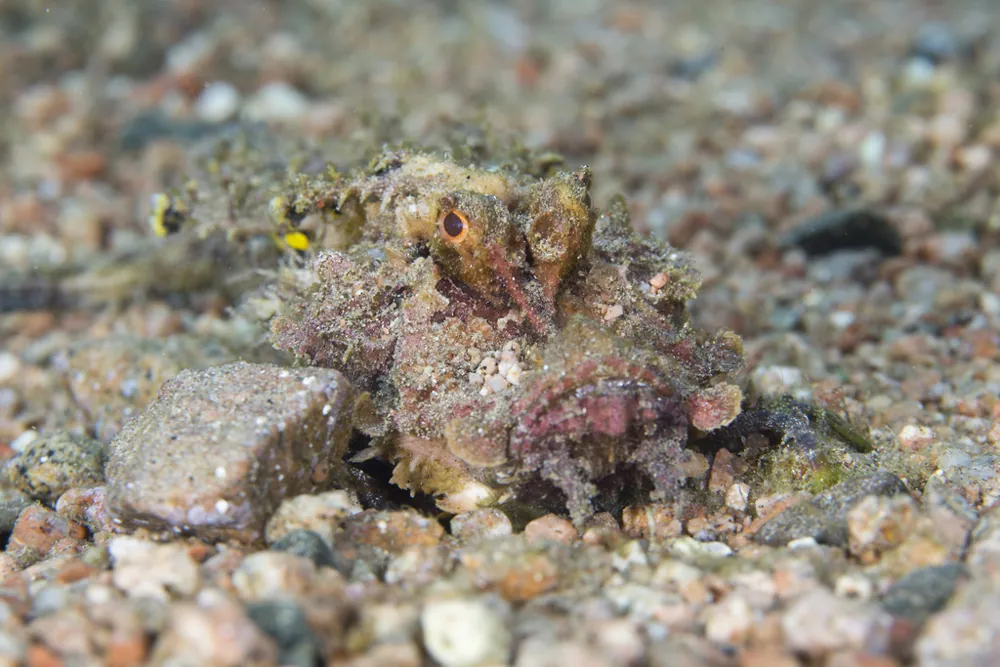
 Uko wayimenya
- Body colour is dull yellow, grey, brown or rust, with light blotches that match the seabed1
- Skin has no scales along most of the body, but is covered in venomous spines and wart-like glands, giving a knobby look1
- Flattened, concave head, with the eyes, mouth and nostrils projecting upwards and outwards1
- Caudal (tail) fin has dark bands at its base and near its tip1
- Two pectoral fin rays are detached and angled downwards, and are used like legs1
Ikunze kwitiranywa na: It is often confused with Inimicus sinensis, which is nearly identical. The key difference is on the underside of the pectoral fins: the black bands of this species are faint, while those of I. sinensis have yellow spots.1
Imbaraga z'ubumara
Amahwa atyaye ni yo atwara ubumara. Kuyikandagira cyangwa kuyifata birababaza.
Iteje akaga kangana iki ku bantu?
Akaga ku bantu: IkomeyeNiba amahwa yayo akujombye, jya kwa muganga. Abapfa ni bake cyane.Ikora iki iyo ifite ubwoba?
When disturbed by a diver or a possible predator, it fans out its brightly coloured pectoral and tail fins as a warning, and it is very reluctant to leave its hiding place once dug in.1
 Niba amahwa yayo akujombye
- Shyira igikomere mu mazi ashyushye, ashyushye uko umuntu abyihanganira atiriwe ashya (bigerageze ukoresheje ukuboko kwawe), mu gihe cy'iminota 30 kugeza kuri 90. Shaka ubufasha bwa muganga, cyane cyane ku bya stonefish na stingray.
Buri gihe banza uhamagare nimero y'ubutabazi (112, 000, 911). Izi ni inama rusange z'ubutabazi bw'ibanze, si inama za muganga. Ibanze by'ubutabazi bw'ibanze
 Irinde akaga
- Ntuzigere ukora, ufata cyangwa ushotora inyamaswa yo mu gasozi, nubwo yaba ntoya, kandi nubwo yasa n'isinziriye cyangwa yapfuye.
- Yihe umwanya. Niba uhuye n'imwe, tuza, usubire inyuma buhoro buhoro kandi uyireke yigendere.
- Niba amahwa yayo akujombye: tuza, ntunyeganyege, hamagara nimero y'ubutabazi (112, 000, 911) cyangwa ujye ku bitaro vuba. Ibuka uko yasaga, ifoto irafasha.
Ntigushakisha ngo ikugirire nabi. Ikoresha ubumara bwayo kugira ngo ifate ibyo kurya cyangwa yirinde, kandi ikunda cyane kwihisha. Ibindi ku kwirinda
Ni hehe ku isi?
Ingana gute?
Ireshya ite?
Iremera ibingana iki?

 ireshya n'ibice 8 by'ibikinisho byo kubaka biri ku murongo
 yakoga uburebure bw'ikidendezi kinini (metero 50) mu masegonda 36
Filament-finned stinger ingana ite ugereranyije NAWE?
Ni imibare gusa ikorerwa muri mudasobwa yawe. Nta kintu kibikwa cyangwa cyoherezwa ahandi.
Yihuta gute?
Ibintu by'ukuri
It walks slowly along the seabed, using the two lower pectoral fin rays on each side as legs.1
Its pectoral fins can be brightly coloured, which it shows as a warning when threatened.1
It has no known natural predators.1
During the day it covers itself with sand and debris, which hides it further.1
It is nocturnal, so it hunts mainly at night.1
Ku bahanga mu by'ubumara
Aho ibintu bivugwa bituruka
- Inimicus filamentosus (Wikipedia (CC BY-SA 4.0))
- Inimicus filamentosus (iNaturalist): amazina n'ibyiciro.
- Venom Wiki: urwego rw'akaga, ingano isanzwe n'ikigereranyo cy'umuvuduko ni ibyacu bwite. Reba uko tubibara: Uko tugena akaga.
Buri kintu kivugwa kuri iyi paji gifite nimero yerekana aho cyavuye. Niba twibeshye, tubabarire, turi abakunzi b'inyamaswa, ntituri ikinyamakuru cya siyansi. Tubwire kuri [email protected] tuzabikosora.
 Sikorupiyo irashonje! Venom Wiki ni umushinga w'umuntu umwe: ni ubuntu, nta matangazo kandi nta bikurikirana abantu. Impano ntoya ifasha kugira ngo ikomeze kuboneka kuri interineti.Gaburira sikorupiyo
Izindi zo mu itsinda rimwe: Amafi afite ubumara
 Reef stonefishAmafi afite ubumaraIshobora kwicaNtukayikoreho
 Red lionfishAmafi afite ubumaraBisaba mugangaNtukayikoreho
 Estuarine stonefishAmafi afite ubumaraIshobora kwicaNtukayikoreho
 Short-tail stingrayAmafi afite ubumaraIshobora kwica
 Striped eel catfishAmafi afite ubumaraIshobora kwicaNtukayikoreho
 Bluespotted ribbontail rayAmafi afite ubumaraBisaba muganga
Iba kandi muri: Inyanja y'Abahinde
 Australian box jellyfishJellyfish n'izindi nyamaswa zo mu nyanja zitera uruboriYicaNtukayikoreho
 Geography coneCone snail na octopusYica
 Greater blue-ringed octopusCone snail na octopusYica
 Southern blue-ringed octopusCone snail na octopusYica
 Hawksbill sea turtleIzindi nyamaswa zifite uburoziIshobora kwica
 Irukandji jellyfishJellyfish n'izindi nyamaswa zo mu nyanja zitera uruboriIshobora kwicaNtukayikoreho