
 Afrika
 Asia
Asia Yuropa
 Amerika Borwa
 Australia le Oceania
 Antarctica
 Lewatle la Pacific
 Lewatle la Atlantic
 Lewatle la India
 Lewatle la Arctic
 Lewatle la Mediterranean
 Lewatle le Lefubedu
 Lewatle la Caribbean
 Lewatle la Coral
 Lewatle la China Borwa
 Lewatle la Philippine
 Lewatle la Andaman
 Lewatle la Leboya
 Lewatle la Timor le Arafura
 Kgwohlo ya Bengal
 Kgwohlo ya California
Antilles pinktoe tarantula
 Ho loma
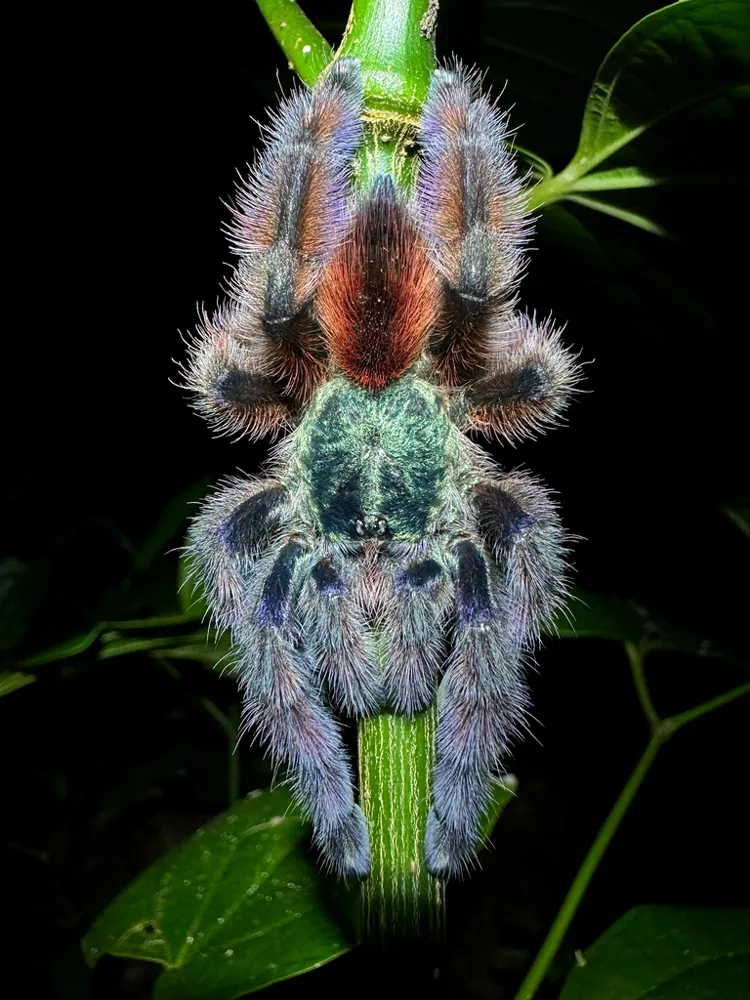
The Antilles pinktoe tarantula is a large, tree-dwelling spider found in the Lesser Antilles, including the island of Martinique in the Caribbean Sea. It spends most of its time in funnel webs that it spins. Its colours change as it grows, so the young and adults look very different.1
 Ho e tseba jwang
- Spiderlings are bright blue with a black tree trunk pattern on the abdomen.1
- As it grows, it loses the blue colour. The carapace (top of the body) turns green and the abdomen turns red.1
- Adults have green legs with pink tarsi (the feet at the end of the legs) and a covering of purple hairs.1
- Males are usually slightly more brightly coloured than females.1
- Males do not grow as large as females, and their abdomens are smaller, even in proportion to their size.1
Matla a chefo
Chefo e tswa ka meno a yona a chefo (fangs) kapa ka meno a mang ha e loma.
E kotsi hakae ho batho?
Kotsi ho batho: E bobebeJwaloka ho hlajwa ke notshi kapa ho fetang moo. Ha e na kotsi ho batho. Haeba e loma
- Hlatswa moo e lomileng teng mme o pholise. Fumana thuso ya bongaka haeba bohloko bo le matla kapa motho a ikutlwa a kula.
Kamehla letsetsa nomoro ya tshohanyetso pele (112, 000, 911). Ena ke tataiso e akaretsang ya thuso ya pele, hase keletso ya bongaka. Metheo ya thuso ya pele
 Dula o bolokehile
- O se ke wa ama, wa tshwara kapa wa tena phoofolo ya naheng, leha e le e nyenyane, le leha e shebahala e robetse kapa e shwele.
- E fe sebaka. Ha o kopana le yona, dula o kgutsitse, kgutlela morao butle mme o e tlohele e tsamaye ka tsela ya yona.
- Haeba e nngwe e o loma: dula o kgutsitse, o se ke wa sisinyeha, letsetsa nomoro ya tshohanyetso (112, 000, 911) kapa o ye sepetlele kapele. Hopola hore e ne e shebahala jwang, foto e a thusa.
Ha e o batle. E sebedisa chefo ya yona ho tshwara dijo kapa ho itshireletsa, mme e kgetha ho ipata. Ho eketsehileng ka ho dula o bolokehile
Hokae lefatsheng?
E kgolo hakae?
E telele hakae?
 e telele jwaloka diboloko tsa ho bapala tse 4 moleng
 e ka matha metara e 100 ka metsotswana e 220 (motho ya potlakang ka ho fetisisa o hloka 9,6)
Antilles pinktoe tarantula e kgolo hakae ha e bapiswa le WENA?
Ke dipalo feela ka hara sebatli sa hao. Ha ho letho le bolokwang kapa le romelwang kae kapa kae.
E potlaka hakae?


Dintlha
Spiderlings are bright blue, and their colours change gradually as they grow into adults.1
This spider was first described in 1837 by Charles Athanase Walckenaer, who used a female said to be from Guadeloupe and a male from Brazil. The two actually belong to different species.1
Males are smaller than females and have smaller abdomens, even when size is taken into account.1
Moo dintlha di tswang teng
- Antilles pinktoe tarantula (Wikipedia (CC BY-SA 4.0))
- Caribena versicolor (iNaturalist): mabitso le tlhophiso.
- Venom Wiki: boemo ba kotsi, boholo bo tlwaelehileng le kakanyo ya lebelo ke tsa rona. Bona kamoo re di balang ka teng: Kamoo re lekanyang kotsi ka teng.
Taba e nngwe le e nngwe leqepheng lena e na le nomoro e bontshang mohlodi wa yona. Haeba re entse phoso, re kopa tshwarelo, re barati ba diphoofolo, hase makasine wa saense. Re bolelle ho [email protected] mme re tla e lokisa.
 Phepheng e lapile! Venom Wiki ke projeke ya motho a le mong: ke mahala, ha e na dipapatso ebile ha e na di-tracker. Thuso e nyenyane ya tjhelete e e boloka e ntse e le inthaneteng.Fepa phepheng
Tse ding tsa sehlopha se le seng: Di-tarantula le di-funnel-web
 Mexican redknee tarantulaDi-tarantula le di-funnel-webHa e na kotsi
 Arizona blond tarantulaDi-tarantula le di-funnel-webHa e na kotsi
 Ravine trapdoor spiderDi-tarantula le di-funnel-webHa e na kotsi
 Trinidad chevron tarantulaDi-tarantula le di-funnel-webE utlwisa bohloko feela
 California trapdoor spiderDi-tarantula le di-funnel-webHa e na kotsi
 Costa Rican zebra tarantulaDi-tarantula le di-funnel-webHa e na kotsi
 Terciopelo
 Eastern coral snake
 Eastern diamondback rattlesnake
 Eyelash viper
 Timber rattlesnake
 Western diamondback rattlesnake