
 Afrika
 Asia
Asia Yuropa
 Amerika Borwa
 Australia le Oceania
 Antarctica
 Lewatle la Pacific
 Lewatle la Atlantic
 Lewatle la India
 Lewatle la Arctic
 Lewatle la Mediterranean
 Lewatle le Lefubedu
 Lewatle la Caribbean
 Lewatle la Coral
 Lewatle la China Borwa
 Lewatle la Philippine
 Lewatle la Andaman
 Lewatle la Leboya
 Lewatle la Timor le Arafura
 Kgwohlo ya Bengal
 Kgwohlo ya California
Arizona blond tarantula
 Ho loma
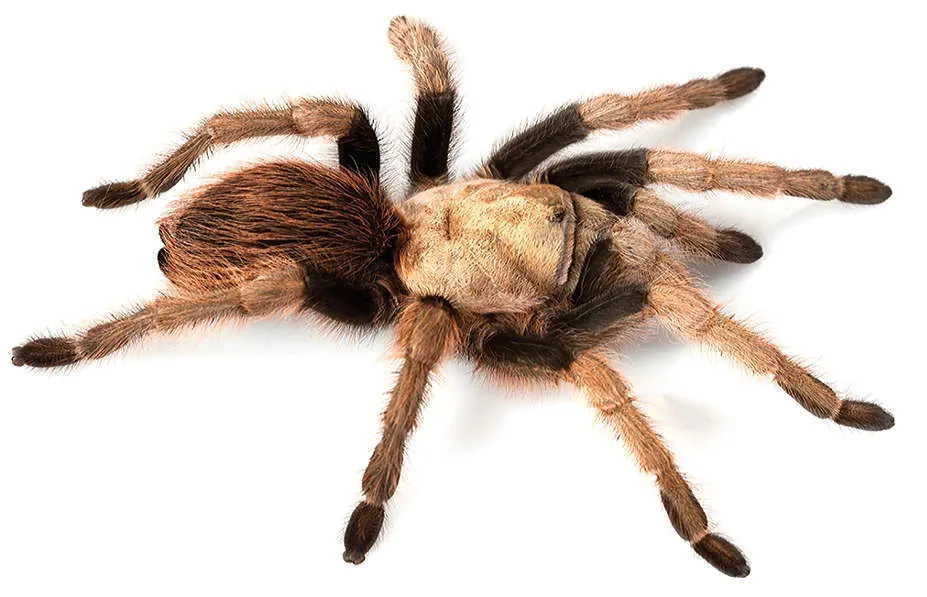
The Arizona blond tarantula is a large, burrowing spider with pale, golden-looking hairs on its front body. It lives in the deserts of Arizona and New Mexico and nearby parts of Mexico. Its venom is considered low in toxicity, so it is not highly dangerous to people.1

 Ho e tseba jwang
- Front body (carapace) covered in dense pale hairs, which gives it the blonde name.1
- Females are usually a uniform tan colour.1
- Males have black legs, a copper-coloured front body and a reddish abdomen.1
- Burrows can be 2.5 to 5.1 cm across, with some strands of silk over the opening.1
- Body length is up to 5.6 cm in females and up to 4.4 cm in males.1
Matla a chefo
Chefo e tswa ka meno a yona a chefo (fangs) kapa ka meno a mang ha e loma.
Chefo ya yona (eo e e kenyang ka ho loma kapa ho hlaba) e etsang?
The venom contains neurotoxins, which attack the nerves. The two named compounds are Apc600 and Apc728. These toxins have not been studied in depth, and the venom is considered low in toxicity for humans.1
E kotsi hakae ho batho?
Kotsi ho batho: E bobebeJwaloka ho hlajwa ke notshi kapa ho fetang moo. Ha e na kotsi ho batho.The venom is not highly dangerous to humans. Compared with a bee sting, its venom level is not significantly higher. It is one of the least dangerous spiders in its family, Theraphosidae.1
 Haeba e loma
- Hlatswa moo e lomileng teng mme o pholise. Fumana thuso ya bongaka haeba bohloko bo le matla kapa motho a ikutlwa a kula.
Kamehla letsetsa nomoro ya tshohanyetso pele (112, 000, 911). Ena ke tataiso e akaretsang ya thuso ya pele, hase keletso ya bongaka. Metheo ya thuso ya pele
 Dula o bolokehile
- O se ke wa ama, wa tshwara kapa wa tena phoofolo ya naheng, leha e le e nyenyane, le leha e shebahala e robetse kapa e shwele.
- E fe sebaka. Ha o kopana le yona, dula o kgutsitse, kgutlela morao butle mme o e tlohele e tsamaye ka tsela ya yona.
- Haeba e nngwe e o loma: dula o kgutsitse, o se ke wa sisinyeha, letsetsa nomoro ya tshohanyetso (112, 000, 911) kapa o ye sepetlele kapele. Hopola hore e ne e shebahala jwang, foto e a thusa.
Ha e o batle. E sebedisa chefo ya yona ho tshwara dijo kapa ho itshireletsa, mme e kgetha ho ipata. Ho eketsehileng ka ho dula o bolokehile
Hokae lefatsheng?
E kgolo hakae?
E telele hakae?
 e kgutshwane ho feta monwana wa hao o monyenyane
 e ka matha metara e 100 ka metsotswana e 220 (motho ya potlakang ka ho fetisisa o hloka 9,6)
Arizona blond tarantula e kgolo hakae ha e bapiswa le WENA?
Ke dipalo feela ka hara sebatli sa hao. Ha ho letho le bolokwang kapa le romelwang kae kapa kae.
E potlaka hakae?


Dintlha
Females can live about 24 to 30 years, while males live about 5 to 10 years.1
Each spider molts about 25 times over two years, going through ten main stages.1
Newborns look like females, and males only show male features after several years of development.1
Its popularity among beginner tarantula keepers is linked to its long lifespan and calm nature.1
Molting is seasonal, and is especially common in March and April, even though tarantulas can molt at any time of day.1
Bakeng sa ditsebi tsa chefo
Moo dintlha di tswang teng
- Aphonopelma chalcodes (Wikipedia (CC BY-SA 4.0))
- Aphonopelma chalcodes (iNaturalist): mabitso le tlhophiso.
- Venom Wiki: boemo ba kotsi, boholo bo tlwaelehileng le kakanyo ya lebelo ke tsa rona. Bona kamoo re di balang ka teng: Kamoo re lekanyang kotsi ka teng.
Taba e nngwe le e nngwe leqepheng lena e na le nomoro e bontshang mohlodi wa yona. Haeba re entse phoso, re kopa tshwarelo, re barati ba diphoofolo, hase makasine wa saense. Re bolelle ho [email protected] mme re tla e lokisa.
 Phepheng e lapile! Venom Wiki ke projeke ya motho a le mong: ke mahala, ha e na dipapatso ebile ha e na di-tracker. Thuso e nyenyane ya tjhelete e e boloka e ntse e le inthaneteng.Fepa phepheng
Tse ding tsa sehlopha se le seng: Di-tarantula le di-funnel-web
 Mexican redknee tarantulaDi-tarantula le di-funnel-webHa e na kotsi
 Ravine trapdoor spiderDi-tarantula le di-funnel-webHa e na kotsi
 Trinidad chevron tarantulaDi-tarantula le di-funnel-webE utlwisa bohloko feela
 Antilles pinktoe tarantulaDi-tarantula le di-funnel-webHa e na kotsi
 California trapdoor spiderDi-tarantula le di-funnel-webHa e na kotsi
 Costa Rican zebra tarantulaDi-tarantula le di-funnel-webHa e na kotsi
 Terciopelo
 Eastern coral snake
 Eastern diamondback rattlesnake
 Eyelash viper
 Timber rattlesnake
 Western diamondback rattlesnake