
 Afrika
 Asia
Asia Yuropa
 Amerika Borwa
 Australia le Oceania
 Antarctica
 Lewatle la Pacific
 Lewatle la Atlantic
 Lewatle la India
 Lewatle la Arctic
 Lewatle la Mediterranean
 Lewatle le Lefubedu
 Lewatle la Caribbean
 Lewatle la Coral
 Lewatle la China Borwa
 Lewatle la Philippine
 Lewatle la Andaman
 Lewatle la Leboya
 Lewatle la Timor le Arafura
 Kgwohlo ya Bengal
 Kgwohlo ya California
Brown centipede
 Ho loma
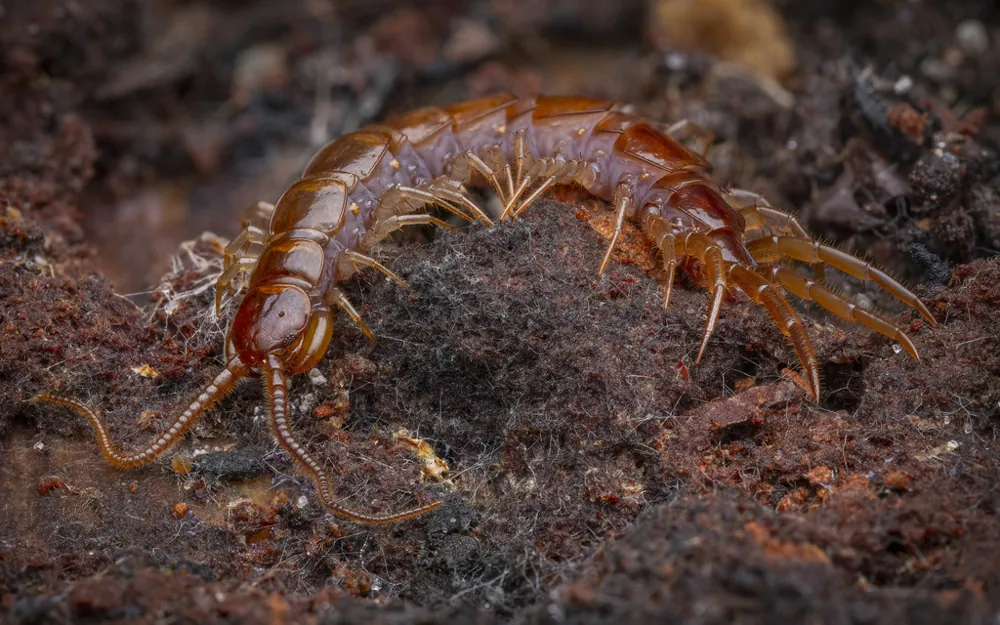
The brown centipede is a small, common centipede with a chestnut brown body. It lives in the upper layers of soil, under rocks and rotting logs, across Europe, North America and the Hawaiian Islands. It is venomous, but its bite is not dangerous to people.1
 Ho e tseba jwang
- Chestnut brown body1
- Adults are 18 to 30 mm long and up to 4 mm wide1
- Legs have no stripes1
- Runs extremely quickly for cover when uncovered1
Hangata e ferekanngwa le: It is similar to several other European centipedes, especially the striped centipede (Lithobius variegatus). The brown centipede does not have stripes on its legs.1
Matla a chefo
Chefo e tswa ka meno a yona a chefo (fangs) kapa ka meno a mang ha e loma.
Chefo ya yona (eo e e kenyang ka ho loma kapa ho hlaba) e etsang?
Its venom is used to overpower prey such as insects and spiders. In people, a bite causes at most brief, localised pain.1
E kotsi hakae ho batho?
Kotsi ho batho: E bobebeJwaloka ho hlajwa ke notshi kapa ho fetang moo. Ha e na kotsi ho batho.It is considered harmless to humans. Its small size means it rarely breaks the skin.1
E etsang ha e tshohile?
When uncovered, it runs away extremely quickly to find cover.1
 Haeba e loma
- Hlatswa moo e lomileng teng, o pholise kapa o ho kenye metsing a futhumetseng bakeng sa bohloko, mme o fumane thuso ya bongaka haeba ho mpefala.
Kamehla letsetsa nomoro ya tshohanyetso pele (112, 000, 911). Ena ke tataiso e akaretsang ya thuso ya pele, hase keletso ya bongaka. Metheo ya thuso ya pele
 Dula o bolokehile
- O se ke wa ama, wa tshwara kapa wa tena phoofolo ya naheng, leha e le e nyenyane, le leha e shebahala e robetse kapa e shwele.
- E fe sebaka. Ha o kopana le yona, dula o kgutsitse, kgutlela morao butle mme o e tlohele e tsamaye ka tsela ya yona.
- Haeba e nngwe e o loma: dula o kgutsitse, o se ke wa sisinyeha, letsetsa nomoro ya tshohanyetso (112, 000, 911) kapa o ye sepetlele kapele. Hopola hore e ne e shebahala jwang, foto e a thusa.
Ha e o batle. E sebedisa chefo ya yona ho tshwara dijo kapa ho itshireletsa, mme e kgetha ho ipata. Ho eketsehileng ka ho dula o bolokehile
Hokae lefatsheng?
E kgolo hakae?
E telele hakae?
 e telele jwaloka klipi ya pampiri
Brown centipede e kgolo hakae ha e bapiswa le WENA?
Ke dipalo feela ka hara sebatli sa hao. Ha ho letho le bolokwang kapa le romelwang kae kapa kae.
E potlaka hakae?


Dintlha
Ho senya ditshomo
Tshomo: Any centipede with venom is dangerous to people.
Nnete: Although it has venom, this centipede is considered harmless to humans. Its small size means it rarely breaks the skin, and bites cause at most brief, localised pain.1
Bakeng sa ditsebi tsa chefo
- Lebitso la saense
- Lithobius forficatus
- Sehlopha
- Di-centipede
- Lelapa
- Lithobiidae2
- Tatelano
- Lithobiomorpha
- Dikontinente
- Yuropa
- Masea
- It hatches from an egg with seven pairs of legs. It gains body segments and a new pair of legs each time it moults, up to a maximum of 15 pairs in adults.1
- Nako ya bophelo
- e ka bang dilemo tse 61
- Kotsi ho batho
- 1 / 5: E bobebe3
Moo dintlha di tswang teng
- Lithobius forficatus (Wikipedia (CC BY-SA 4.0))
- Lithobius forficatus (iNaturalist): mabitso le tlhophiso.
- Venom Wiki: boemo ba kotsi, boholo bo tlwaelehileng le kakanyo ya lebelo ke tsa rona. Bona kamoo re di balang ka teng: Kamoo re lekanyang kotsi ka teng.
Taba e nngwe le e nngwe leqepheng lena e na le nomoro e bontshang mohlodi wa yona. Haeba re entse phoso, re kopa tshwarelo, re barati ba diphoofolo, hase makasine wa saense. Re bolelle ho [email protected] mme re tla e lokisa.
 Phepheng e lapile! Venom Wiki ke projeke ya motho a le mong: ke mahala, ha e na dipapatso ebile ha e na di-tracker. Thuso e nyenyane ya tjhelete e e boloka e ntse e le inthaneteng.Fepa phepheng
Tse ding tsa sehlopha se le seng: Di-centipede
 Mediterranean banded centipedeDi-centipedeE utlwisa bohloko feela
 House centipedeDi-centipedeHa e na kotsi
 Western Mediterranean centipedeDi-centipedeE utlwisa bohloko feela
 Peruvian giant centipedeDi-centipedeE hloka ngaka
 Chinese red-headed centipedeDi-centipedeE hloka ngaka
 Giant Australian centipedeDi-centipedeE utlwisa bohloko feela
E boetse e phela: Yuropa
 Common European adderDi-viper le di-adderE hloka ngaka
 Spanish flyDiphoofolo tse ding tse chefangE hloka ngakaO se ke wa ama
 Common waspDinotshi, di-wasp le di-hornetE utlwisa bohloko feela
 European hornetDinotshi, di-wasp le di-hornetE utlwisa bohloko feela
 Fire salamanderDihoho tse chefang, mampotsana le di-newtE utlwisa bohloko feelaO se ke wa ama
 Western honey beeDinotshi, di-wasp le di-hornetE utlwisa bohloko feela