
 Afrika
 Asia
Asia Yuropa
 Amerika Borwa
 Australia le Oceania
 Antarctica
 Lewatle la Pacific
 Lewatle la Atlantic
 Lewatle la India
 Lewatle la Arctic
 Lewatle la Mediterranean
 Lewatle le Lefubedu
 Lewatle la Caribbean
 Lewatle la Coral
 Lewatle la China Borwa
 Lewatle la Philippine
 Lewatle la Andaman
 Lewatle la Leboya
 Lewatle la Timor le Arafura
 Kgwohlo ya Bengal
 Kgwohlo ya California
Eastern lubber grasshopper
 E a chefa ha e jewa
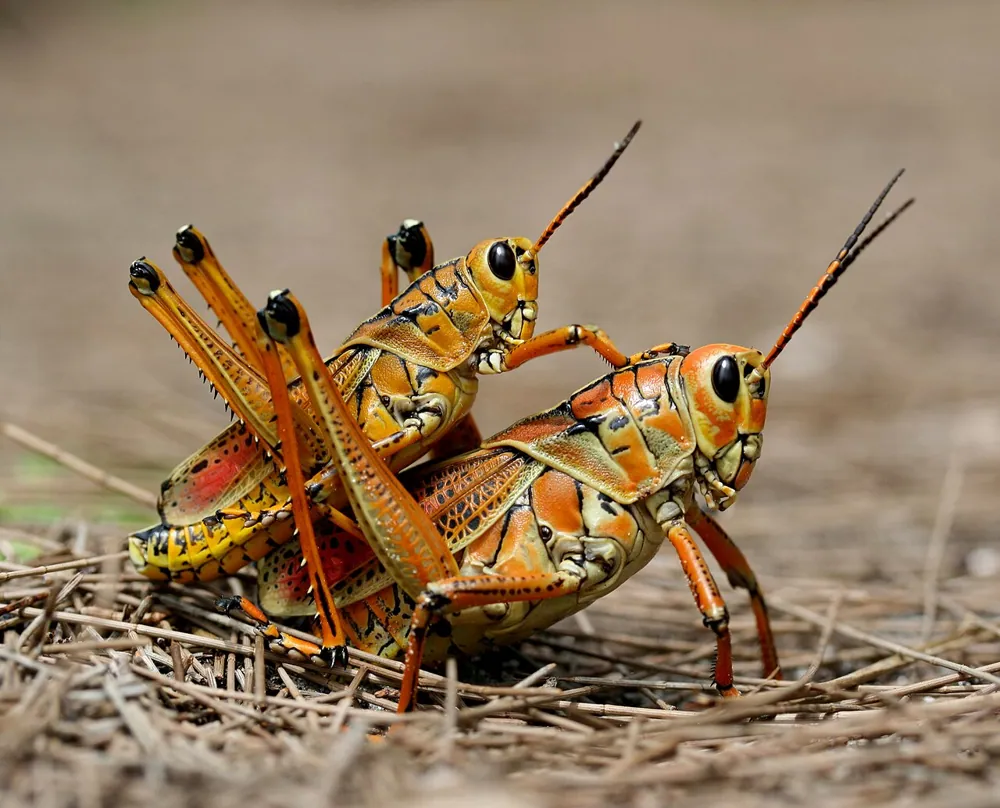
The Eastern lubber grasshopper is one of the largest grasshoppers in the United States, with bright, easy-to-spot colours. It lives in the southeastern and south-central United States, including all of Florida. It is poisonous rather than venomous: it does not bite or sting, but it can harm animals that eat it.1
 Ho e tseba jwang
- Nymphs are smaller than adults, wingless and completely black, with one or more yellow, orange or red stripes.1
- Adults are dull yellow with black spots and markings, bright orange with black markings, or entirely black with yellow or red striping.1
- Adult wings are usually much shorter than the body and cannot be used for flight.1
- Adult males are typically 4.3–5.5 cm long and females 5–7 cm long, making them very large for a grasshopper.1
Matla a chefo
E kotsi feela haeba ho na le se e jang.
E kotsi hakae ho batho?
Kotsi ho batho: E bobebeJwaloka ho hlajwa ke notshi kapa ho fetang moo. Ha e na kotsi ho batho.E etsang ha e tshohile?
When disturbed, it shows its bright colours as a warning, releases a dark, foul-smelling and foul-tasting foamy liquid from its thorax, and gives off a loud hiss to scare would-be attackers.1
 Haeba motho a e amme kapa a e jele
- Haeba motho a e jele kapa a na le matshwao ka mora ho e ja: letsetsa nomoro ya tshohanyetso kapa setsi sa chefo (poison centre) hang-hang.
Kamehla letsetsa nomoro ya tshohanyetso pele (112, 000, 911). Ena ke tataiso e akaretsang ya thuso ya pele, hase keletso ya bongaka. Metheo ya thuso ya pele
 Dula o bolokehile
- O se ke wa ama, wa tshwara kapa wa tena phoofolo ya naheng, leha e le e nyenyane, le leha e shebahala e robetse kapa e shwele.
- E fe sebaka. Ha o kopana le yona, dula o kgutsitse, kgutlela morao butle mme o e tlohele e tsamaye ka tsela ya yona.
- Haeba o e amme kapa o e jele: o se ke wa hohla mahlo kapa molomo, hlatswa matsoho mme o fumane thuso ya bongaka.
Ha e o batle. Chefo ya yona e teng feela hore ho se be le letho le e jang. Ho eketsehileng ka ho dula o bolokehile
Hokae lefatsheng?
E kgolo hakae?
E telele hakae?
 e telele jwaloka diboloko tsa ho bapala tse 3 moleng
Eastern lubber grasshopper e kgolo hakae ha e bapiswa le WENA?
Ke dipalo feela ka hara sebatli sa hao. Ha ho letho le bolokwang kapa le romelwang kae kapa kae.
E potlaka hakae?


Dintlha
Most predatory birds and mammals avoid it because of its toxicity, but large predatory insects can still catch and kill adults.1
It is one of the largest grasshoppers in the United States, along with the western horse lubber grasshopper.1
Its wings are too small for flight in most adults, so it relies on its colours and defences instead.1
Adults in the black colour form are widely known as 'diablo' or 'black diablo'.1
In Louisiana it is called the 'devil's horse' or 'cheval-diable', and in Mississippi it is known as the 'giant locust'.1
Ho senya ditshomo
Tshomo: Its bright colours are just for decoration.
Nnete: The colours are a warning to predators that the grasshopper tastes unpleasant.1
Moo dintlha di tswang teng
- Romalea (Wikipedia (CC BY-SA 4.0))
- Romalea microptera (iNaturalist): mabitso le tlhophiso.
- Venom Wiki: boemo ba kotsi, boholo bo tlwaelehileng le kakanyo ya lebelo ke tsa rona. Bona kamoo re di balang ka teng: Kamoo re lekanyang kotsi ka teng.
Taba e nngwe le e nngwe leqepheng lena e na le nomoro e bontshang mohlodi wa yona. Haeba re entse phoso, re kopa tshwarelo, re barati ba diphoofolo, hase makasine wa saense. Re bolelle ho [email protected] mme re tla e lokisa.
 Phepheng e lapile! Venom Wiki ke projeke ya motho a le mong: ke mahala, ha e na dipapatso ebile ha e na di-tracker. Thuso e nyenyane ya tjhelete e e boloka e ntse e le inthaneteng.Fepa phepheng
Tse ding tsa sehlopha se le seng: Diphoofolo tse ding tse chefang
 Monarch butterflyDiphoofolo tse ding tse chefangHa e na kotsi
 Striped blister beetleDiphoofolo tse ding tse chefangE utlwisa bohloko feelaO se ke wa ama
 Japanese pufferfishDiphoofolo tse ding tse chefangE a bolaya
 Hawksbill sea turtleDiphoofolo tse ding tse chefangE ka bolaya
 Spanish flyDiphoofolo tse ding tse chefangE hloka ngakaO se ke wa ama
 Greenland sharkDiphoofolo tse ding tse chefangE utlwisa bohloko feela
 Terciopelo
 Eastern coral snake
 Eastern diamondback rattlesnake
 Eyelash viper
 Timber rattlesnake
 Western diamondback rattlesnake
,_mating.jpg)