
 Afrika
 Asia
Asia Yuropa
 Amerika Borwa
 Australia le Oceania
 Antarctica
 Lewatle la Pacific
 Lewatle la Atlantic
 Lewatle la India
 Lewatle la Arctic
 Lewatle la Mediterranean
 Lewatle le Lefubedu
 Lewatle la Caribbean
 Lewatle la Coral
 Lewatle la China Borwa
 Lewatle la Philippine
 Lewatle la Andaman
 Lewatle la Leboya
 Lewatle la Timor le Arafura
 Kgwohlo ya Bengal
 Kgwohlo ya California
False wolf spider
 Ho loma
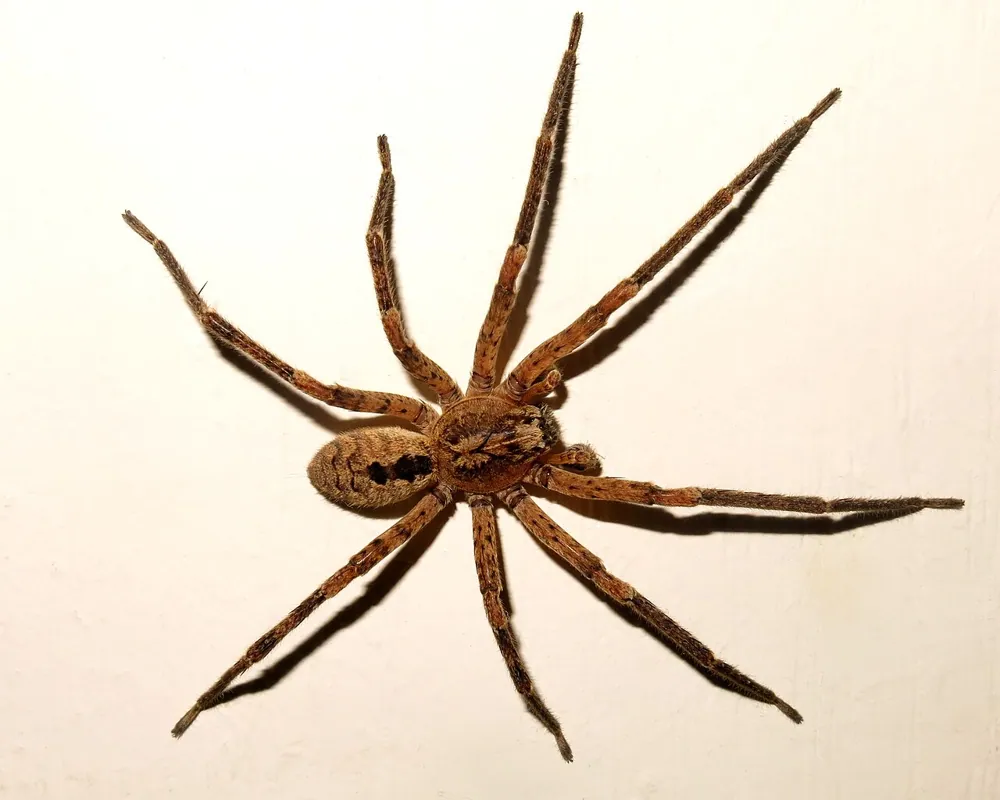
Zoropsis spinimana is a spider from the Mediterranean region. Its front body has a pattern that looks like the face of the vampire in the 1922 German film Nosferatu. It has spread north across Europe and has also been found in the United States and the United Kingdom, often inside houses.1
 Ho e tseba jwang
- The front body is brownish with broad, darker markings, and the brown and light pattern evokes a vampire's face.1
- The abdomen has black markings along the middle.1
- The legs are mainly speckled brown.1
- The eyes are spread out along the front third of the front body, unlike most wolf spiders.1
- Females are 15–18 mm long, and males are 10–12 mm long.1
Hangata e ferekanngwa le: It resembles a wolf spider, and the eyes are arranged in a similar pattern. However, unlike wolf spiders, the eyes of Zoropsis spiders are more spread out along the front third of the front body.1
Matla a chefo
Chefo e tswa ka meno a yona a chefo (fangs) kapa ka meno a mang ha e loma.
E kotsi hakae ho batho?
Kotsi ho batho: E bobebeJwaloka ho hlajwa ke notshi kapa ho fetang moo. Ha e na kotsi ho batho. Haeba e loma
- Hlatswa moo e lomileng teng mme o bee pakete ya leqhwa hodima teng bakeng sa bohloko. Fumana thuso ya bongaka haeba bohloko bo le matla, bo phatlalla kapa motho a ikutlwa a kula.
Kamehla letsetsa nomoro ya tshohanyetso pele (112, 000, 911). Ena ke tataiso e akaretsang ya thuso ya pele, hase keletso ya bongaka. Metheo ya thuso ya pele
 Dula o bolokehile
- O se ke wa ama, wa tshwara kapa wa tena phoofolo ya naheng, leha e le e nyenyane, le leha e shebahala e robetse kapa e shwele.
- E fe sebaka. Ha o kopana le yona, dula o kgutsitse, kgutlela morao butle mme o e tlohele e tsamaye ka tsela ya yona.
- Haeba e nngwe e o loma: dula o kgutsitse, o se ke wa sisinyeha, letsetsa nomoro ya tshohanyetso (112, 000, 911) kapa o ye sepetlele kapele. Hopola hore e ne e shebahala jwang, foto e a thusa.
Ha e o batle. E sebedisa chefo ya yona ho tshwara dijo kapa ho itshireletsa, mme e kgetha ho ipata. Ho eketsehileng ka ho dula o bolokehile
Hokae lefatsheng?
E kgolo hakae?
E telele hakae?
 e kgutshwane ho feta monwana wa hao o monyenyane
 e ka matha metara e 100 ka metsotswana e 330 (motho ya potlakang ka ho fetisisa o hloka 9,6)
False wolf spider e kgolo hakae ha e bapiswa le WENA?
Ke dipalo feela ka hara sebatli sa hao. Ha ho letho le bolokwang kapa le romelwang kae kapa kae.
E potlaka hakae?


Dintlha
Its common German name, Nosferatu-Spinne, refers to the vampire film Nosferatu from 1922.1
It does not build a web. Instead, it roams and hunts its prey.1
Ecologists think climate change helped it survive and reproduce north of the Alps.1
Since the mid-1990s it has been seen along Europe's North-South transport routes, such as near Lucerne, Basel and Innsbruck.1
Moo dintlha di tswang teng
- Zoropsis spinimana (Wikipedia (CC BY-SA 4.0))
- Zoropsis spinimana (iNaturalist): mabitso le tlhophiso.
- Venom Wiki: boemo ba kotsi, boholo bo tlwaelehileng le kakanyo ya lebelo ke tsa rona. Bona kamoo re di balang ka teng: Kamoo re lekanyang kotsi ka teng.
Taba e nngwe le e nngwe leqepheng lena e na le nomoro e bontshang mohlodi wa yona. Haeba re entse phoso, re kopa tshwarelo, re barati ba diphoofolo, hase makasine wa saense. Re bolelle ho [email protected] mme re tla e lokisa.
 Phepheng e lapile! Venom Wiki ke projeke ya motho a le mong: ke mahala, ha e na dipapatso ebile ha e na di-tracker. Thuso e nyenyane ya tjhelete e e boloka e ntse e le inthaneteng.Fepa phepheng
Tse ding tsa sehlopha se le seng: Dikgo
 Mediterranean black widow
 Six-eyed sand spider
 Brown widow
 Diving bell spider
 European yellow sac spider
 Noble false widow
E boetse e phela: Yuropa
 Common European adderDi-viper le di-adderE hloka ngaka
 Spanish flyDiphoofolo tse ding tse chefangE hloka ngakaO se ke wa ama
 Common waspDinotshi, di-wasp le di-hornetE utlwisa bohloko feela
 European hornetDinotshi, di-wasp le di-hornetE utlwisa bohloko feela
 Fire salamanderDihoho tse chefang, mampotsana le di-newtE utlwisa bohloko feelaO se ke wa ama
 Western honey beeDinotshi, di-wasp le di-hornetE utlwisa bohloko feela