
 Afrika
 Asia
Asia Yuropa
 Amerika Borwa
 Australia le Oceania
 Antarctica
 Lewatle la Pacific
 Lewatle la Atlantic
 Lewatle la India
 Lewatle la Arctic
 Lewatle la Mediterranean
 Lewatle le Lefubedu
 Lewatle la Caribbean
 Lewatle la Coral
 Lewatle la China Borwa
 Lewatle la Philippine
 Lewatle la Andaman
 Lewatle la Leboya
 Lewatle la Timor le Arafura
 Kgwohlo ya Bengal
 Kgwohlo ya California
Giant vinegaroon
 E a fafatsa kapa e a tshwela
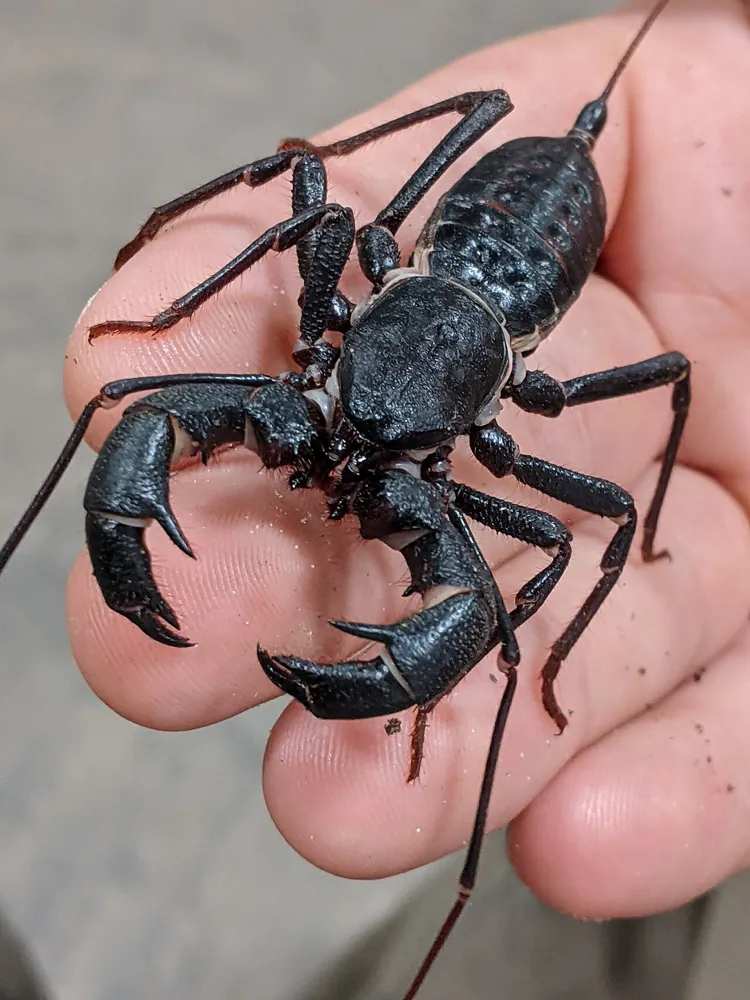
The giant vinegaroon is a large, harmless-to-people relative of the scorpion, known for the vinegar smell it gives off when threatened. It lives in the southern United States and Mexico, where it hunts insects and other small creatures at night. It is useful to people because it eats scorpions and other pests.1



 Ho e tseba jwang
- Body length is 40 to 60 millimetres, not counting the tail.1
- Has a long, thin, whip-like tail at the back.1
- Has two long front legs that it uses to feel around and sense vibrations.1
- Has two large pedipalps (front limbs) modified into claws for crushing prey.1
- When sprayed, it smells strongly of vinegar.1
Matla a chefo
E fafatsa kapa e tshwela mokedikedi o hlabang ho ba e hlaselang.
Chefo ya yona (eo e e kenyang ka ho loma kapa ho hlaba) e etsang?
It is not venomous. From the base of its tail it sprays a liquid made of 85% acetic acid, the main component of vinegar. If the spray gets into mucous membranes or cuts, it can sting, and it can irritate the eyes.1
E kotsi hakae ho batho?
Kotsi ho batho: E bobebeJwaloka ho hlajwa ke notshi kapa ho fetang moo. Ha e na kotsi ho batho.It seldom bites or pinches people. Its main risk is the acid spray, which can sting and cause eye irritation.1
E etsang ha e tshohile?
When threatened, it sprays acetic acid from the base of its tail.1
 Haeba e o fafatsa
- Bakeng sa boya bo hlabang ba diboko: bo tlose ka theipi e kgomarelang, ebe o hlatswa letlalo. O se ke wa hohla.
- Bakeng sa ho longwa: hlatswa mme o pholise. Fumana thuso ya bongaka haeba motho a ikutlwa a kula kapa a tswa madi habonolo.
Kamehla letsetsa nomoro ya tshohanyetso pele (112, 000, 911). Ena ke tataiso e akaretsang ya thuso ya pele, hase keletso ya bongaka. Metheo ya thuso ya pele
 Dula o bolokehile
- O se ke wa ama, wa tshwara kapa wa tena phoofolo ya naheng, leha e le e nyenyane, le leha e shebahala e robetse kapa e shwele.
- E fe sebaka. Ha o kopana le yona, dula o kgutsitse, kgutlela morao butle mme o e tlohele e tsamaye ka tsela ya yona.
- Haeba e nngwe e o fafatsa: dula o kgutsitse, o se ke wa sisinyeha, letsetsa nomoro ya tshohanyetso (112, 000, 911) kapa o ye sepetlele kapele. Hopola hore e ne e shebahala jwang, foto e a thusa.
Ha e o batle. E sebedisa chefo ya yona ho tshwara dijo kapa ho itshireletsa, mme e kgetha ho ipata. Ho eketsehileng ka ho dula o bolokehile
Hokae lefatsheng?
E kgolo hakae?
E telele hakae?
 e telele jwaloka diboloko tsa ho bapala tse 2 moleng
Giant vinegaroon e kgolo hakae ha e bapiswa le WENA?
Ke dipalo feela ka hara sebatli sa hao. Ha ho letho le bolokwang kapa le romelwang kae kapa kae.
E potlaka hakae?


Dintlha
Its common name 'vinegaroon' comes from the vinegar smell of the acid it sprays.1
It is an efficient predator of scorpions, and it is sometimes bought for that purpose.1
Males fight each other at night in fierce battles for the chance to mate with a female.1
It has eight eyes, but they are very weak, so it finds its way mostly by feeling with its front legs, tail and pedipalps.1
Raccoons, coatis, armadillos, skunks, bears, roadrunners, lizards and tarantulas may all eat it.1
It is sold in the exotic animal trade as a pet.1
Ho senya ditshomo
Tshomo: Giant vinegaroons are dangerous and venomous to people.
Nnete: They are non-venomous and seldom bite or pinch people. The main risk is the acid spray, which can irritate the eyes or sting if it reaches cuts or mucous membranes.1
Bakeng sa ditsebi tsa chefo
- Lebitso la saense
- Mastigoproctus giganteus
- Sehlopha
- Diboko le dikokoanyana
- Lelapa
- Thelyphonidae2
- Tatelano
- Uropygi
- Dikontinente
- Amerika Leboya
- Masea
- The female produces about 40 offspring, which she protects and feeds during their early lives. She reproduces only once.1
- Nako ya bophelo
- e ka bang dilemo tse 71
- Kotsi ho batho
- 1 / 5: E bobebe3
Moo dintlha di tswang teng
- Mastigoproctus giganteus (Wikipedia (CC BY-SA 4.0))
- Mastigoproctus giganteus (iNaturalist): mabitso le tlhophiso.
- Venom Wiki: boemo ba kotsi, boholo bo tlwaelehileng le kakanyo ya lebelo ke tsa rona. Bona kamoo re di balang ka teng: Kamoo re lekanyang kotsi ka teng.
Taba e nngwe le e nngwe leqepheng lena e na le nomoro e bontshang mohlodi wa yona. Haeba re entse phoso, re kopa tshwarelo, re barati ba diphoofolo, hase makasine wa saense. Re bolelle ho [email protected] mme re tla e lokisa.
 Phepheng e lapile! Venom Wiki ke projeke ya motho a le mong: ke mahala, ha e na dipapatso ebile ha e na di-tracker. Thuso e nyenyane ya tjhelete e e boloka e ntse e le inthaneteng.Fepa phepheng
Tse ding tsa sehlopha se le seng: Diboko le dikokoanyana
 Giant water bugDiboko le dikokoanyanaE utlwisa bohloko feela
 Puss caterpillarDiboko le dikokoanyanaE utlwisa bohloko feelaO se ke wa ama
 Saddleback caterpillarDiboko le dikokoanyanaE utlwisa bohloko feelaO se ke wa ama
 Wheel bugDiboko le dikokoanyanaE utlwisa bohloko feela
 Rhodnius kissing bugDiboko le dikokoanyanaE hloka ngaka
 Black-waved flannel mothDiboko le dikokoanyanaE utlwisa bohloko feelaO se ke wa ama
 Terciopelo
 Eastern coral snake
 Eastern diamondback rattlesnake
 Eyelash viper
 Timber rattlesnake
 Western diamondback rattlesnake
_face.jpg)