
 Afrika
 Asia
Asia Yuropa
 Amerika Borwa
 Australia le Oceania
 Antarctica
 Lewatle la Pacific
 Lewatle la Atlantic
 Lewatle la India
 Lewatle la Arctic
 Lewatle la Mediterranean
 Lewatle le Lefubedu
 Lewatle la Caribbean
 Lewatle la Coral
 Lewatle la China Borwa
 Lewatle la Philippine
 Lewatle la Andaman
 Lewatle la Leboya
 Lewatle la Timor le Arafura
 Kgwohlo ya Bengal
 Kgwohlo ya California
Saddleback caterpillar
 Boya bo hlabang
The saddleback caterpillar is the larva of a moth found in eastern North America and Mexico. It is green with a brown saddle-shaped marking on its back, and its spiny hairs can cause a painful rash. Gardeners who handle plants where it lives are most at risk of contact.1

 Ho e tseba jwang
- Primarily lime-green, with brown at both ends.1
- A dark brown centre marking, outlined in white and black, that looks like a saddle.1
- A pair of fleshy horns, called tentacles, at each end of the body, which are orange or black as the caterpillar grows.1
- Tufts of spines along the body, with a row of orange spines along the sides.1
- Some larvae have a false face at the rear, with two pale dots that look like large eyes.1
Matla a chefo
Boya bo bonyenyane kapa ditlhaka di robehela letlalong mme di a hlaba.
Chefo ya yona (eo e e kenyang ka ho loma kapa ho hlaba) e etsang?
The hairs and spines contain an irritating venom that is released when they touch skin or are broken. Contact causes a painful, swollen rash and sometimes nausea. Severe reactions are possible and can include migraines, breathing trouble related to asthma, anaphylactic shock (a dangerous allergic reaction) and bleeding. Symptoms can last from a few hours to a few days, depending on how sensitive a person is.1
E kotsi hakae ho batho?
Kotsi ho batho: E bohlokoE ka utlwisa bohloko haholo, empa hoo e batlang e le kamehla ha e kotsi haholo.This caterpillar has one of the strongest stings of its kind. Gardeners are most at risk because the caterpillar is common on ornamental plants. Symptoms vary from mild to severe, and the sensitivity of the person affected makes a difference.1
 Ditaba tse monate: dingaka di na le moriana (antivenom) kapa kalafo bakeng sa sena.1
E etsang ha e tshohile?
When threatened, the larva curls outwards so its spines are hard for a predator to avoid, and its bright colours warn of its toxicity.1
 Haeba o ama boya ba yona
- Remove the spines from the skin immediately using adhesive tape over the affected area, with a new piece of tape for each treatment, to stop the venom spreading. Ice packs, corticosteroids and antihistamines (taken orally or applied to the skin) have been reported to help relieve pain. Symptoms are relieved with prescribed medication on a case-by-case basis.1
- Bakeng sa boya bo hlabang ba diboko: bo tlose ka theipi e kgomarelang, ebe o hlatswa letlalo. O se ke wa hohla.
- Bakeng sa ho longwa: hlatswa mme o pholise. Fumana thuso ya bongaka haeba motho a ikutlwa a kula kapa a tswa madi habonolo.
Kamehla letsetsa nomoro ya tshohanyetso pele (112, 000, 911). Ena ke tataiso e akaretsang ya thuso ya pele, hase keletso ya bongaka. Metheo ya thuso ya pele
 Dula o bolokehile
- O se ke wa ama, wa tshwara kapa wa tena phoofolo ya naheng, leha e le e nyenyane, le leha e shebahala e robetse kapa e shwele.
- E fe sebaka. Ha o kopana le yona, dula o kgutsitse, kgutlela morao butle mme o e tlohele e tsamaye ka tsela ya yona.
- Haeba o ama boya ba yona: dula o kgutsitse, o se ke wa sisinyeha, letsetsa nomoro ya tshohanyetso (112, 000, 911) kapa o ye sepetlele kapele. Hopola hore e ne e shebahala jwang, foto e a thusa.
Ha e o batle. E sebedisa chefo ya yona ho tshwara dijo kapa ho itshireletsa, mme e kgetha ho ipata. Ho eketsehileng ka ho dula o bolokehile
Hokae lefatsheng?
E kgolo hakae?
E telele hakae?
 e telele jwaloka klipi ya pampiri
 e dieha ho feta kgofu ya serapeng
Saddleback caterpillar e kgolo hakae ha e bapiswa le WENA?
Ke dipalo feela ka hara sebatli sa hao. Ha ho letho le bolokwang kapa le romelwang kae kapa kae.
E potlaka hakae?

Dintlha
The false face on the rear end is thought to confuse predators, which may attack the wrong end.1
Its cocoon is made of silk mixed with its stinging spines, which protect the pupa during metamorphosis.1
Braconid wasps often lay their eggs inside these caterpillars, and the wasp larvae feed from the inside and later emerge through holes in the body.1
Like other slug caterpillars, it moves on suckers and mucus, which help it roll and stick to surfaces.1
The adult moth has no sting and lives about 10 days on average.1
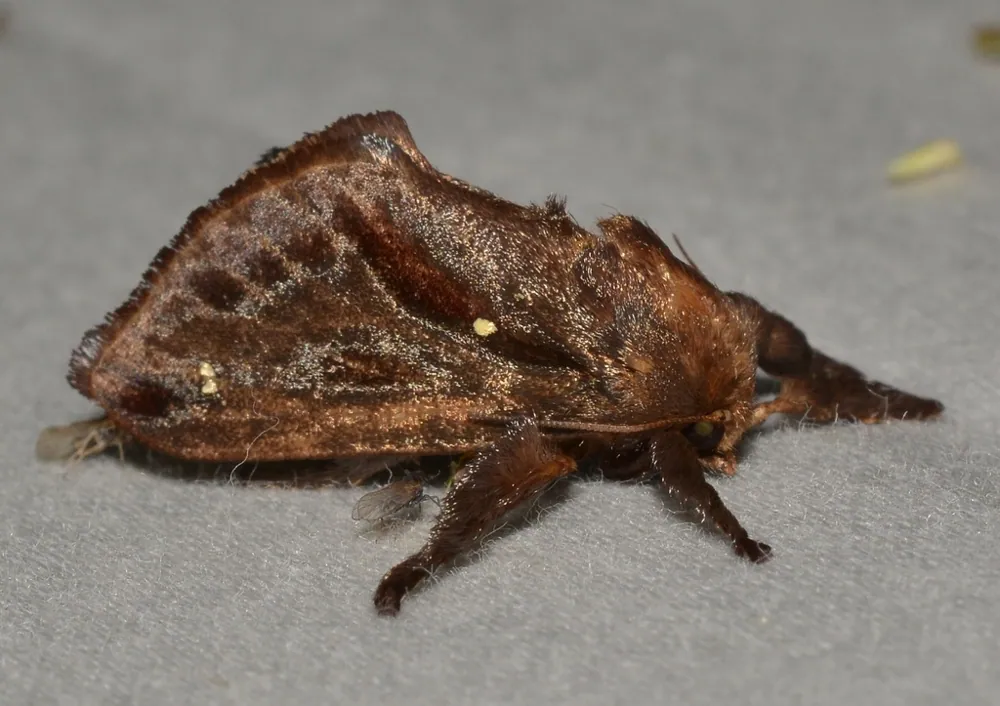
The adult moth loses the caterpillar's bright colours and has velvety dark brown forewings and cream hindwings.1
Moo dintlha di tswang teng
- Saddleback caterpillar (Wikipedia (CC BY-SA 4.0))
- Acharia stimulea (iNaturalist): mabitso le tlhophiso.
- Venom Wiki: boemo ba kotsi, boholo bo tlwaelehileng le kakanyo ya lebelo ke tsa rona. Bona kamoo re di balang ka teng: Kamoo re lekanyang kotsi ka teng.
Taba e nngwe le e nngwe leqepheng lena e na le nomoro e bontshang mohlodi wa yona. Haeba re entse phoso, re kopa tshwarelo, re barati ba diphoofolo, hase makasine wa saense. Re bolelle ho [email protected] mme re tla e lokisa.
 Phepheng e lapile! Venom Wiki ke projeke ya motho a le mong: ke mahala, ha e na dipapatso ebile ha e na di-tracker. Thuso e nyenyane ya tjhelete e e boloka e ntse e le inthaneteng.Fepa phepheng
Tse ding tsa sehlopha se le seng: Diboko le dikokoanyana
 Giant water bugDiboko le dikokoanyanaE utlwisa bohloko feela
 Puss caterpillarDiboko le dikokoanyanaE utlwisa bohloko feelaO se ke wa ama
 Wheel bugDiboko le dikokoanyanaE utlwisa bohloko feela
 Giant vinegaroonDiboko le dikokoanyanaHa e na kotsi
 Rhodnius kissing bugDiboko le dikokoanyanaE hloka ngaka
 Black-waved flannel mothDiboko le dikokoanyanaE utlwisa bohloko feelaO se ke wa ama
 Terciopelo
 Eastern coral snake
 Eastern diamondback rattlesnake
 Eyelash viper
 Timber rattlesnake
 Western diamondback rattlesnake