
 Afrika
 Asia
Asia Yuropa
 Amerika Borwa
 Australia le Oceania
 Antarctica
 Lewatle la Pacific
 Lewatle la Atlantic
 Lewatle la India
 Lewatle la Arctic
 Lewatle la Mediterranean
 Lewatle le Lefubedu
 Lewatle la Caribbean
 Lewatle la Coral
 Lewatle la China Borwa
 Lewatle la Philippine
 Lewatle la Andaman
 Lewatle la Leboya
 Lewatle la Timor le Arafura
 Kgwohlo ya Bengal
 Kgwohlo ya California
Wheel bug
 Ho loma
The wheel bug is a large assassin bug with a wheel-shaped crest on its back. It is the only wheel bug found in the United States, and it hunts caterpillars and beetles. Gardeners value it because it helps keep pests down.1
 Ho e tseba jwang
- Adults are grey to brownish grey, and black shortly after moulting.1
- Adults have a wheel-shaped or cog-shaped ridge on the back of the thorax. Young nymphs do not have this wheel yet.1
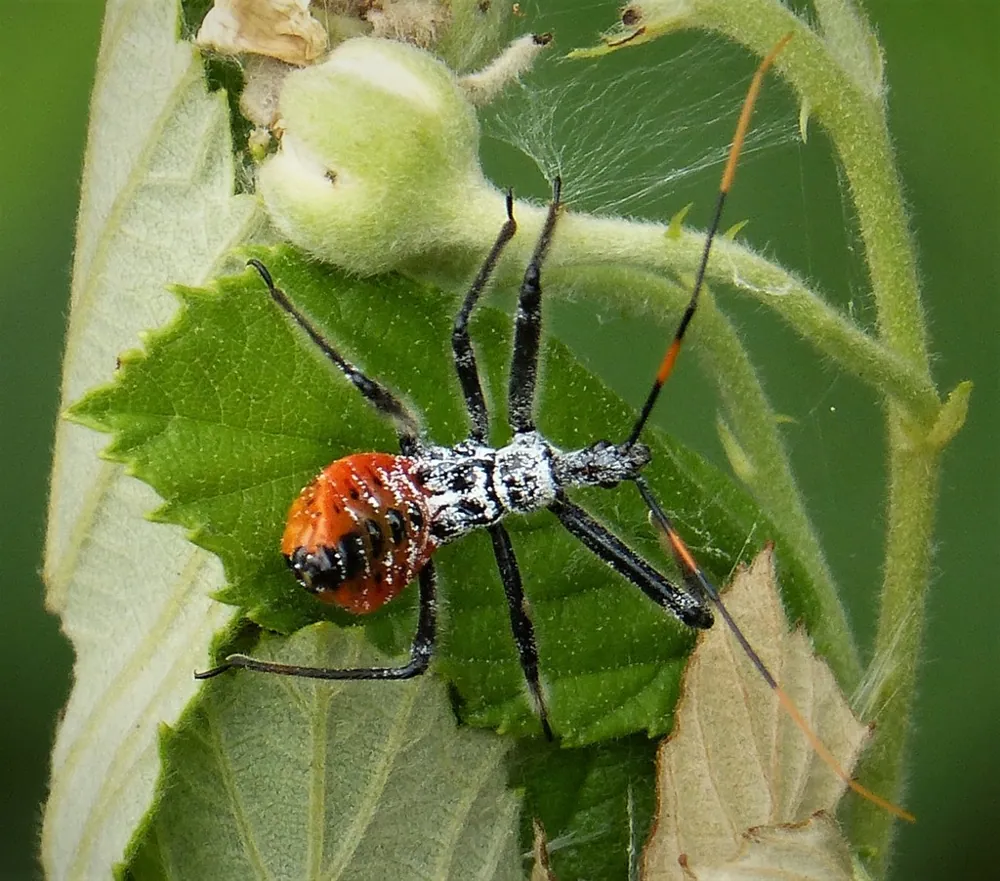
- Nymphs have a bright red or orange abdomen.1
- Adults can grow up to 38 mm long. Females are somewhat larger than males.1
- They move and fly slowly, and make a noisy buzzing sound in flight.1
Matla a chefo
Chefo e tswa ka meno a yona a chefo (fangs) kapa ka meno a mang ha e loma.
Chefo ya yona (eo e e kenyang ka ho loma kapa ho hlaba) e etsang?
The bug injects enzymes into its prey that paralyse it and dissolve its insides. Its bite is not considered highly venomous. In people, the bite causes a wound that is very painful and lingering, with the area becoming hot and irritated, and numbness that can last for days.1
E kotsi hakae ho batho?
Kotsi ho batho: E bohlokoE ka utlwisa bohloko haholo, empa hoo e batlang e le kamehla ha e kotsi haholo.The bite is not considered highly venomous, so it is not serious in the short term. Discomfort may last for two weeks, and in some cases up to six months. Longer-lasting problems are often linked to allergic reactions or repeated infections of the wound.1
E etsang ha e tshohile?
When threatened, it relies on camouflage, its bite, or unpleasant odours from two scent glands in its abdomen.1
 Haeba e loma
- Bakeng sa boya bo hlabang ba diboko: bo tlose ka theipi e kgomarelang, ebe o hlatswa letlalo. O se ke wa hohla.
- Bakeng sa ho longwa: hlatswa mme o pholise. Fumana thuso ya bongaka haeba motho a ikutlwa a kula kapa a tswa madi habonolo.
Kamehla letsetsa nomoro ya tshohanyetso pele (112, 000, 911). Ena ke tataiso e akaretsang ya thuso ya pele, hase keletso ya bongaka. Metheo ya thuso ya pele
 Dula o bolokehile
- O se ke wa ama, wa tshwara kapa wa tena phoofolo ya naheng, leha e le e nyenyane, le leha e shebahala e robetse kapa e shwele.
- E fe sebaka. Ha o kopana le yona, dula o kgutsitse, kgutlela morao butle mme o e tlohele e tsamaye ka tsela ya yona.
- Haeba e nngwe e o loma: dula o kgutsitse, o se ke wa sisinyeha, letsetsa nomoro ya tshohanyetso (112, 000, 911) kapa o ye sepetlele kapele. Hopola hore e ne e shebahala jwang, foto e a thusa.
Ha e o batle. E sebedisa chefo ya yona ho tshwara dijo kapa ho itshireletsa, mme e kgetha ho ipata. Ho eketsehileng ka ho dula o bolokehile
Hokae lefatsheng?
E kgolo hakae?
E telele hakae?
 e telele jwaloka klipi ya pampiri
Wheel bug e kgolo hakae ha e bapiswa le WENA?
Ke dipalo feela ka hara sebatli sa hao. Ha ho letho le bolokwang kapa le romelwang kae kapa kae.
E potlaka hakae?


Dintlha
It is cannibalistic. Nymphs may prey on each other, and a female may feed on the male after mating.1
It can make a sound by rubbing the tip of its beak in a groove under its thorax. The purpose is unknown, but it may be a way of communicating.1
Nymphs are predators as soon as they hatch, but the wheel only appears after the final moult into adulthood.1
It can prey on useful insects such as lady beetles and honey bees, as well as pests.1
It is one of the largest true bugs in North America.1
In a laboratory test, parasitic wasps attacked 10 of 12 egg clusters, stopping many eggs from hatching normally.1
Bakeng sa ditsebi tsa chefo
- Lebitso la saense
- Arilus cristatus
- Sehlopha
- Diboko le dikokoanyana
- Lelapa
- Reduviidae2
- Tatelano
- Hemiptera
- Dikontinente
- Amerika Leboya
- Masea
- After mating in autumn, a female lays 40 to 200 small, brown, cylindrical eggs in a glued cluster on trees, bushes, twigs and other objects. The eggs hatch the following spring.1
- Kotsi ho batho
- 2 / 5: E bohloko3
Moo dintlha di tswang teng
- Arilus cristatus (Wikipedia (CC BY-SA 4.0))
- Arilus cristatus (iNaturalist): mabitso le tlhophiso.
- Venom Wiki: boemo ba kotsi, boholo bo tlwaelehileng le kakanyo ya lebelo ke tsa rona. Bona kamoo re di balang ka teng: Kamoo re lekanyang kotsi ka teng.
Taba e nngwe le e nngwe leqepheng lena e na le nomoro e bontshang mohlodi wa yona. Haeba re entse phoso, re kopa tshwarelo, re barati ba diphoofolo, hase makasine wa saense. Re bolelle ho [email protected] mme re tla e lokisa.
 Phepheng e lapile! Venom Wiki ke projeke ya motho a le mong: ke mahala, ha e na dipapatso ebile ha e na di-tracker. Thuso e nyenyane ya tjhelete e e boloka e ntse e le inthaneteng.Fepa phepheng
Tse ding tsa sehlopha se le seng: Diboko le dikokoanyana
 Giant water bugDiboko le dikokoanyanaE utlwisa bohloko feela
 Puss caterpillarDiboko le dikokoanyanaE utlwisa bohloko feelaO se ke wa ama
 Saddleback caterpillarDiboko le dikokoanyanaE utlwisa bohloko feelaO se ke wa ama
 Giant vinegaroonDiboko le dikokoanyanaHa e na kotsi
 Rhodnius kissing bugDiboko le dikokoanyanaE hloka ngaka
 Black-waved flannel mothDiboko le dikokoanyanaE utlwisa bohloko feelaO se ke wa ama
 Terciopelo
 Eastern coral snake
 Eastern diamondback rattlesnake
 Eyelash viper
 Timber rattlesnake
 Western diamondback rattlesnake