
 Afrika
 Asia
Asia Yuropa
 Amerika Borwa
 Australia le Oceania
 Antarctica
 Lewatle la Pacific
 Lewatle la Atlantic
 Lewatle la India
 Lewatle la Arctic
 Lewatle la Mediterranean
 Lewatle le Lefubedu
 Lewatle la Caribbean
 Lewatle la Coral
 Lewatle la China Borwa
 Lewatle la Philippine
 Lewatle la Andaman
 Lewatle la Leboya
 Lewatle la Timor le Arafura
 Kgwohlo ya Bengal
 Kgwohlo ya California
Mexican fireleg tarantula
 Ho loma
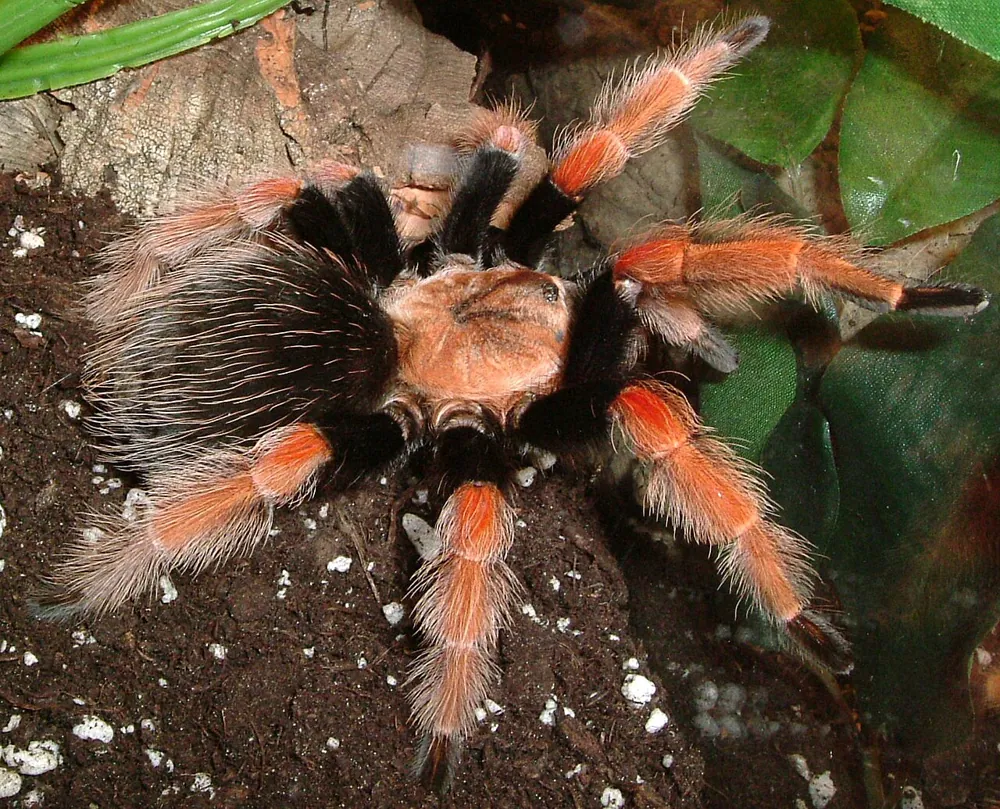
The Mexican fireleg tarantula is a large, long-lived spider with bright orange and black colouring. It lives in dry scrubland in western Guerrero state, Mexico, where it hides in burrows. It is popular in the pet trade, which has put pressure on wild numbers.1



 Ho e tseba jwang
- Dramatic orange and black colouring.1
- Orange carapace (the upper body shell) with a dark black band on the upper legs (femora).1
- Bright, fiery red knees (patellae) that fade to a paler orange further down the leg.1
- Black tips on the feet (tarsi).1
- Adults are 12.7 to 15.2 cm across, converted from 5 to 6 inches.1
Hangata e ferekanngwa le: It resembles the Mexican redknee tarantula (Brachypelma hamorii). The main difference is the legs: the knees of the Mexican fireleg are bright red, while the joints of the redknee are orange.1
Matla a chefo
Chefo e tswa ka meno a yona a chefo (fangs) kapa ka meno a mang ha e loma.
E kotsi hakae ho batho?
Kotsi ho batho: E bobebeJwaloka ho hlajwa ke notshi kapa ho fetang moo. Ha e na kotsi ho batho.The spider is not particularly defensive. Its main defence is its urticating hairs, which it can flick when threatened. Some individuals may have a nervous temperament.1
E etsang ha e tshohile?
When it feels threatened, it flicks urticating hairs at the attacker.1
 Haeba e loma
- Hlatswa moo e lomileng teng mme o pholise. Fumana thuso ya bongaka haeba bohloko bo le matla kapa motho a ikutlwa a kula.
Kamehla letsetsa nomoro ya tshohanyetso pele (112, 000, 911). Ena ke tataiso e akaretsang ya thuso ya pele, hase keletso ya bongaka. Metheo ya thuso ya pele
 Dula o bolokehile
- O se ke wa ama, wa tshwara kapa wa tena phoofolo ya naheng, leha e le e nyenyane, le leha e shebahala e robetse kapa e shwele.
- E fe sebaka. Ha o kopana le yona, dula o kgutsitse, kgutlela morao butle mme o e tlohele e tsamaye ka tsela ya yona.
- Haeba e nngwe e o loma: dula o kgutsitse, o se ke wa sisinyeha, letsetsa nomoro ya tshohanyetso (112, 000, 911) kapa o ye sepetlele kapele. Hopola hore e ne e shebahala jwang, foto e a thusa.
Ha e o batle. E sebedisa chefo ya yona ho tshwara dijo kapa ho itshireletsa, mme e kgetha ho ipata. Ho eketsehileng ka ho dula o bolokehile
Hokae lefatsheng?
E kgolo hakae?
E telele hakae?
 e telele jwaloka diboloko tsa ho bapala tse 5 moleng
 e ka matha metara e 100 ka metsotswana e 210 (motho ya potlakang ka ho fetisisa o hloka 9,6)
Mexican fireleg tarantula e kgolo hakae ha e bapiswa le WENA?
Ke dipalo feela ka hara sebatli sa hao. Ha ho letho le bolokwang kapa le romelwang kae kapa kae.
E potlaka hakae?


Dintlha
Tarantulas of this genus are long-lived. Females may live about ten years after reaching maturity, while males usually live only up to a year after their final moult.1
It is commonly kept as a pet and is regarded as suitable for beginners, which has led to heavy collection from the wild.1
It is mostly active after dark, but can sometimes be active during the day, especially in the morning and evening.1
Adults moult at the end of the dry season, between November and June. Males then begin searching for mates.1
Bakeng sa ditsebi tsa chefo
- Lebitso la saense
- Brachypelma boehmei
- Sehlopha
- Di-tarantula le di-funnel-web
- Lelapa
- Theraphosidae2
- Tatelano
- Araneae
- Dikontinente
- Amerika Leboya
- Masea
- Mated females produce an egg sac. If it succeeds, the eggs generally hatch three to four weeks before the rainy season begins.1
- Boemo ba yona naheng
- Listed on CITES Appendix II, which regulates international trade. Ongoing habitat destruction, illegal pet trade and high mortality before maturity are a considerable concern for its future.1
- Kotsi ho batho
- 1 / 5: E bobebe3
Moo dintlha di tswang teng
- Brachypelma boehmei (Wikipedia (CC BY-SA 4.0))
- Brachypelma boehmei (iNaturalist): mabitso le tlhophiso.
- Venom Wiki: boemo ba kotsi, boholo bo tlwaelehileng le kakanyo ya lebelo ke tsa rona. Bona kamoo re di balang ka teng: Kamoo re lekanyang kotsi ka teng.
Taba e nngwe le e nngwe leqepheng lena e na le nomoro e bontshang mohlodi wa yona. Haeba re entse phoso, re kopa tshwarelo, re barati ba diphoofolo, hase makasine wa saense. Re bolelle ho [email protected] mme re tla e lokisa.
 Phepheng e lapile! Venom Wiki ke projeke ya motho a le mong: ke mahala, ha e na dipapatso ebile ha e na di-tracker. Thuso e nyenyane ya tjhelete e e boloka e ntse e le inthaneteng.Fepa phepheng
Tse ding tsa sehlopha se le seng: Di-tarantula le di-funnel-web
 Mexican redknee tarantulaDi-tarantula le di-funnel-webHa e na kotsi
 Arizona blond tarantulaDi-tarantula le di-funnel-webHa e na kotsi
 Ravine trapdoor spiderDi-tarantula le di-funnel-webHa e na kotsi
 Trinidad chevron tarantulaDi-tarantula le di-funnel-webE utlwisa bohloko feela
 Antilles pinktoe tarantulaDi-tarantula le di-funnel-webHa e na kotsi
 California trapdoor spiderDi-tarantula le di-funnel-webHa e na kotsi
 Terciopelo
 Eastern coral snake
 Eastern diamondback rattlesnake
 Eyelash viper
 Timber rattlesnake
 Western diamondback rattlesnake