
 Afrika
 Asia
Asia Yuropa
 Amerika Borwa
 Australia le Oceania
 Antarctica
 Lewatle la Pacific
 Lewatle la Atlantic
 Lewatle la India
 Lewatle la Arctic
 Lewatle la Mediterranean
 Lewatle le Lefubedu
 Lewatle la Caribbean
 Lewatle la Coral
 Lewatle la China Borwa
 Lewatle la Philippine
 Lewatle la Andaman
 Lewatle la Leboya
 Lewatle la Timor le Arafura
 Kgwohlo ya Bengal
 Kgwohlo ya California
Sea apple
 E a chefa ha e jewaE ja: Dijo tse nyenyane tsa lewatleE chefang, eseng e nang le chefo
The sea apple is a round, colourful sea cucumber that lives in the warm waters of the Indo-Pacific. It filters tiny floating food from the water with its feathery tentacles. It is special because it can release a toxin into the water when it is stressed, which can harm other sea creatures nearby.1

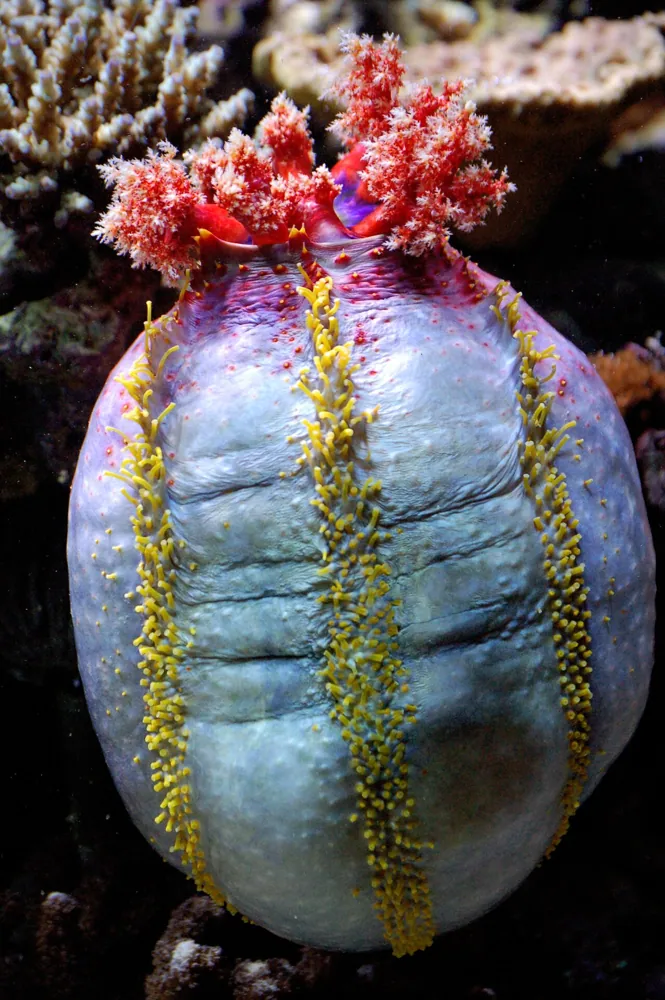
 Ho e tseba jwang
Matla a chefo
E kotsi feela haeba ho na le se e jang.
Chefo ya yona (e chefang ha o e ama kapa o e ja) e etsang?
Sea apples release a toxic saponin called holothurin into the water when they are stressed. Saponin is a chemical that is harmful to other organisms. In aquariums, this toxin can poison other animals living nearby.1
E kotsi hakae ho batho?
Kotsi ho batho: E bobebeJwaloka ho hlajwa ke notshi kapa ho fetang moo. Ha e na kotsi ho batho.Its toxin can poison other aquarium inhabitants, and this is one reason sea apples are not commonly kept in aquariums.1
E etsang ha e tshohile?
When disturbed, sea apples can violently push out their internal organs through their rear end, a process called evisceration. They can also release their toxin into the water.1
 Haeba motho a e amme kapa a e jele
- Kenya leqeba metsing a tjhesang, a tjhesang hoo motho a ka a mamellang ntle le ho tjha, mme o fumane thuso ya bongaka ho ntsha meutlwa. O se ke wa e cheka ka bowena.
Kamehla letsetsa nomoro ya tshohanyetso pele (112, 000, 911). Ena ke tataiso e akaretsang ya thuso ya pele, hase keletso ya bongaka. Metheo ya thuso ya pele
 Dula o bolokehile
- O se ke wa ama, wa tshwara kapa wa tena phoofolo ya naheng, leha e le e nyenyane, le leha e shebahala e robetse kapa e shwele.
- E fe sebaka. Ha o kopana le yona, dula o kgutsitse, kgutlela morao butle mme o e tlohele e tsamaye ka tsela ya yona.
- Haeba o e amme kapa o e jele: o se ke wa hohla mahlo kapa molomo, hlatswa matsoho mme o fumane thuso ya bongaka.
Ha e o batle. Chefo ya yona e teng feela hore ho se be le letho le e jang. Ho eketsehileng ka ho dula o bolokehile
Hokae lefatsheng?
E kgolo hakae?
E telele hakae?
 e telele jwaloka diboloko tsa ho bapala tse 6 moleng
 e dieha ho feta kgofu ya serapeng
Sea apple e kgolo hakae ha e bapiswa le WENA?
Ke dipalo feela ka hara sebatli sa hao. Ha ho letho le bolokwang kapa le romelwang kae kapa kae.
E potlaka hakae?


Dintlha
Sea apples can swell to nearly double their original size by drinking large amounts of seawater when threatened or in an unsuitable environment.1
Their swollen bodies let water currents carry them to a new area, which is much quicker than walking.1
In aquariums, sea apples often starve because plankton levels are lower than they need, and they try to feed in the daytime too.1
Hermit crabs and fish often peck at sea apple tentacles, either to eat them or to steal the food caught in them.1
Sea apples usually feed at night, when their delicate tentacles are less at risk from predators.1
Ho senya ditshomo
Tshomo: Sea apples are safe for reef aquariums.
Nnete: Sea apples are considered reef safe for their compatibility with other species. However, they are unsafe for reef aquariums for other reasons, including starvation and the toxin they release.1
Bakeng sa ditsebi tsa chefo
Moo dintlha di tswang teng
- Sea apple (Wikipedia (CC BY-SA 4.0))
- Pseudocolochirus violaceus (iNaturalist): mabitso le tlhophiso.
- Venom Wiki: boemo ba kotsi, boholo bo tlwaelehileng le kakanyo ya lebelo ke tsa rona. Bona kamoo re di balang ka teng: Kamoo re lekanyang kotsi ka teng.
Taba e nngwe le e nngwe leqepheng lena e na le nomoro e bontshang mohlodi wa yona. Haeba re entse phoso, re kopa tshwarelo, re barati ba diphoofolo, hase makasine wa saense. Re bolelle ho [email protected] mme re tla e lokisa.
 Phepheng e lapile! Venom Wiki ke projeke ya motho a le mong: ke mahala, ha e na dipapatso ebile ha e na di-tracker. Thuso e nyenyane ya tjhelete e e boloka e ntse e le inthaneteng.Fepa phepheng
Tse ding tsa sehlopha se le seng: Di-sea urchin, dinaledi tsa lewatle le diboko
 Crown-of-thorns starfishDi-sea urchin, dinaledi tsa lewatle le dibokoE hloka ngakaO se ke wa ama
 Flower urchinDi-sea urchin, dinaledi tsa lewatle le dibokoE ka bolaya
 Fire urchinDi-sea urchin, dinaledi tsa lewatle le dibokoE hloka ngakaO se ke wa ama
 Bearded firewormDi-sea urchin, dinaledi tsa lewatle le dibokoE utlwisa bohloko feelaO se ke wa ama
 Black long-spined urchinDi-sea urchin, dinaledi tsa lewatle le dibokoE utlwisa bohloko feelaO se ke wa ama
 BloodwormDi-sea urchin, dinaledi tsa lewatle le dibokoE utlwisa bohloko feela
E boetse e phela: Lewatle la Pacific
 Australian box jellyfishDi-jellyfish le diphoofolo tsa lewatle tse hlabangE a bolayaO se ke wa ama
 Geography coneDikgofu tsa cone le di-octopusE a bolaya
 Greater blue-ringed octopusDikgofu tsa cone le di-octopusE a bolaya
 Japanese pufferfishDiphoofolo tse ding tse chefangE a bolaya
 Southern blue-ringed octopusDikgofu tsa cone le di-octopusE a bolaya
 Hawksbill sea turtleDiphoofolo tse ding tse chefangE ka bolaya