
 Afrika
 Asia
Asia Yuropa
 Amerika Borwa
 Australia le Oceania
 Antarctica
 Lewatle la Pacific
 Lewatle la Atlantic
 Lewatle la India
 Lewatle la Arctic
 Lewatle la Mediterranean
 Lewatle le Lefubedu
 Lewatle la Caribbean
 Lewatle la Coral
 Lewatle la China Borwa
 Lewatle la Philippine
 Lewatle la Andaman
 Lewatle la Leboya
 Lewatle la Timor le Arafura
 Kgwohlo ya Bengal
 Kgwohlo ya California
Violet carpenter bee
 Ho hlaba
The violet carpenter bee is one of the largest bees in Europe. It is also found across parts of Asia. It nests in dead wood, which is where the name 'carpenter bee' comes from.1
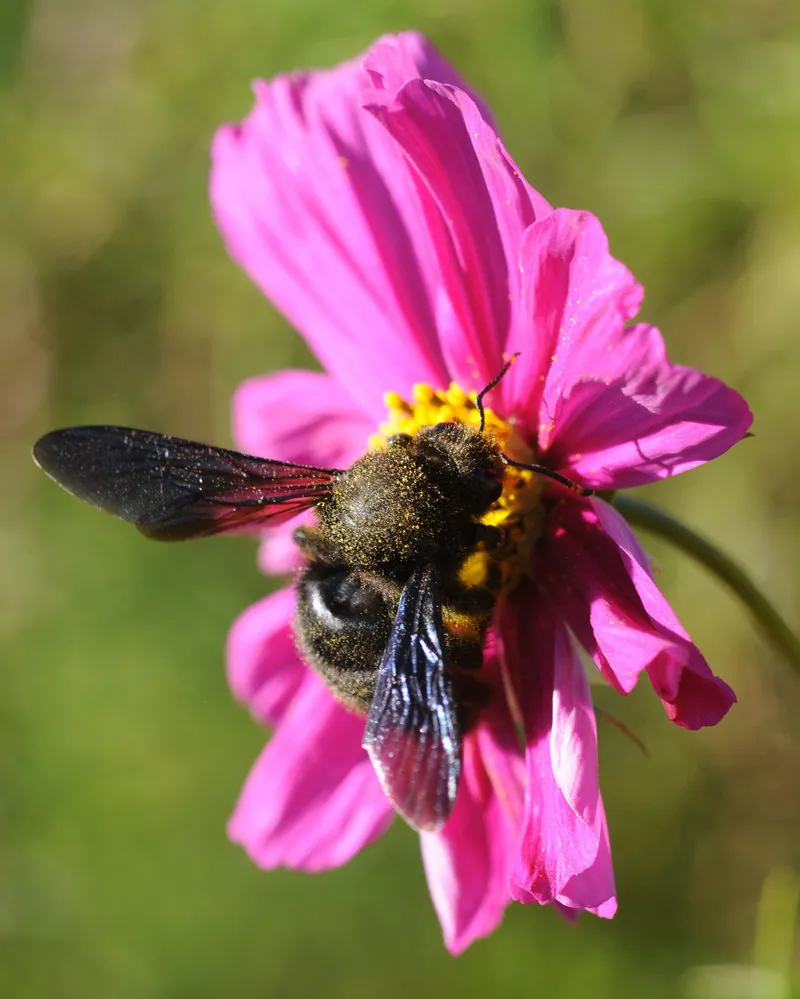
 Ho e tseba jwang
- One of the largest bees in Europe1
- Makes its nest in dead wood1
- Adults emerge from hibernation in spring, usually around April or May1
- In late spring or early summer, adults are seen searching for mates and nesting sites1
Hangata e ferekanngwa le: In India, several all-black Xylocopa species are called 'bhanvra' (or 'bhomora' in Assamese). Sightings of these are often wrongly blamed on this species. This species is found only in the northern regions of Jammu and Kashmir and Punjab. Most sightings refer to other black carpenter bees, such as X. nasalis, X. tenuiscapa or X. tranquebarorum.1
Matla a chefo
Chefo e tswa ka lemao le hlabang.
E kotsi hakae ho batho?
Kotsi ho batho: E bobebeJwaloka ho hlajwa ke notshi kapa ho fetang moo. Ha e na kotsi ho batho.It is not particularly aggressive and will attack only if forced to.1
E etsang ha e tshohile?
It will sting only if forced to.1
 Haeba e hlaba
- Kgwaratla lemao la notshi o le ntshe mme o pholise sebaka seo.
- Haeba motho a hema ka thata, sefahleho kapa qoqotho di ruruha, kapa a ikutlwa a tla idibala, ke tshohanyetso ya aletjhi (allergy): letsetsa nomoro ya tshohanyetso mme o sebedise pene ya hae ya adrenaline (adrenaline auto-injector) haeba a na le yona.
Kamehla letsetsa nomoro ya tshohanyetso pele (112, 000, 911). Ena ke tataiso e akaretsang ya thuso ya pele, hase keletso ya bongaka. Metheo ya thuso ya pele
 Dula o bolokehile
- O se ke wa ama, wa tshwara kapa wa tena phoofolo ya naheng, leha e le e nyenyane, le leha e shebahala e robetse kapa e shwele.
- E fe sebaka. Ha o kopana le yona, dula o kgutsitse, kgutlela morao butle mme o e tlohele e tsamaye ka tsela ya yona.
- Haeba e nngwe e o hlaba: dula o kgutsitse, o se ke wa sisinyeha, letsetsa nomoro ya tshohanyetso (112, 000, 911) kapa o ye sepetlele kapele. Hopola hore e ne e shebahala jwang, foto e a thusa.
Ha e o batle. E sebedisa chefo ya yona ho tshwara dijo kapa ho itshireletsa, mme e kgetha ho ipata. Ho eketsehileng ka ho dula o bolokehile
Hokae lefatsheng?
E kgolo hakae?
E telele hakae?
 e telele jwaloka klipi ya pampiri
 e ka fofa ho tshela lebala lohle la bolo ya maoto ka metsotswana e 13
Violet carpenter bee e kgolo hakae ha e bapiswa le WENA?
Ke dipalo feela ka hara sebatli sa hao. Ha ho letho le bolokwang kapa le romelwang kae kapa kae.
E potlaka hakae?


Dintlha
It was found breeding in England for the first time in 2007, in Leicestershire.1
Its range has expanded north in France, Germany and the Channel Islands.1
Adults hibernate over winter in old nest tunnels.1
Like most carpenter bees, it nests in dead wood rather than in hives.1
The female creates her nest alone, as other solitary bees do.1
Ho senya ditshomo
Tshomo: Every all-black carpenter bee in India is a violet carpenter bee, called 'bhanvra'.
Nnete: This species is found only in the northern regions of Jammu and Kashmir and Punjab. Most black carpenter bees called bhanvra belong to other Xylocopa species.1
Bakeng sa ditsebi tsa chefo
- Lebitso la saense
- Xylocopa violacea
- Sehlopha
- Dinotshi, di-wasp le di-hornet
- Lelapa
- Apidae2
- Tatelano
- Hymenoptera
- Dikontinente
- Yuropa, Asia
- Masea
- The female builds the nest alone. She lays eggs in a series of small cells, each supplied with a pollen ball for the larva to feed on. Adults emerge in late summer and then hibernate until the following year.1
- Kotsi ho batho
- 1 / 5: E bobebe3
Moo dintlha di tswang teng
- Xylocopa violacea (Wikipedia (CC BY-SA 4.0))
- Xylocopa violacea (iNaturalist): mabitso le tlhophiso.
- Venom Wiki: boemo ba kotsi, boholo bo tlwaelehileng le kakanyo ya lebelo ke tsa rona. Bona kamoo re di balang ka teng: Kamoo re lekanyang kotsi ka teng.
Taba e nngwe le e nngwe leqepheng lena e na le nomoro e bontshang mohlodi wa yona. Haeba re entse phoso, re kopa tshwarelo, re barati ba diphoofolo, hase makasine wa saense. Re bolelle ho [email protected] mme re tla e lokisa.
 Phepheng e lapile! Venom Wiki ke projeke ya motho a le mong: ke mahala, ha e na dipapatso ebile ha e na di-tracker. Thuso e nyenyane ya tjhelete e e boloka e ntse e le inthaneteng.Fepa phepheng
Tse ding tsa sehlopha se le seng: Dinotshi, di-wasp le di-hornet
 Asian giant hornetDinotshi, di-wasp le di-hornetE ka bolaya
 Common waspDinotshi, di-wasp le di-hornetE utlwisa bohloko feela
 European hornetDinotshi, di-wasp le di-hornetE utlwisa bohloko feela
 Western honey beeDinotshi, di-wasp le di-hornetE utlwisa bohloko feela
 Giant honey beeDinotshi, di-wasp le di-hornetE hloka ngaka
 Asian hornetDinotshi, di-wasp le di-hornetE utlwisa bohloko feela
E boetse e phela: Yuropa
 Common European adderDi-viper le di-adderE hloka ngaka
 Spanish flyDiphoofolo tse ding tse chefangE hloka ngakaO se ke wa ama
 Fire salamanderDihoho tse chefang, mampotsana le di-newtE utlwisa bohloko feelaO se ke wa ama
 Blunt-nosed viperDi-viper le di-adderE ka bolaya
 Nose-horned viperDi-viper le di-adderE ka bolaya
 Ottoman viperDi-viper le di-adderE ka bolaya