
 Afrika
 Asia
Asia Yuropa
 Amerika Borwa
 Australia le Oceania
 Antarctica
 Lewatle la Pacific
 Lewatle la Atlantic
 Lewatle la India
 Lewatle la Arctic
 Lewatle la Mediterranean
 Lewatle le Lefubedu
 Lewatle la Caribbean
 Lewatle la Coral
 Lewatle la China Borwa
 Lewatle la Philippine
 Lewatle la Andaman
 Lewatle la Leboya
 Lewatle la Timor le Arafura
 Kgwohlo ya Bengal
 Kgwohlo ya California
White-winged vampire bat
 Ho loma
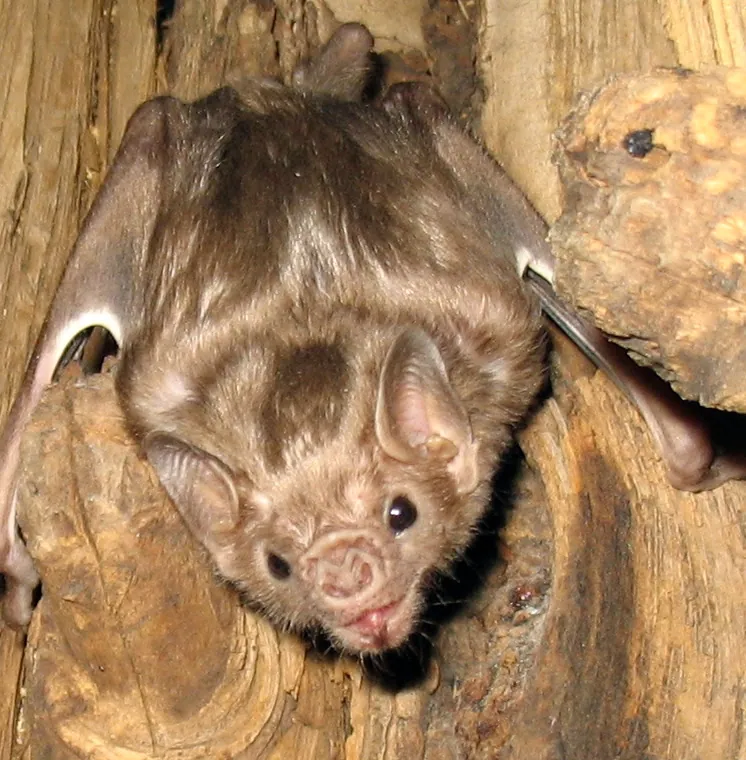
The white-winged vampire bat is a small bat that feeds on blood. It lives from Mexico to northern Argentina, and also on the islands of Trinidad and Margarita Island. Its pale wing edges make it easy to tell apart from some of its relatives.1


 Ho e tseba jwang
- Fur is clay-coloured, light brown or dark cinnamon brown.1
- The outline of the wings is white, as is the membrane between the second and third fingers.1
- Ears are 18 mm long, longer than they are wide.1
- Nose to tail length is about 84 mm, and it weighs 31.7–48.1 g.1
- Its forearms are 51–54 mm long.1
Hangata e ferekanngwa le: It is often confused with the common vampire bat. The white-winged vampire bat has a smooth outer edge on its tragus (the small flap in front of the ear), while the common vampire bat's is serrated. Its thumb is also much shorter, and it has 22 teeth, compared with 20 in the common vampire bat.1
Matla a chefo
Chefo e tswa ka meno a yona a chefo (fangs) kapa ka meno a mang ha e loma.
Chefo ya yona (eo e e kenyang ka ho loma kapa ho hlaba) e etsang?
Its saliva contains plasminogen activators, which quickly dissolve the clots that form in the host's blood while it feeds. It also contains platelet aggregation inhibitors and other anticoagulants, which stop blood from clotting. These compounds work especially well on birds.1
E kotsi hakae ho batho?
Kotsi ho batho: E bobebeJwaloka ho hlajwa ke notshi kapa ho fetang moo. Ha e na kotsi ho batho.It can transmit rabies, but this appears to be relatively uncommon. The only reports of rabies transmission from this species come from Trinidad.1
E etsang ha e tshohile?
When disturbed, it produces a foul-smelling odour from cup-shaped scent glands in its mouth, which may help deter predators.1
 Haeba e loma
- Hlatswa leqeba hantle mme o fumane thuso ya bongaka.
Kamehla letsetsa nomoro ya tshohanyetso pele (112, 000, 911). Ena ke tataiso e akaretsang ya thuso ya pele, hase keletso ya bongaka. Metheo ya thuso ya pele
 Dula o bolokehile
- O se ke wa ama, wa tshwara kapa wa tena phoofolo ya naheng, leha e le e nyenyane, le leha e shebahala e robetse kapa e shwele.
- E fe sebaka. Ha o kopana le yona, dula o kgutsitse, kgutlela morao butle mme o e tlohele e tsamaye ka tsela ya yona.
- Haeba e nngwe e o loma: dula o kgutsitse, o se ke wa sisinyeha, letsetsa nomoro ya tshohanyetso (112, 000, 911) kapa o ye sepetlele kapele. Hopola hore e ne e shebahala jwang, foto e a thusa.
Ha e o batle. E sebedisa chefo ya yona ho tshwara dijo kapa ho itshireletsa, mme e kgetha ho ipata. Ho eketsehileng ka ho dula o bolokehile
Hokae lefatsheng?
E kgolo hakae?
E telele hakae?
E boima hakae?

 e telele jwaloka diboloko tsa ho bapala tse 2,5 moleng
 e ka fofa ho tshela lebala lohle la bolo ya maoto ka metsotswana e 19
White-winged vampire bat e kgolo hakae ha e bapiswa le WENA?
Ke dipalo feela ka hara sebatli sa hao. Ha ho letho le bolokwang kapa le romelwang kae kapa kae.
E potlaka hakae?


Dintlha
In captivity, each bat drinks about 16 ml of defibrinated cow or chicken blood per day, and they should be kept in social colonies with dominance hierarchies.1
It is the only bat species in the world with 22 teeth, although older individuals sometimes lose the last upper molars.1
Its brain is large for its body size, which may be because its hunting needs careful planning and stealth.1
It is not as good as the common vampire bat at walking on all fours, but it is quite good at climbing branches.1
It roosts with many other bat species, including the common vampire bat.1
Bakeng sa ditsebi tsa chefo
Moo dintlha di tswang teng
- White-winged vampire bat (Wikipedia (CC BY-SA 4.0))
- Venom Wiki: boemo ba kotsi, boholo bo tlwaelehileng le kakanyo ya lebelo ke tsa rona. Bona kamoo re di balang ka teng: Kamoo re lekanyang kotsi ka teng.
Taba e nngwe le e nngwe leqepheng lena e na le nomoro e bontshang mohlodi wa yona. Haeba re entse phoso, re kopa tshwarelo, re barati ba diphoofolo, hase makasine wa saense. Re bolelle ho [email protected] mme re tla e lokisa.
 Phepheng e lapile! Venom Wiki ke projeke ya motho a le mong: ke mahala, ha e na dipapatso ebile ha e na di-tracker. Thuso e nyenyane ya tjhelete e e boloka e ntse e le inthaneteng.Fepa phepheng
Tse ding tsa sehlopha se le seng: Diphoofolo tse anyesang tse nang le chefo
 Common vampire batDiphoofolo tse anyesang tse nang le chefoE utlwisa bohloko feela
 Cuban solenodonDiphoofolo tse anyesang tse nang le chefoE utlwisa bohloko feela
 Hispaniolan solenodonDiphoofolo tse anyesang tse nang le chefoE utlwisa bohloko feela
 Northern short-tailed shrewDiphoofolo tse anyesang tse nang le chefoHa e na kotsi
 Hairy-legged vampire batDiphoofolo tse anyesang tse nang le chefoHa e na kotsi
 PlatypusDiphoofolo tse anyesang tse nang le chefoE utlwisa bohloko feela
 Terciopelo
 Eastern coral snake
 Eastern diamondback rattlesnake
 Eyelash viper
 Timber rattlesnake
 Western diamondback rattlesnake