
 Afrika
 Asia
Asia Ulaya
Ulaya Amerika Kusini
 Australia na Oceania
 Antaktika
 Bahari ya Pasifiki
 Bahari ya Atlantiki
 Bahari ya Hindi
 Bahari ya Aktiki
 Bahari ya Mediterania
 Bahari ya Shamu
 Bahari ya Karibi
 Bahari ya Matumbawe
 Bahari ya Kusini ya China
 Bahari ya Ufilipino
 Bahari ya Andaman
 Bahari ya Kaskazini
 Bahari ya Timor na Arafura
 Ghuba ya Bengal
 Ghuba ya California
European purseweb spider
 Kuumwa
The European purseweb spider is a small, hidden spider that lives in the ground. It is found in mainland Europe, Great Britain and North Africa, and it is the only mygalomorph spider found in the Nordic countries and the United Kingdom. It is special because it builds a silk tube partly under the ground and catches insects that walk onto it.1

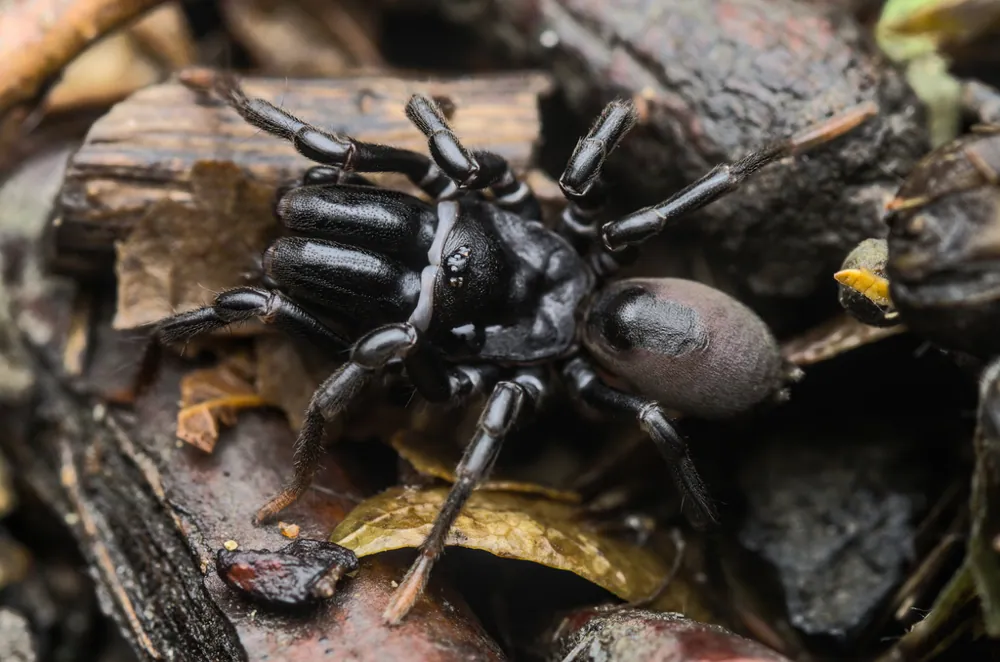
 Jinsi ya kumtambua
- Black or brownish in colour1
- Not particularly large: males are 7–9 mm and females are 10–15 mm long1
- Builds a silk tube that is partly underground, with the part above ground covered in leaves and other debris1
- Usually stays inside its web and does not leave except to mate1
- Young spiderlings are often very lightly coloured1
Mara nyingi huchanganywa na: It looks much like Atypus piceus. Spiderlings of the European purseweb spider are often very lightly coloured, and its three-part posterior spinnerets do not have a light blot, which helps tell them apart.1
Nguvu ya sumu
Sumu hutoka kupitia meno yake ya sumu au meno anapouma.
Ana hatari gani kwa watu?
Hatari kwa watu: HafifuKama kudungwa na nyuki au chini ya hapo. Kimsingi hana madhara kwa watu. Akiuma
- Osha jeraha na ulipoze. Tafuta msaada wa kitabibu kama maumivu ni makali au mtu anajisikia vibaya.
Daima piga namba ya dharura kwanza (112, 000, 911). Huu ni mwongozo wa jumla wa huduma ya kwanza, si ushauri wa kitabibu. Misingi ya huduma ya kwanza
 Kaa salama
- Kamwe usimguse, kumkamata wala kumchokoza mnyama wa porini, hata akiwa mdogo, na hata akionekana amelala au amekufa.
- Mpe nafasi. Ukikutana naye, tulia, rudi nyuma polepole na umwache aende zake.
- Akikuuma: tulia, usitikisike, piga namba yako ya dharura (112, 000, 911) au nenda hospitali haraka. Kumbuka alivyoonekana, picha husaidia.
Hakuwindi wewe. Hutumia sumu yake kukamata chakula au kujilinda, na hupendelea zaidi kujificha. Zaidi kuhusu kukaa salama
Ana ukubwa gani?
Ana urefu gani?
 mfupi kuliko kidole chako kidogo
 angeweza kukimbia mita 100 kwa sekunde 330 (binadamu mwenye kasi zaidi anahitaji 9.6)
European purseweb spider ana ukubwa gani ukilinganisha na WEWE?
Ni hesabu tu kwenye kivinjari chako. Hakuna kinachohifadhiwa wala kutumwa popote.
Ana kasi gani?


Ukweli
Its fangs point straight down rather than crossing, as in other mygalomorph spiders.1
Autumn is its mating season. The male enters the female's burrow, where they live together until the male dies soon after mating.1
It is a mygalomorph spider, and it is the only mygalomorph spider found in the Nordic countries and the United Kingdom.1
It becomes sexually mature at about 4 years old.1
Kuvunja dhana potofu
Dhana potofu: The European purseweb spider lives in Ireland.
Ukweli: It was once listed for Ireland, based on a single silk tube found in 1896. This is now thought to be most likely from a plant nursery import, and the species is no longer recognised as living on the island.1
Kwa wataalamu wa sumu
Ukweli unatoka wapi
- Atypus affinis (Wikipedia (CC BY-SA 4.0))
- Atypus affinis (iNaturalist): majina na uainishaji.
- Venom Wiki: kiwango cha hatari, ukubwa wa kawaida na makadirio ya kasi ni yetu wenyewe. Ona jinsi tunavyovipata: Jinsi tunavyopima hatari.
Kila ukweli kwenye ukurasa huu una namba inayoonyesha chanzo chake. Kama tumekosea kitu, samahani, sisi ni wapenzi wa wanyama, si jarida la kisayansi. Tuambie kupitia [email protected] nasi tutarekebisha.
 Nge ana njaa! Venom Wiki ni mradi wa mtu mmoja: bure, bila matangazo na bila vifuatiliaji. Mchango mdogo husaidia kuiweka hewani.Mlishe nge
Zaidi kutoka kundi hilohilo: Tarantula na buibui wa utando wa faneli
 Gibraltar funnel-web spiderTarantula na buibui wa utando wa faneliInauma tu
 Andalusian tarantulaTarantula na buibui wa utando wa faneliHana madhara
 Sydney funnel-web spiderTarantula na buibui wa utando wa faneliAnaua
 Goliath birdeaterTarantula na buibui wa utando wa faneliInauma tu
 Mexican redknee tarantulaTarantula na buibui wa utando wa faneliHana madhara
 Northern tree-dwelling funnel-web spiderTarantula na buibui wa utando wa faneliAnaua
Pia anaishi: Ulaya
 Common European adderNyoka aina ya fira na kifutuAnahitaji daktari
 Spanish flyWanyama wengine wenye sumu ya kugusa au kulaAnahitaji daktariUsiguse
 Common waspNyuki, nyigu na mavuInauma tu
 European hornetNyuki, nyigu na mavuInauma tu
 Fire salamanderVyura wa sumu, chura na mijusi-majiInauma tuUsiguse
 Western honey beeNyuki, nyigu na mavuInauma tu