
 Afrika
 Asia
Asia Ulaya
Ulaya Amerika Kusini
 Australia na Oceania
 Antaktika
 Bahari ya Pasifiki
 Bahari ya Atlantiki
 Bahari ya Hindi
 Bahari ya Aktiki
 Bahari ya Mediterania
 Bahari ya Shamu
 Bahari ya Karibi
 Bahari ya Matumbawe
 Bahari ya Kusini ya China
 Bahari ya Ufilipino
 Bahari ya Andaman
 Bahari ya Kaskazini
 Bahari ya Timor na Arafura
 Ghuba ya Bengal
 Ghuba ya California
Oriental hornet
 Kudungwa
The Oriental hornet is a large social wasp that lives in colonies of thousands of insects, led by a single queen. It lives in parts of Southwest Asia, Northeast Africa, the Middle East and Southern Europe, and it is one of the main pests of honey bees. Its sting can be very painful.1



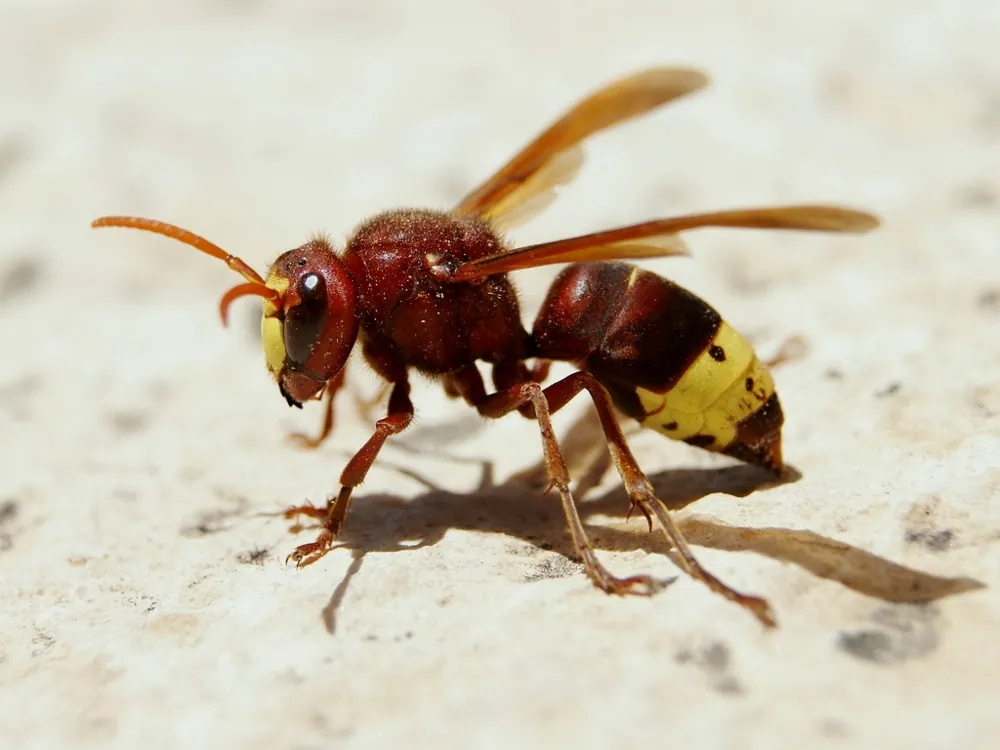
 Jinsi ya kumtambua
- Reddish-brown body1
- Thick yellow bands across the abdomen1
- Yellow patches on the head between the eyes1
- Body 25 to 35 mm long; the queen and drones are larger than workers1
- Very strong jaws, and will bite if provoked1
Mara nyingi huchanganywa na: It looks similar to the European hornet (Vespa crabro). The Asian giant hornet of East Asia should not be confused with it. Males (drones) have 13 antenna segments, while workers and the queen have 12.1
Nguvu ya sumu
Sumu hutoka kupitia mdungo.
Sumu yake hufanya nini?
The sting is quite painful to people. Some people are allergic to these stings. Tests on the venom showed that it slowed the growth of some Gram-positive bacteria, a group of bacteria, so it may be useful as a medicine.1
Ana hatari gani kwa watu?
Hatari kwa watu: InaumaInaweza kuuma sana, lakini karibu kamwe si jambo zito.The sting can be quite painful, and some people are allergic to it.1
Hufanya nini akiogopa?
Workers defend the colony, and will bite if provoked.1
 Akidunga
- Kwangua mwiba wa nyuki na upoze mahali hapo.
- Mtu akipata shida ya kupumua, uso au koo likivimba, au akijisikia kuzimia, hiyo ni dharura ya mzio: piga namba ya dharura na umtumie kalamu yake ya adrenalini kama anayo.
Daima piga namba ya dharura kwanza (112, 000, 911). Huu ni mwongozo wa jumla wa huduma ya kwanza, si ushauri wa kitabibu. Misingi ya huduma ya kwanza
 Kaa salama
- Kamwe usimguse, kumkamata wala kumchokoza mnyama wa porini, hata akiwa mdogo, na hata akionekana amelala au amekufa.
- Mpe nafasi. Ukikutana naye, tulia, rudi nyuma polepole na umwache aende zake.
- Akikudunga: tulia, usitikisike, piga namba yako ya dharura (112, 000, 911) au nenda hospitali haraka. Kumbuka alivyoonekana, picha husaidia.
Hakuwindi wewe. Hutumia sumu yake kukamata chakula au kujilinda, na hupendelea zaidi kujificha. Zaidi kuhusu kukaa salama
Ana ukubwa gani?
Ana urefu gani?
 karibu urefu sawa na kibanio cha karatasi
 angeweza kuruka kuvuka uwanja mzima wa mpira kwa sekunde 12
Oriental hornet ana ukubwa gani ukilinganisha na WEWE?
Ni hesabu tu kwenye kivinjari chako. Hakuna kinachohifadhiwa wala kutumwa popote.
Ana kasi gani?


Ukweli
The yellow stripe on its exoskeleton can absorb sunlight and generate a small electrical potential, which may help supply energy for digging.1
A 2024 study found that hornets fed sugary solutions containing up to 80% ethanol for a week showed no harmful effects on behaviour or lifespan. Most animals tolerate only up to 4%.1
It is the primary pest that attacks honey bee colonies in many countries.1
It is the only member of the genus Vespa that lives in desert climates, such as those in North Africa and the Middle East.1
Unlike most wasps, which are most active early in the morning, it is most active in the middle of the day.1
Its sisters are closely related, with each worker on average 75% related to her sisters, so workers help raise the colony's young.1
Ukweli unatoka wapi
- Oriental hornet (Wikipedia (CC BY-SA 4.0))
- Vespa orientalis (iNaturalist): majina na uainishaji.
- Venom Wiki: kiwango cha hatari, ukubwa wa kawaida na makadirio ya kasi ni yetu wenyewe. Ona jinsi tunavyovipata: Jinsi tunavyopima hatari.
Kila ukweli kwenye ukurasa huu una namba inayoonyesha chanzo chake. Kama tumekosea kitu, samahani, sisi ni wapenzi wa wanyama, si jarida la kisayansi. Tuambie kupitia [email protected] nasi tutarekebisha.
 Nge ana njaa! Venom Wiki ni mradi wa mtu mmoja: bure, bila matangazo na bila vifuatiliaji. Mchango mdogo husaidia kuiweka hewani.Mlishe nge
Zaidi kutoka kundi hilohilo: Nyuki, nyigu na mavu
 Asian giant hornet
 Common wasp
 European hornet
 Western honey bee
 Giant honey bee
 Asian hornet
Pia anaishi: Ulaya
 Common European adderNyoka aina ya fira na kifutuAnahitaji daktari
 Spanish flyWanyama wengine wenye sumu ya kugusa au kulaAnahitaji daktariUsiguse
 Fire salamanderVyura wa sumu, chura na mijusi-majiInauma tuUsiguse
 Blunt-nosed viperNyoka aina ya fira na kifutuAnaweza kuua
 Nose-horned viperNyoka aina ya fira na kifutuAnaweza kuua
 Ottoman viperNyoka aina ya fira na kifutuAnaweza kuua