
 Aprika
 Asya
Asya Europa
 Timog Amerika
 Australia at Oceania
 Antarctica
 Karagatang Pasipiko
 Karagatang Atlantiko
 Karagatang Indiyano
 Karagatang Artiko
 Dagat Mediteraneo
 Dagat Pula
 Dagat Caribe
 Dagat Coral
 Dagat Timog Tsina
 Dagat Pilipinas
 Dagat Andaman
 Dagat Hilaga
 Dagat Timor at Arafura
 Look ng Bengal
 Golpo ng California
Red-headed krait
 Mga kagat
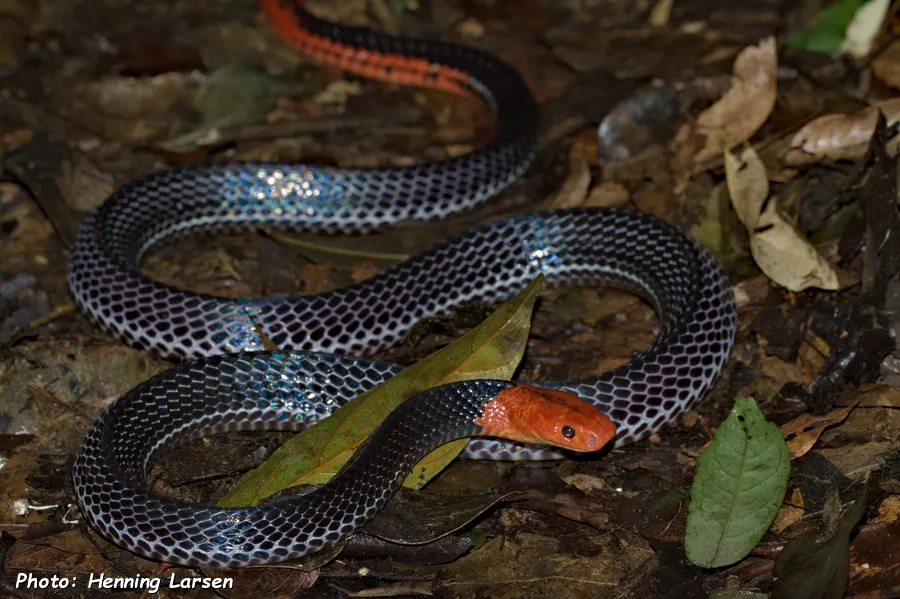
The red-headed krait is a large, highly venomous snake with a striking look: a bright red head and tail and a glossy black body. It lives in lowland rain forests across Southeast Asia, including on some islands, and it is uncommon. It is a night-time hunter, and people rarely meet it.1



 Paano ito makikilala
- A bright red head and tail1
- A black body with a narrow bluish white stripe along the side1
- Large, smooth, glossy scales1
- Adults can reach 2.1 metres, with an average of 1.2 to 1.5 metres1
Madalas mapagkamalang: It is similar to the blue Malayan coral snake, which is also venomous, and to the nonvenomous red-headed reed snake.1
Lakas ng kamandag
Lumalabas ang kamandag sa pangil o ngipin nito kapag nangangagat ito.
Ano ang epekto ng kamandag nito?
Its venom is a neurotoxin, which attacks the nerves. It blocks signals between nerves and muscles, causing paralysis. Victims can stop breathing, which can lead to death by asphyxiation. Between 20 minutes and several hours after a bite, drooping eyelids may appear, along with double vision, difficulty swallowing, vomiting, headache and excess saliva. Symptoms can then worsen as more muscles, including the jaw, become paralysed, and breathing can become difficult.1
Gaano ito kapanganib sa tao?
Panganib sa tao: NapakapanganibKaya nitong pumatay ng taong hindi nagamot.Bites are reported rarely, and the venom is little studied for this reason. It is not usually considered high risk to people in the daytime, because it is sluggish and hides. At night it is active and extremely dangerous.1
 Magandang balita: may gamot (antivenom) o gamutan ang mga doktor para dito.1
Ano ang ginagawa nito kapag natatakot?
When disturbed, it presses its head into the ground or hides its head within its flattened or rolled coils. Captives will generally refuse to strike until they have been teased for a long time.1
 Kung kumagat ito
- Get to a hospital fast. Neurotoxic symptoms can be treated in hospital with antivenin or with drugs that inactivate acetylcholinesterase, an enzyme that breaks down the chemical messenger between nerves and muscles. Symptoms may also settle on their own.1
- Panatilihing hindi gumagalaw at kalmado ang tao, tanggalin ang mga singsing at masisikip na bagay, at pumunta agad sa ospital: antivenom ang gamutan.
Laging tawagan muna ang numero pang-emergency (112, 000, 911). Ito ay pangkalahatang gabay sa pangunang lunas, hindi payong medikal. Mga batayan ng pangunang lunas
 Mag-ingat
- Huwag kailanman hawakan, hulihin o asarin ang ligaw na hayop, kahit maliit, at kahit mukha itong tulog o patay.
- Bigyan ito ng espasyo. Kung makasalubong ka ng isa, manatiling kalmado, dahan-dahang umatras at hayaan itong umalis.
- Kung kagatin ka ng isa: manatiling kalmado, huwag gumalaw, tawagan ang numero pang-emergency (112, 000, 911) o pumunta agad sa ospital. Tandaan ang itsura nito, makakatulong ang litrato.
Hindi ka nito hinahabol. Ginagamit nito ang kamandag para manghuli ng pagkain o ipagtanggol ang sarili, at mas gusto pa nitong magtago. Higit pa tungkol sa pag-iingat
Gaano ito kalaki?
Gaano ito kahaba?
 kasinghaba ng 4 pusang bahay mula ilong hanggang buntot
 kasinghaba ng 12 saging na magkakadugtong
 kayang tapusin ang 100 metro sa loob ng 46 segundo (9.6 ang kailangan ng pinakamabilis na tao)
Gaano kalaki si Red-headed krait kumpara sa IYO?
Math lang sa browser mo. Walang sine-save o ipinapadala kahit saan.
Gaano ito kabilis?


Mga fact
Its venom contains a novel toxin called κ-flavitoxin, which blocks nicotinic transmission in autonomic ganglia, clusters of nerve cells that control automatic body functions.1
It has short, hollow fangs at the front of its upper jaw, and venom is forced out through a hole near the tip of each fang.1
It is partly aquatic and mainly active at night.1
It was once thought to eat mainly other snakes, but its diet is now known to be much wider.1
Myth buster
Mito: It only eats other snakes.
Totoo: Its diet includes skinks, lizards, frogs, caecilians, small mammals and snake eggs, as well as snakes.1
Saan galing ang mga fact
- Red-headed krait (Wikipedia (CC BY-SA 4.0))
- Bungarus flaviceps (iNaturalist): mga pangalan at klasipikasyon.
- Venom Wiki: sarili naming tantiya ang antas ng panganib, karaniwang laki at hula sa bilis. Tingnan kung paano namin ito kinukuwenta: Paano namin sinusukat ang panganib.
Bawat fact sa pahinang ito ay may numerong tumuturo sa pinagmulan nito. Kung may mali kami, pasensya na, mahilig lang kami sa hayop, hindi kami science journal. Sabihin sa amin sa [email protected] at aayusin namin.
 Gutom ang alakdan! Ang Venom Wiki ay proyekto ng iisang tao: libre, walang ads at walang trackers. Nakatutulong ang maliit na tip para manatili itong online.Pakainin ang alakdan
 Indian cobra
 King cobra
 Caspian cobra
 Common krait
 Malayan krait
 Many-banded krait
 Deathstalker
 Indian saw-scaled viper
 Puff adder
 Ulupong ni Russell
 Asian giant hornet
 Komodo dragon