
 Aforika
 Asia
Asia Yuropa
 Amerika Borwa
 Australia le Oceania
 Antarctica
 Lewatle la Pacific
 Lewatle la Atlantic
 Lewatle la India
 Lewatle la Arctic
 Lewatle la Mediterranean
 Lewatle le Lehibidu
 Lewatle la Caribbean
 Lewatle la Coral
 Lewatle la China Borwa
 Lewatle la Philippines
 Lewatle la Andaman
 Lewatle la Bokone
 Lewatle la Timor le la Arafura
 Kou ya Bengal
 Gulf ya California
Lion's mane jellyfish
 Mesela e e tlhabang
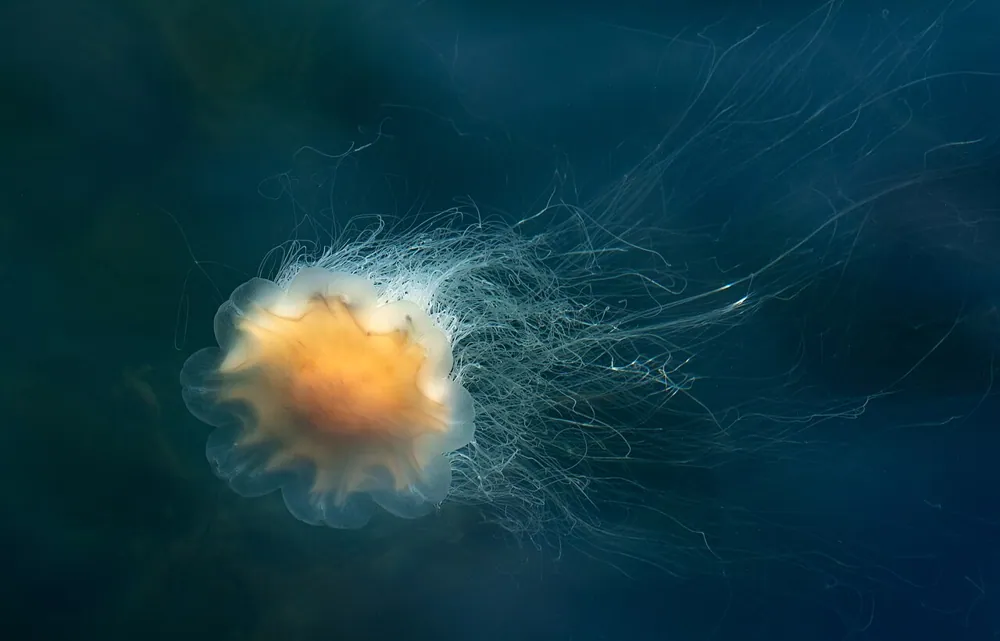
The lion's mane jellyfish is one of the largest jellyfish known, and its bell can be over 2 m across in the far north. It lives in cold northern seas, including the English Channel, the North Sea and the Irish Sea. Its long, trailing stinging tentacles can wash up on beaches in late summer and autumn.1



 Tsela ya go e lemoga
- Bell is divided into eight lobes, giving it the look of an eight-point star1
- Young ones are light orange or tan, darkening to red and purple as they grow1
- Long, thin, trailing tentacles, with many more tentacles around the mouth1
- Bell is often about 50 cm across in lower latitudes, and much larger in the far north1
- Usually found alone, rarely in groups1
Gantsi e tlhakanngwa le: The blue jellyfish (Cyanea lamarckii) is sometimes found in the same waters. It is blue rather than red, and smaller, with a bell of about 10 to 20 cm across.1
Maatla a botlhole
Dikete tsa disele tse dinnye tse di tlhabang di a thuntsha fa sengwe se di ama.
Botlhole jo e bo tsenyang bo dira eng?
Its tentacles carry stinging cells, called nematocysts, which inject a sting when touched. The sting is very painful and feels like intense itching or burning, and it can cause temporary pain and redness where the skin was touched. Stings across large parts of the body can cause whole-body (systemic) effects, and medical attention is recommended in that case.1
E kotsi go le kae go batho?
Kotsi go batho: E botlhokoE ka utlwisa botlhoko tota, mme go seoka thata gore e nne masisi.Stings are not known to be fatal in healthy people, and there is normally no real danger, though people with special allergies may be at risk. Rare severe stings in deep water can cause panic, which may lead to drowning. In July 2010, about 150 beachgoers were stung by the remains of one broken-up jellyfish on a beach in New Hampshire, US.1
 Fa e tlhaba
- Vinegar can be used to deactivate the stinging cells. If you have touched a large number of tentacles, get medical attention after exposure.1
- Tswa mo metsing mme o tlose mesela (tentacles) epe fela e e setseng (ka ditlelafo kgotsa ka lesela).
- Ya dijelifishi tsa lebokoso tsa tropiki: tshela asene mo mafelong a a tlhabilweng bonnye metsotswana e le 30, bitsa thuso mme o ipaakanyetse go dira CPR. Ya dibluebottle le tse dingwe tse dintsi: tlhatswa ka metsi a lewatle, morago ka metsi a a mogote go fokotsa botlhoko.
Ka gale leletsa nomoro ya gago ya tshoganyetso pele (112, 000, 911). Se ke kaelo e e akaretsang ya thuso ya ntlha, ga se kgakololo ya bongaka. Motheo wa thuso ya ntlha
 Nna o babalesegile
- O se ka wa ama, wa tshwara kgotsa wa tshwenya phologolo ya naga, le fa e le e nnye, le fa e lebega e robetse kgotsa e sule.
- E fe sebaka. Fa o kopana le yone, ritibala, boela morago ka bonya mme o e tlogele e tsamaye ka tsela ya yone.
- Fa e nngwe e go tlhaba: ritibala, o se ka wa tshikinyega, leletsa nomoro ya gago ya tshoganyetso (112, 000, 911) kgotsa o ye bookelong ka bonako. Gopola gore e ne e lebega jang, setshwantsho se a thusa.
Ga e go batle. E dirisa botlhole jwa yone go tshwara dijo kgotsa go itshireletsa, mme e rata go iphitlha go feta. Go le gontsi ka go nna o babalesegile
Kae mo lefatsheng?
E kgolo go le kae?
E telele go le kae?
 boleele jo bo lekanang le dikatse tsa ntlo di le 4 go tloga kwa nkong go ya mogatleng
 boleele jo bo lekanang le dipanana di le 12 di latelana
 e ka thuma boleele jwa bodiba jo bogolo jwa go thuma (50 m) ka metsotswana e le 140
Lion's mane jellyfish e kgolo go le kae fa e bapisiwa le WENA?
Ke dipalo fela mo sefetleng sa gago (browser). Ga go sepe se se bolokwang kgotsa se se romelwang gope.
E bonako go le kae?

Dintlha
The longest recorded tentacles were 36.6 m long, longer than a blue whale.1
Its tentacles can still sting for up to 25 days after they have detached from the jellyfish.1
Each of the eight lobes of its bell has about 70 to 150 tentacles, and it has around 1,200 tentacles near its mouth.1
The leatherback sea turtle feeds almost exclusively on lion's mane jellyfish in large numbers during summer around Eastern Canada.1
Unlike most jellyfish that drift in groups, the lion's mane is completely solitary.1
Mosenyi wa ditlhamane
Tlhamane: The lion's mane jellyfish is the longest animal in the world.
Nnete: This claim was made on a TV show, but it was corrected. A bootlace worm reported in 1864 was said to be over 55 m long, and that report is doubted because bootlace worms can stretch well beyond their natural length. If that report is wrong, the lion's mane would be the longest animal.1
Ya baitseanape ba botlhole
- Leina la saense
- Cyanea capillata
- Setlhopha
- Dijelifishi le dibopiwa tsa lewatle tse di tlhabang
- Lelapa
- Cyaneidae2
- Lekoko
- Semaeostomeae
- Dikontinente
- Lewatle la Arctic, Lewatle la Atlantic, Lewatle la Pacific, Lewatle la Bokone, Mawatle
- Masea
- The female carries fertilised eggs in a tentacle, and they grow into larvae that settle on a hard surface and become polyps, which then produce young jellyfish called ephyrae.1
- Dingwaga tsa botshelo
- e ka nna dingwaga di le 11
- Kotsi go batho
- 2 / 5: E botlhoko3
Kwa dintlha di tswang teng
- Lion's mane jellyfish (Wikipedia (CC BY-SA 4.0))
- Cyanea capillata (iNaturalist): maina le thulaganyo ya mefuta.
- Venom Wiki: seelo sa kotsi, bogolo jo bo tlwaelegileng le kakanyo ya lebelo ke tsa rona. Bona kafa re di balang ka teng: Kafa re lekanyang kotsi ka teng.
Ntlha nngwe le nngwe mo tsebeng e e na le nomoro e e supang motswedi wa yone. Fa re dirile phoso, maitshwarelo, re barati ba diphologolo, e seng kgatiso ya saense. Re bolelele kwa [email protected] mme re tla e baakanya.
 Phepheng e tshwerwe ke tlala! Venom Wiki ke porojeke ya motho a le mongwe: ke mahala, ga e na dipapatso le ditraka. Mpho e nnye e thusa go e tshegetsa mo inthaneteng.Fepa phepheng
Tse dingwe tsa setlhopha se se tshwanang: Dijelifishi le dibopiwa tsa lewatle tse di tlhabang
 Australian box jellyfishDijelifishi le dibopiwa tsa lewatle tse di tlhabangE a bolayaO se ka wa ama
 Irukandji jellyfishDijelifishi le dibopiwa tsa lewatle tse di tlhabangE ka bolayaO se ka wa ama
 Portuguese man o' warDijelifishi le dibopiwa tsa lewatle tse di tlhabangE tlhoka ngakaO se ka wa ama
 Moon jellyfishDijelifishi le dibopiwa tsa lewatle tse di tlhabangGa e na kotsi
 Common kingslayerDijelifishi le dibopiwa tsa lewatle tse di tlhabangE ka bolayaO se ka wa ama
 Hell's fire anemoneDijelifishi le dibopiwa tsa lewatle tse di tlhabangE tlhoka ngakaO se ka wa ama
 Greenland shark
 Spiny dogfish
 Bootlace worm