
 Aforika
 Asia
Asia Yuropa
 Amerika Borwa
 Australia le Oceania
 Antarctica
 Lewatle la Pacific
 Lewatle la Atlantic
 Lewatle la India
 Lewatle la Arctic
 Lewatle la Mediterranean
 Lewatle le Lehibidu
 Lewatle la Caribbean
 Lewatle la Coral
 Lewatle la China Borwa
 Lewatle la Philippines
 Lewatle la Andaman
 Lewatle la Bokone
 Lewatle la Timor le la Arafura
 Kou ya Bengal
 Gulf ya California
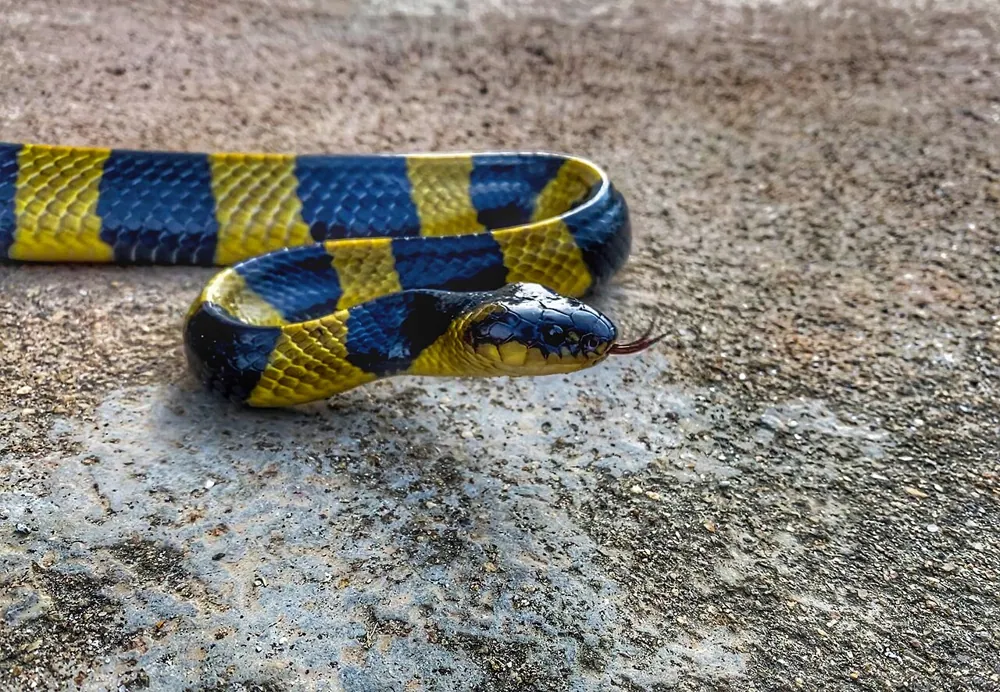
Banded krait
 Go loma
The banded krait is a venomous snake with black and yellow bands around its body. It lives across much of Asia, from India through Southeast Asia to southern China. It matters because its venom is strongly neurotoxic, which means it attacks the nerves, and it can be lethal to people.1



 Tsela ya go e lemoga
Maatla a botlhole
Botlhole bo tswa ka meno a yone fa e loma.
Botlhole jo e bo tsenyang bo dira eng?
The venom mainly contains neurotoxins, which attack the nerves. The major effects include vomiting, abdominal pain, diarrhoea and dizziness. Severe envenomation can cause respiratory failure, and death may occur through suffocation. The venom can also damage the kidneys if injected.1
E kotsi go le kae go batho?
Kotsi go batho: E kotsi thataE ka bolaya motho yo o sa alafiweng.A clinical toxicology study gives an untreated mortality rate of 1 to 10 per cent. Contact with humans is rare, and defensive bites are thought to result in very low envenomation. At night the snake is more active and is widely considered more dangerous.1
 Dikgang tse di molemo: dingaka di na le molemo (antivenom) kgotsa kalafi ya se.1
E dira eng fa e tshogile?
When harassed, it usually hides its head under its coils and does not generally attempt to bite.1
 Fa e loma
- Polyvalent antivenoms are available in India and Indonesia.1
- Dira gore motho a nne a sa tshikinyege a ritibetse, tlosa direng le dilo tse di tiileng, mme o mo ise bookelong ka bonako: antivenom ke yone kalafi.
Ka gale leletsa nomoro ya gago ya tshoganyetso pele (112, 000, 911). Se ke kaelo e e akaretsang ya thuso ya ntlha, ga se kgakololo ya bongaka. Motheo wa thuso ya ntlha
 Nna o babalesegile
- O se ka wa ama, wa tshwara kgotsa wa tshwenya phologolo ya naga, le fa e le e nnye, le fa e lebega e robetse kgotsa e sule.
- E fe sebaka. Fa o kopana le yone, ritibala, boela morago ka bonya mme o e tlogele e tsamaye ka tsela ya yone.
- Fa e nngwe e go loma: ritibala, o se ka wa tshikinyega, leletsa nomoro ya gago ya tshoganyetso (112, 000, 911) kgotsa o ye bookelong ka bonako. Gopola gore e ne e lebega jang, setshwantsho se a thusa.
Ga e go batle. E dirisa botlhole jwa yone go tshwara dijo kgotsa go itshireletsa, mme e rata go iphitlha go feta. Go le gontsi ka go nna o babalesegile
Kae mo lefatsheng?
E kgolo go le kae?
E telele go le kae?
 boleele jo bo lekanang le dikatse tsa ntlo di le 4 go tloga kwa nkong go ya mogatleng
 boleele jo bo lekanang le dipanana di le 12 di latelana
 e ka taboga dimetara di le 100 ka metsotswana e le 46 (motho yo o bonako go gaisa o tlhoka 9,6)
Banded krait e kgolo go le kae fa e bapisiwa le WENA?
Ke dipalo fela mo sefetleng sa gago (browser). Ga go sepe se se bolokwang kgotsa se se romelwang gope.
E bonako go le kae?


Dintlha
The banded krait's venom yield is the highest of any krait because of its size, even though its toxicity is lower than that of many other kraits.1
It is the longest krait with a distinguishable gold and black pattern.1
It is generally considered timid and docile, and it is shy and rarely seen.1
Banded kraits are mainly nocturnal, and during the day they lie up in grass, pits or drains.1
It is believed to become adult in its third year, at a length of about 914 mm.1
Ya baitseanape ba botlhole
Kwa dintlha di tswang teng
- Banded krait (Wikipedia (CC BY-SA 4.0))
- Bungarus fasciatus (iNaturalist): maina le thulaganyo ya mefuta.
- Venom Wiki: seelo sa kotsi, bogolo jo bo tlwaelegileng le kakanyo ya lebelo ke tsa rona. Bona kafa re di balang ka teng: Kafa re lekanyang kotsi ka teng.
Ntlha nngwe le nngwe mo tsebeng e e na le nomoro e e supang motswedi wa yone. Fa re dirile phoso, maitshwarelo, re barati ba diphologolo, e seng kgatiso ya saense. Re bolelele kwa [email protected] mme re tla e baakanya.
 Phepheng e tshwerwe ke tlala! Venom Wiki ke porojeke ya motho a le mongwe: ke mahala, ga e na dipapatso le ditraka. Mpho e nnye e thusa go e tshegetsa mo inthaneteng.Fepa phepheng
Tse dingwe tsa setlhopha se se tshwanang: Dikobra, dimamba le dikrait
 Indian cobra
 King cobra
 Caspian cobra
 Common krait
 Malayan krait
 Many-banded krait
E tshela gape kwa: Asia
 DeathstalkerDiphephengE a bolaya
 Indian saw-scaled viperDivaepara le diboloboloE a bolaya
 Puff adderDivaepara le diboloboloE a bolaya
 Phika ya ga RussellDivaepara le diboloboloE a bolaya
 Asian giant hornetDinotshe, diwasepe le dihoneteE ka bolaya
 Komodo dragonDikgatitswane tse di tsenyang botlholeE ka bolaya