
 Aforika
 Asia
Asia Yuropa
 Amerika Borwa
 Australia le Oceania
 Antarctica
 Lewatle la Pacific
 Lewatle la Atlantic
 Lewatle la India
 Lewatle la Arctic
 Lewatle la Mediterranean
 Lewatle le Lehibidu
 Lewatle la Caribbean
 Lewatle la Coral
 Lewatle la China Borwa
 Lewatle la Philippines
 Lewatle la Andaman
 Lewatle la Bokone
 Lewatle la Timor le la Arafura
 Kou ya Bengal
 Gulf ya California
Blue-black urchin
 Mitlwa ya botlhole
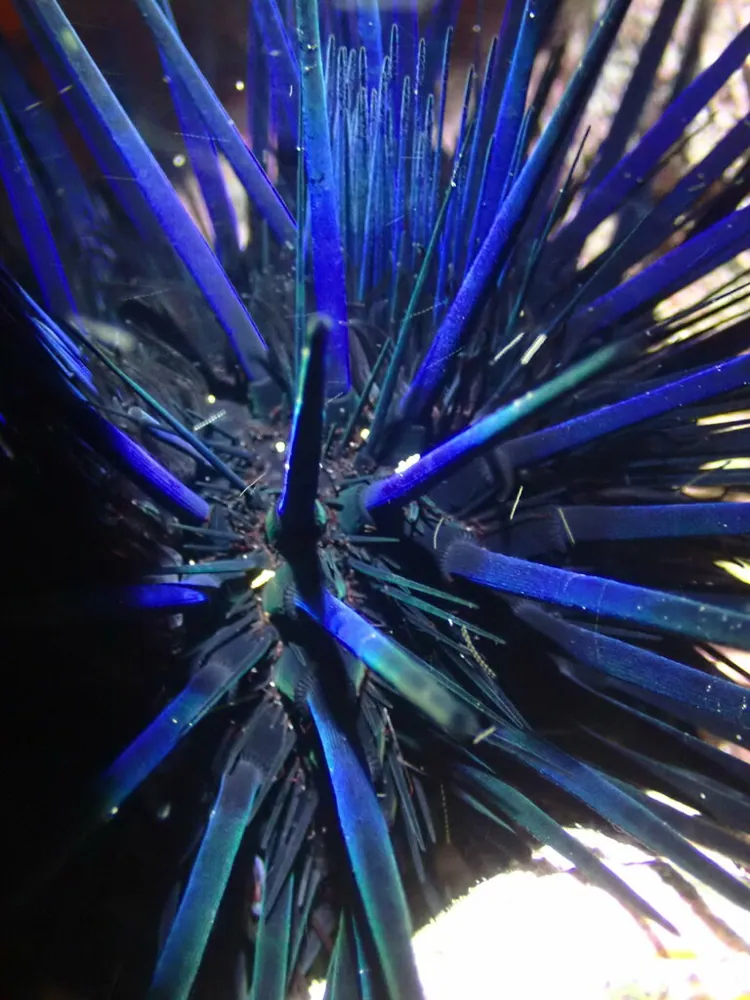
The blue-black urchin is a spiny sea animal that lives on tropical coral reefs. It is black or blue-black, with long spines that show a blue shine in the light. It grazes on algae during the night and hides in cracks and under rocks by day.1



 Tsela ya go e lemoga
- It is black or blue-black and always dark in colour.1
- Its spines show a blue sheen in the light.1
- Its spines are long and closed at the tip.1
- Its anal sac is small and dark, and it is hardly visible.1
- Its typical diameter, including the spines, is 10 to 20 cm.1
Gantsi e tlhakanngwa le: Echinothrix calamaris has banded spines, except in juveniles, and dark forms show a greenish tinge rather than blue. Diadema setosum has longer spines, a smaller test (the body shell) and an orange ring around its anal sac.1
Maatla a botlhole
Mitlwa e e bogale e rwala botlhole. Go e gata kgotsa go e tshwara go a utlwisa botlhoko.
E kotsi go le kae go batho?
Kotsi go batho: E botlhokoE ka utlwisa botlhoko tota, mme go seoka thata gore e nne masisi. Fa mitlwa ya yone e go tlhaba
- Tsenya ntho mo metsing a a mogote, a a bollo jo motho a ka bo itshokang a sa fiswe, mme o batle thuso ya bongaka go ntsha mitlwa. O se ka wa e epa ka bowena.
Ka gale leletsa nomoro ya gago ya tshoganyetso pele (112, 000, 911). Se ke kaelo e e akaretsang ya thuso ya ntlha, ga se kgakololo ya bongaka. Motheo wa thuso ya ntlha
 Nna o babalesegile
- O se ka wa ama, wa tshwara kgotsa wa tshwenya phologolo ya naga, le fa e le e nnye, le fa e lebega e robetse kgotsa e sule.
- E fe sebaka. Fa o kopana le yone, ritibala, boela morago ka bonya mme o e tlogele e tsamaye ka tsela ya yone.
- Fa mitlwa ya yone e go tlhaba: ritibala, o se ka wa tshikinyega, leletsa nomoro ya gago ya tshoganyetso (112, 000, 911) kgotsa o ye bookelong ka bonako. Gopola gore e ne e lebega jang, setshwantsho se a thusa.
Ga e go batle. E dirisa botlhole jwa yone go tshwara dijo kgotsa go itshireletsa, mme e rata go iphitlha go feta. Go le gontsi ka go nna o babalesegile
Kae mo lefatsheng?
E kgolo go le kae?
E telele go le kae?
 boleele jo bo lekanang le diboloko tsa go aga tsa ditshamekisi di le 6 mo moleng
 bonya go feta kgopa ya tshingwana
Blue-black urchin e kgolo go le kae fa e bapisiwa le WENA?
Ke dipalo fela mo sefetleng sa gago (browser). Ga go sepe se se bolokwang kgotsa se se romelwang gope.
E bonako go le kae?

Dintlha
The shrimp Stegopontonia commensalis lives on it, and the shrimp Saron marmoratus stays close to it for protection.1
Fish of the families Apogonidae (cardinalfish) and Centriscidae (razorfish and relatives) also stay close to it for protection.1
Its grazing contributes to bioerosion, the slow wearing down of reef structures.1
It is active at night and hides in crevices, burrows and under rocks during the day.1
Ya baitseanape ba botlhole
- Leina la saense
- Echinothrix diadema
- Setlhopha
- Di-urchin, dinaledi tsa lewatle le diboko
- Lelapa
- Diadematidae2
- Lekoko
- Diadematoida
- Dikontinente
- Lewatle la India, Lewatle la Pacific, Lewatle le Lehibidu, Lewatle la Coral, Lewatle la Philippines, Lewatle la Timor le la Arafura, Kou ya Bengal, Mawatle
- Masea
- Females generally choose low-lying spots, which give their tiny larvae better protection from predators.1
- Kotsi go batho
- 2 / 5: E botlhoko3
Kwa dintlha di tswang teng
- Echinothrix diadema (Wikipedia (CC BY-SA 4.0))
- Echinothrix diadema (iNaturalist): maina le thulaganyo ya mefuta.
- Venom Wiki: seelo sa kotsi, bogolo jo bo tlwaelegileng le kakanyo ya lebelo ke tsa rona. Bona kafa re di balang ka teng: Kafa re lekanyang kotsi ka teng.
Ntlha nngwe le nngwe mo tsebeng e e na le nomoro e e supang motswedi wa yone. Fa re dirile phoso, maitshwarelo, re barati ba diphologolo, e seng kgatiso ya saense. Re bolelele kwa [email protected] mme re tla e baakanya.
 Phepheng e tshwerwe ke tlala! Venom Wiki ke porojeke ya motho a le mongwe: ke mahala, ga e na dipapatso le ditraka. Mpho e nnye e thusa go e tshegetsa mo inthaneteng.Fepa phepheng
Tse dingwe tsa setlhopha se se tshwanang: Di-urchin, dinaledi tsa lewatle le diboko
 Crown-of-thorns starfishDi-urchin, dinaledi tsa lewatle le dibokoE tlhoka ngakaO se ka wa ama
 Flower urchinDi-urchin, dinaledi tsa lewatle le dibokoE ka bolaya
 Fire urchinDi-urchin, dinaledi tsa lewatle le dibokoE tlhoka ngakaO se ka wa ama
 Bearded firewormDi-urchin, dinaledi tsa lewatle le dibokoE utlwisa botlhoko felaO se ka wa ama
 Black long-spined urchinDi-urchin, dinaledi tsa lewatle le dibokoE utlwisa botlhoko felaO se ka wa ama
 BloodwormDi-urchin, dinaledi tsa lewatle le dibokoE utlwisa botlhoko fela
E tshela gape kwa: Lewatle la India
 Australian box jellyfishDijelifishi le dibopiwa tsa lewatle tse di tlhabangE a bolayaO se ka wa ama
 Geography coneDikgopa tsa khouno le diokotopaseE a bolaya
 Greater blue-ringed octopusDikgopa tsa khouno le diokotopaseE a bolaya
 Southern blue-ringed octopusDikgopa tsa khouno le diokotopaseE a bolaya
 Hawksbill sea turtleDiphologolo tse dingwe tse di botlhole go di ama kgotsa go di jaE ka bolaya
 Irukandji jellyfishDijelifishi le dibopiwa tsa lewatle tse di tlhabangE ka bolayaO se ka wa ama