
 Aforika
 Asia
Asia Yuropa
 Amerika Borwa
 Australia le Oceania
 Antarctica
 Lewatle la Pacific
 Lewatle la Atlantic
 Lewatle la India
 Lewatle la Arctic
 Lewatle la Mediterranean
 Lewatle le Lehibidu
 Lewatle la Caribbean
 Lewatle la Coral
 Lewatle la China Borwa
 Lewatle la Philippines
 Lewatle la Andaman
 Lewatle la Bokone
 Lewatle la Timor le la Arafura
 Kou ya Bengal
 Gulf ya California
Chinese cobra
 Go loma
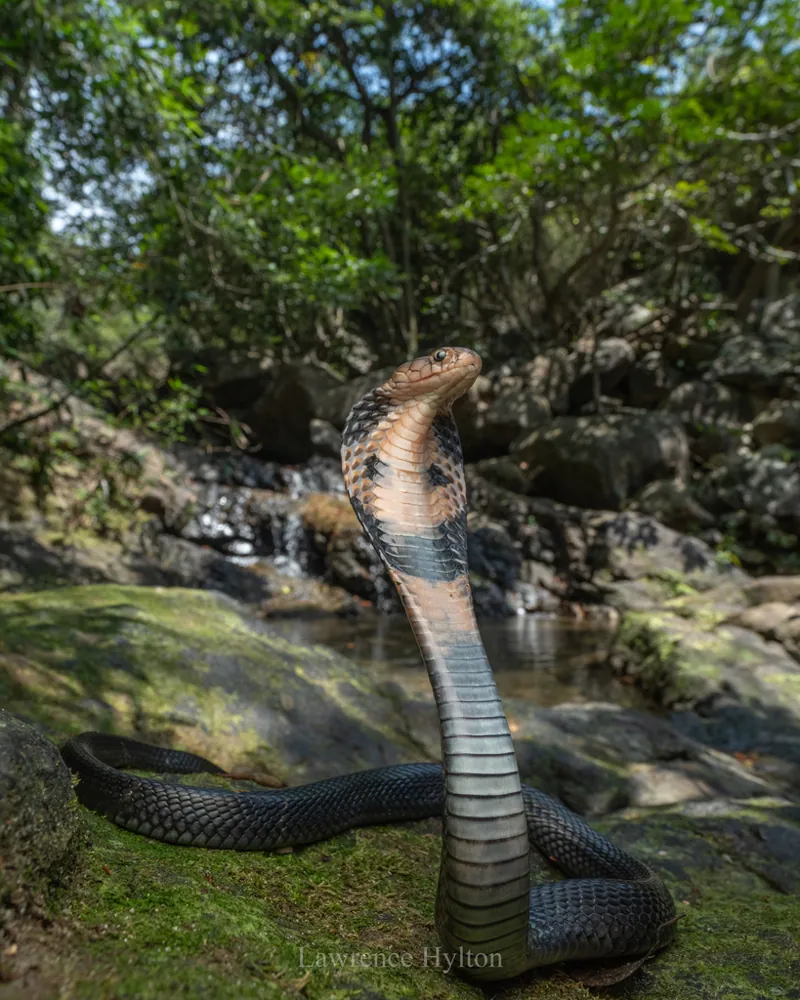
The Chinese cobra is a venomous snake from southern China and a few neighbouring countries and islands. It is one of the most common venomous snakes in China, and it has caused many snakebites there.1
 Tsela ya go e lemoga
- The hood marking varies. It can look like spectacles, a mask, a horseshoe or the letter O, and it is often linked to a pale throat area on at least one side.1
- The body is iridescent black, with widely spaced yellow double lines running across it.1
- The underside is pearl or slate-coloured. The upper colour is usually brown, grey or black, sometimes with narrow pale lines, which are especially clear in young snakes.1
- Typical adults are 1.2 to 1.5 metres long.1
Gantsi e tlhakanngwa le: It is sometimes confused with the monocled cobra (Naja kaouthia). The Chinese cobra has lower counts of ventral and subcaudal scales, which are the belly and tail scales. Sex should be taken into account when comparing these counts.1
Maatla a botlhole
Botlhole bo tswa ka meno a yone fa e loma.
Botlhole jo e bo tsenyang bo dira eng?
The Chinese cobra is a highly venomous member of the true cobras. Local symptoms at the bite include darkening of the wound, redness, swelling, pain and numbness, and blisters and necrosis (death of tissue) almost always follow. Necrosis can last for years after the person has otherwise recovered. Whole-body symptoms can include chest discomfort, fever, sore throat, difficulty swallowing, loss of voice, weak limbs, unsteady walking, lockjaw and difficulty breathing.1
E kotsi go le kae go batho?
Kotsi go batho: E kotsi thataE ka bolaya motho yo o sa alafiweng.It is one of the most common venomous snakes in China and has caused many snakebite incidents there. Deaths occasionally occur, but they are much rarer than they used to be.1
 Dikgang tse di molemo: dingaka di na le molemo (antivenom) kgotsa kalafi ya se.1
E dira eng fa e tshogile?
Adults can be aggressive, and young snakes are more nervous and more likely to be aggressive, but it usually escapes to avoid a confrontation.1
 Fa e loma
- Dira gore motho a nne a sa tshikinyege a ritibetse, tlosa direng le dilo tse di tiileng, mme o mo ise bookelong ka bonako: antivenom ke yone kalafi.
- Fa botlhole bo tshwetswe mo matlhong, a tlhatswe ka metsi a mantsi a a phepa ka yone nako eo.
Ka gale leletsa nomoro ya gago ya tshoganyetso pele (112, 000, 911). Se ke kaelo e e akaretsang ya thuso ya ntlha, ga se kgakololo ya bongaka. Motheo wa thuso ya ntlha
 Nna o babalesegile
- O se ka wa ama, wa tshwara kgotsa wa tshwenya phologolo ya naga, le fa e le e nnye, le fa e lebega e robetse kgotsa e sule.
- E fe sebaka. Fa o kopana le yone, ritibala, boela morago ka bonya mme o e tlogele e tsamaye ka tsela ya yone.
- Fa e nngwe e go loma: ritibala, o se ka wa tshikinyega, leletsa nomoro ya gago ya tshoganyetso (112, 000, 911) kgotsa o ye bookelong ka bonako. Gopola gore e ne e lebega jang, setshwantsho se a thusa.
Ga e go batle. E dirisa botlhole jwa yone go tshwara dijo kgotsa go itshireletsa, mme e rata go iphitlha go feta. Go le gontsi ka go nna o babalesegile
Kae mo lefatsheng?
E kgolo go le kae?
E telele go le kae?
 boleele jo bo lekanang le dikatse tsa ntlo di le 4 go tloga kwa nkong go ya mogatleng
 boleele jo bo lekanang le dipanana di le 11 di latelana
 e ka taboga dimetara di le 100 ka metsotswana e le 48 (motho yo o bonako go gaisa o tlhoka 9,6)
Chinese cobra e kgolo go le kae fa e bapisiwa le WENA?
Ke dipalo fela mo sefetleng sa gago (browser). Ga go sepe se se bolokwang kgotsa se se romelwang gope.
E bonako go le kae?


Dintlha
Necrosis from a bite can continue for many years after the victim has recovered in general.1
A snake kept at a snake farm gave an average venom yield of about 250.8 mg, of which about 80 mg was dry weight.1
Its fangs are always erect and sit at the front of the upper jaw, as in other elapid snakes.1
Kwa dintlha di tswang teng
- Chinese cobra (Wikipedia (CC BY-SA 4.0))
- Naja atra (iNaturalist): maina le thulaganyo ya mefuta.
- Venom Wiki: seelo sa kotsi, bogolo jo bo tlwaelegileng le kakanyo ya lebelo ke tsa rona. Bona kafa re di balang ka teng: Kafa re lekanyang kotsi ka teng.
Ntlha nngwe le nngwe mo tsebeng e e na le nomoro e e supang motswedi wa yone. Fa re dirile phoso, maitshwarelo, re barati ba diphologolo, e seng kgatiso ya saense. Re bolelele kwa [email protected] mme re tla e baakanya.
 Phepheng e tshwerwe ke tlala! Venom Wiki ke porojeke ya motho a le mongwe: ke mahala, ga e na dipapatso le ditraka. Mpho e nnye e thusa go e tshegetsa mo inthaneteng.Fepa phepheng
Tse dingwe tsa setlhopha se se tshwanang: Dikobra, dimamba le dikrait
 Indian cobra
 King cobra
 Caspian cobra
 Common krait
 Malayan krait
 Many-banded krait
E tshela gape kwa: Asia
 DeathstalkerDiphephengE a bolaya
 Indian saw-scaled viperDivaepara le diboloboloE a bolaya
 Puff adderDivaepara le diboloboloE a bolaya
 Phika ya ga RussellDivaepara le diboloboloE a bolaya
 Asian giant hornetDinotshe, diwasepe le dihoneteE ka bolaya
 Komodo dragonDikgatitswane tse di tsenyang botlholeE ka bolaya