
 Aforika
 Asia
Asia Yuropa
 Amerika Borwa
 Australia le Oceania
 Antarctica
 Lewatle la Pacific
 Lewatle la Atlantic
 Lewatle la India
 Lewatle la Arctic
 Lewatle la Mediterranean
 Lewatle le Lehibidu
 Lewatle la Caribbean
 Lewatle la Coral
 Lewatle la China Borwa
 Lewatle la Philippines
 Lewatle la Andaman
 Lewatle la Bokone
 Lewatle la Timor le la Arafura
 Kou ya Bengal
 Gulf ya California
Common toad
 Botlhole mo letlalong la yoneE ja: NamaE botlhole go e ama kgotsa go e ja, ga e tsenye botlhole
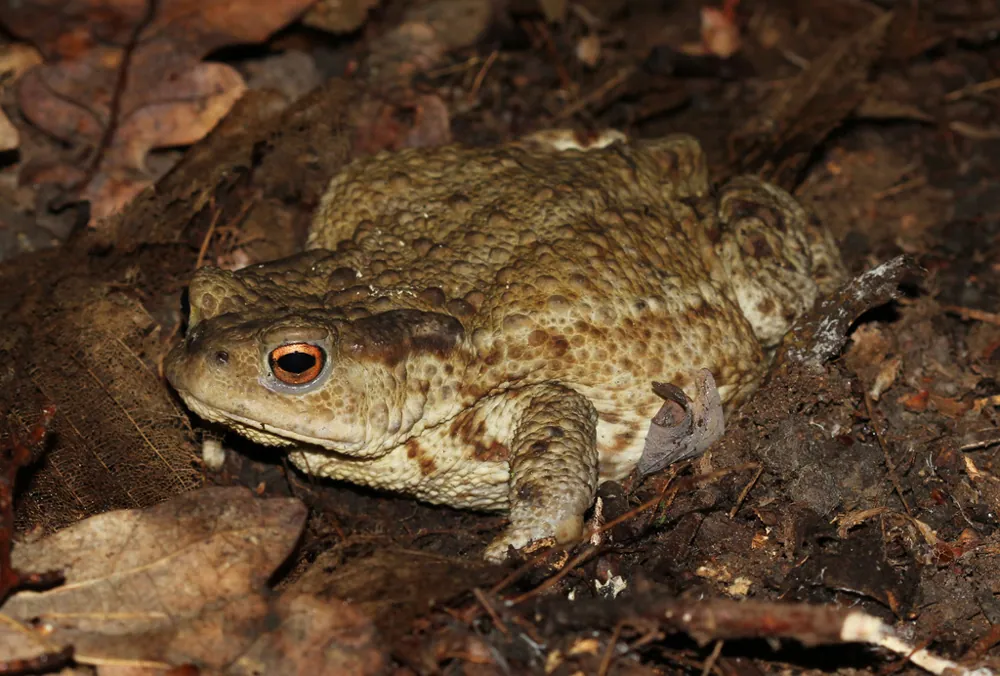
The common toad is a stout, warty toad that lives across most of Europe, in western North Asia and in a small part of northwest Africa. It hides under stones and leaves by day and hunts slugs, beetles and worms at night. Its skin releases a foul-tasting toxin that helps protect it from predators.1
 Tsela ya go e lemoga
- Greyish-brown, olive-brown or brown skin covered in small, wart-like lumps1
- Bulging paratoid glands just behind the eyes, which are a clear sign of a toad1
- Yellow or copper-coloured eyes with horizontal, slit-shaped pupils1
- No tail, no teeth, and no neck visible between the head and body1
- Walks slowly or makes short shuffling hops, rather than leaping1
Gantsi e tlhakanngwa le: The natterjack toad is usually smaller and has a yellow band down its back. The European green toad has a distinctive mottled pattern. The paratoid glands of both of these run parallel to each other, not slanting as in the common toad. The common frog has a less rounded snout, damp smooth skin, and usually leaps.1
Maatla a botlhole
Letlalo la yone le botlhole. Go kotsi go e ama, go e latswa kgotsa go e ja.
Botlhole jwa yone (jwa go e ama kgotsa go e ja) bo dira eng?
The toad is poisonous rather than venomous, so it does not inject venom. Its paratoid glands and other skin glands secrete a noxious, foul-tasting substance containing bufotoxin, which is enough to deter many predators. Grass snakes seem to be unaffected by it.1
E kotsi go le kae go batho?
Kotsi go batho: E botlhokoE ka utlwisa botlhoko tota, mme go seoka thata gore e nne masisi.E dira eng fa e tshogile?
When attacked, it inflates its body and stands with its hindquarters raised and its head lowered.1
 Fa mongwe a e amile kgotsa a e jele
- Fa mongwe a amile e nngwe: tlhatswa diatla sentle mme o se ka wa ama matlho kgotsa molomo. Fa ngwana kgotsa phologolo ya gae e latswitse kgotsa e jele e nngwe: leletsa senthara ya botlhole kgotsa nomoro ya tshoganyetso.
Ka gale leletsa nomoro ya gago ya tshoganyetso pele (112, 000, 911). Se ke kaelo e e akaretsang ya thuso ya ntlha, ga se kgakololo ya bongaka. Motheo wa thuso ya ntlha
 Nna o babalesegile
- O se ka wa ama, wa tshwara kgotsa wa tshwenya phologolo ya naga, le fa e le e nnye, le fa e lebega e robetse kgotsa e sule.
- E fe sebaka. Fa o kopana le yone, ritibala, boela morago ka bonya mme o e tlogele e tsamaye ka tsela ya yone.
- Fa o e amile kgotsa o e jele: o se ka wa gotlha matlho kgotsa molomo wa gago, tlhatswa diatla mme o batle thuso ya bongaka.
Ga e go batle. Botlhole jwa yone bo teng fela gore sepe se se ka se e je. Go le gontsi ka go nna o babalesegile
Kae mo lefatsheng?
E kgolo go le kae?
E telele go le kae?
 boleele jo bo lekanang le diboloko tsa go aga tsa ditshamekisi di le 5 mo moleng
 e ka taboga dimetara di le 100 ka metsotswana e le 180 (motho yo o bonako go gaisa o tlhoka 9,6)
Common toad e kgolo go le kae fa e bapisiwa le WENA?
Ke dipalo fela mo sefetleng sa gago (browser). Ga go sepe se se bolokwang kgotsa se se romelwang gope.
E bonako go le kae?


Dintlha
Common toads have been recorded at depths of about 99 m in Loch Ness, Scotland, which surprised researchers because it is an air-breathing animal.1
Crows have been seen puncturing the toad's skin and pecking out its liver to avoid the toxin.1
They can live for about ten to twelve years in the wild and have survived for fifty years in captivity.1
Toads can see prey in low light where humans cannot see anything.1
Adults often return to the same breeding pond year after year, and over 80% of males marked as juveniles were found to return to the pond where they were spawned.1
Ya baitseanape ba botlhole
- Leina la saense
- Bufo bufo
- Setlhopha
- Digwagwa tsa botlhole, digwagwa tse dingwe le dinewt
- Lelapa
- Bufonidae2
- Lekoko
- Anura
- Dikontinente
- Yuropa, Asia
- Masea
- The female lays eggs in gelatinous strings in the water. These hatch into tadpoles, which take several months to grow and sprout limbs before becoming tiny toads.1
- Dingwaga tsa botshelo
- e ka nna dingwaga di le 101
- Seemo sa yone kwa nageng
- Least Concern1
- Kotsi go batho
- 2 / 5: E botlhoko3
Kwa dintlha di tswang teng
- Common toad (Wikipedia (CC BY-SA 4.0))
- Bufo bufo (iNaturalist): maina le thulaganyo ya mefuta.
- Venom Wiki: seelo sa kotsi, bogolo jo bo tlwaelegileng le kakanyo ya lebelo ke tsa rona. Bona kafa re di balang ka teng: Kafa re lekanyang kotsi ka teng.
Ntlha nngwe le nngwe mo tsebeng e e na le nomoro e e supang motswedi wa yone. Fa re dirile phoso, maitshwarelo, re barati ba diphologolo, e seng kgatiso ya saense. Re bolelele kwa [email protected] mme re tla e baakanya.
 Phepheng e tshwerwe ke tlala! Venom Wiki ke porojeke ya motho a le mongwe: ke mahala, ga e na dipapatso le ditraka. Mpho e nnye e thusa go e tshegetsa mo inthaneteng.Fepa phepheng
Tse dingwe tsa setlhopha se se tshwanang: Digwagwa tsa botlhole, digwagwa tse dingwe le dinewt
 Fire salamanderDigwagwa tsa botlhole, digwagwa tse dingwe le dinewtE utlwisa botlhoko felaO se ka wa ama
 Japanese fire-bellied newtDigwagwa tsa botlhole, digwagwa tse dingwe le dinewtE tlhoka ngakaO se ka wa ama
 European fire-bellied toadDigwagwa tsa botlhole, digwagwa tse dingwe le dinewtGa e na kotsi
 Iberian ribbed newtDigwagwa tsa botlhole, digwagwa tse dingwe le dinewtGa e na kotsi
 Natterjack toadDigwagwa tsa botlhole, digwagwa tse dingwe le dinewtGa e na kotsi
 Oriental fire-bellied toadDigwagwa tsa botlhole, digwagwa tse dingwe le dinewtGa e na kotsi
E tshela gape kwa: Yuropa
 Common European adderDivaepara le diboloboloE tlhoka ngaka
 Spanish flyDiphologolo tse dingwe tse di botlhole go di ama kgotsa go di jaE tlhoka ngakaO se ka wa ama
 Common waspDinotshe, diwasepe le dihoneteE utlwisa botlhoko fela
 European hornetDinotshe, diwasepe le dihoneteE utlwisa botlhoko fela
 Western honey beeDinotshe, diwasepe le dihoneteE utlwisa botlhoko fela
 Blunt-nosed viperDivaepara le diboloboloE ka bolaya