
 Aforika
 Asia
Asia Yuropa
 Amerika Borwa
 Australia le Oceania
 Antarctica
 Lewatle la Pacific
 Lewatle la Atlantic
 Lewatle la India
 Lewatle la Arctic
 Lewatle la Mediterranean
 Lewatle le Lehibidu
 Lewatle la Caribbean
 Lewatle la Coral
 Lewatle la China Borwa
 Lewatle la Philippines
 Lewatle la Andaman
 Lewatle la Bokone
 Lewatle la Timor le la Arafura
 Kou ya Bengal
 Gulf ya California
Eastern brown snake
 Go loma
The eastern brown snake is a slender snake that lives across eastern and central Australia and in southern New Guinea. It is one of the most venomous land snakes in the world, so it is important to know what it looks like. It often lives near farms and the edges of towns, where it hunts house mice.1

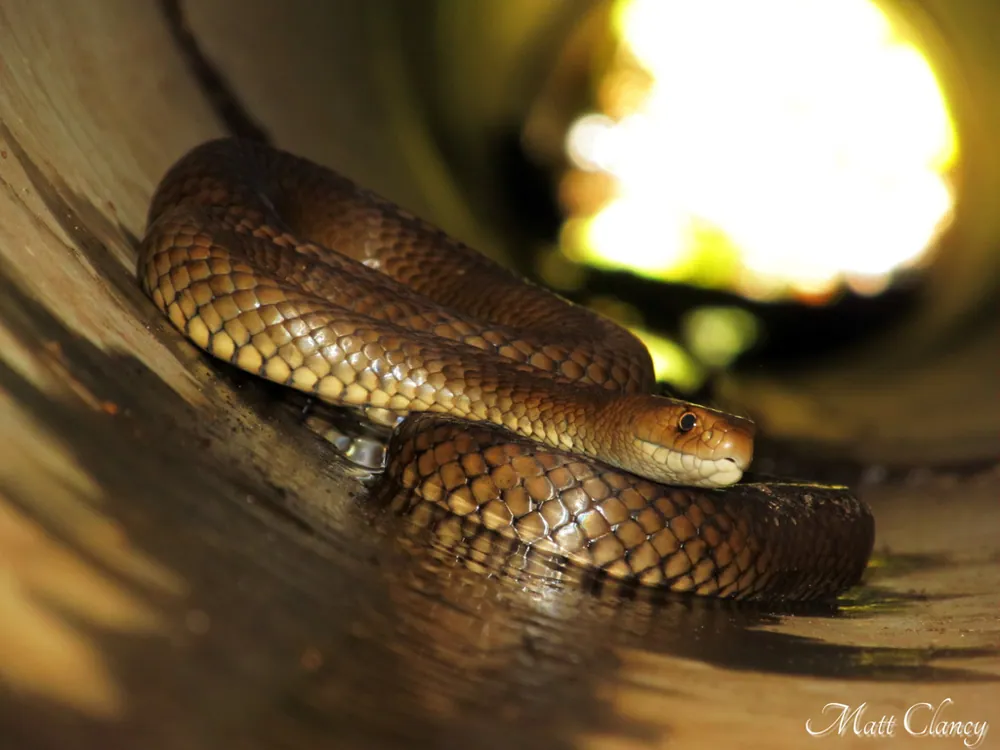
 Tsela ya go e lemoga
- Slender build, with no clear line between the head and neck.1
- Upper parts range from pale brown to black, and sometimes orange or russet.1
- Underside is pale cream or yellow, often with orange, brown or dark grey blotches.1
- Young snakes usually have a black head and may have dark bands or a pattern across the body. These markings fade as the snake grows.1
- Inside of the mouth is flesh-pink.1
Gantsi e tlhakanngwa le: Large eastern brown snakes are often confused with mulga snakes, which share their habitat in many areas; they can be told apart by head size. Its yellowish underparts separate it from the dugite and peninsula brown snake, which are entirely brown or have grey underparts. Young eastern brown snakes have head markings similar to red-naped snakes, grey snakes, Dwyer's snakes and curl snakes.1
Maatla a botlhole
Botlhole bo tswa ka meno a yone fa e loma.
Botlhole jo e bo tsenyang bo dira eng?
Its venom mainly affects the circulatory system, which carries blood around the body. The main effects are coagulopathy (a problem with blood clotting), haemorrhage (bleeding), cardiovascular collapse (the heart and blood vessels failing) and cardiac arrest (the heart stopping). One of the main components is pseutarin-C, a prothrombinase complex that breaks down prothrombin, a substance needed for blood to clot.1
E kotsi go le kae go batho?
Kotsi go batho: E a bolayaNngwe ya diphologolo tse di kotsi go gaisa mo lefatsheng.It is considered the world's second-most venomous land snake after the inland taipan, based on laboratory tests in mice.1
 Fa e loma
- Go gatelela le go sa tshikinyege (pressure immobilisation): bofa bandeiji e e gogegang e e tiileng mo godimo ga fa go lomilweng mme o tswelele o bofe setho sotlhe go ya kwa godimo, se tshegetse ka sepilinti (splint), mme o dire gore motho a nne a sa tshikinyege gotlhelele go fitlha thuso e goroga.
- O se ka wa tlhatswa fa go lomilweng: dibookelo di ka tlhatlhoba botlhole jo bo setseng mo letlalong go tlhopha antivenom e e siameng.
Ka gale leletsa nomoro ya gago ya tshoganyetso pele (112, 000, 911). Se ke kaelo e e akaretsang ya thuso ya ntlha, ga se kgakololo ya bongaka. Motheo wa thuso ya ntlha
 Nna o babalesegile
- O se ka wa ama, wa tshwara kgotsa wa tshwenya phologolo ya naga, le fa e le e nnye, le fa e lebega e robetse kgotsa e sule.
- E fe sebaka. Fa o kopana le yone, ritibala, boela morago ka bonya mme o e tlogele e tsamaye ka tsela ya yone.
- Fa e nngwe e go loma: ritibala, o se ka wa tshikinyega, leletsa nomoro ya gago ya tshoganyetso (112, 000, 911) kgotsa o ye bookelong ka bonako. Gopola gore e ne e lebega jang, setshwantsho se a thusa.
Ga e go batle. E dirisa botlhole jwa yone go tshwara dijo kgotsa go itshireletsa, mme e rata go iphitlha go feta. Go le gontsi ka go nna o babalesegile
Kae mo lefatsheng?
E kgolo go le kae?
E telele go le kae?
 boleele jo bo lekanang le dikatse tsa ntlo di le 5 go tloga kwa nkong go ya mogatleng
 boleele jo bo lekanang le dipanana di le 13 di latelana
 e ka taboga dimetara di le 100 ka metsotswana e le 46 (motho yo o bonako go gaisa o tlhoka 9,6)
Eastern brown snake e kgolo go le kae fa e bapisiwa le WENA?
Ke dipalo fela mo sefetleng sa gago (browser). Ga go sepe se se bolokwang kgotsa se se romelwang gope.
E bonako go le kae?


Dintlha
In December 2023, an eastern brown snake paused a match at the Brisbane International tennis tournament for 40 minutes until a professional snake catcher removed it.1
In winter, it brumates (goes into a state of rest like hibernation). Groups have been found sheltering under concrete slabs of houses in Sydney.1
Its fangs are small compared with other Australian venomous snakes, averaging 2.8 mm and reaching up to 4 mm in larger specimens.1
Within its genus, it has the largest number of chromosomes, at 38 in its cells.1
Local Aboriginal peoples in Sydney, the Illawarra and the Wiradjuri region had their own names for it, and the Dharawal and Awabakal held ceremonies for it.1
Mosenyi wa ditlhamane
Tlhamane: Young and adult brown snakes are different species.
Nnete: Early scientists thought they were different because their markings differ. Later research showed that the markings of young snakes fade as they grow, and all these forms are the same species.1
Kwa dintlha di tswang teng
- Eastern brown snake (Wikipedia (CC BY-SA 4.0))
- Pseudonaja textilis (iNaturalist): maina le thulaganyo ya mefuta.
- Venom Wiki: seelo sa kotsi, bogolo jo bo tlwaelegileng le kakanyo ya lebelo ke tsa rona. Bona kafa re di balang ka teng: Kafa re lekanyang kotsi ka teng.
Ntlha nngwe le nngwe mo tsebeng e e na le nomoro e e supang motswedi wa yone. Fa re dirile phoso, maitshwarelo, re barati ba diphologolo, e seng kgatiso ya saense. Re bolelele kwa [email protected] mme re tla e baakanya.
 Phepheng e tshwerwe ke tlala! Venom Wiki ke porojeke ya motho a le mongwe: ke mahala, ga e na dipapatso le ditraka. Mpho e nnye e thusa go e tshegetsa mo inthaneteng.Fepa phepheng
Tse dingwe tsa setlhopha se se tshwanang: Dinoga tsa Australia
 Coastal taipan
 Common death adder
 Taipan ya kwa teng ga naga
 Noga ya tiger
 Collett's snake
 Desert death adder
E tshela gape kwa: Australia le Oceania
 Sydney funnel-web spiderDitarantula le di-funnel-webE a bolaya
 Redback spiderDigokgoE tlhoka ngaka
 Brown tree snakeDinoga tse di nang le meno a botlhole kwa moragoE utlwisa botlhoko fela
 Hooded pitohuiDiphologolo tse dingwe tse di botlhole go di ama kgotsa go di jaE utlwisa botlhoko felaO se ka wa ama
 PlatypusDiphologolo tse di anyisang tse di tsenyang botlholeE utlwisa botlhoko fela
 Northern tree-dwelling funnel-web spiderDitarantula le di-funnel-webE a bolaya