
 Aforika
 Asia
Asia Yuropa
 Amerika Borwa
 Australia le Oceania
 Antarctica
 Lewatle la Pacific
 Lewatle la Atlantic
 Lewatle la India
 Lewatle la Arctic
 Lewatle la Mediterranean
 Lewatle le Lehibidu
 Lewatle la Caribbean
 Lewatle la Coral
 Lewatle la China Borwa
 Lewatle la Philippines
 Lewatle la Andaman
 Lewatle la Bokone
 Lewatle la Timor le la Arafura
 Kou ya Bengal
 Gulf ya California
Equatorial spitting cobra
 E a fafatsa kgotsa e a tshwela
The equatorial spitting cobra is a medium-sized cobra found in Southeast Asia. It can spray venom from a distance, which is what makes it special. It lives mainly in forests and sometimes in gardens and towns.1



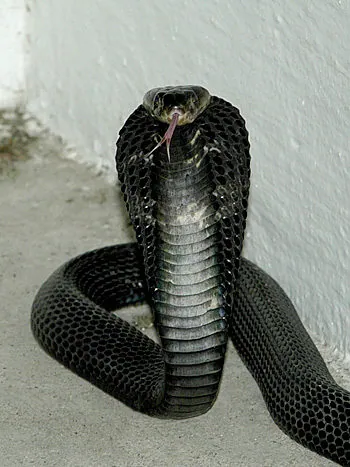
 Tsela ya go e lemoga
- Medium-sized, usually 0.9 to 1.2 metres long, and can grow up to 1.5 metres1
- Has no hood marks1
- Comes in two colour forms: yellow (common in Thailand and northern Peninsular Malaysia) and black (found in Peninsular Malaysia, Singapore and the islands of Indonesia and the Philippines)1
- Juveniles and adults often have different colours1
- Has smooth scales and a short, rounded snout1
Maatla a botlhole
E fafatsa kgotsa e tshwela seedi se se fisang mo go ba ba e tlhaselang.
Botlhole jo e bo tsenyang bo dira eng?
Its venom is postsynaptic neurotoxic, meaning it attacks the nerves. It also contains cardiotoxins, which damage the heart, and cytotoxins, which damage cells. The venom is strong enough that a bite can be serious.1
E kotsi go le kae go batho?
Kotsi go batho: E kotsi thataE ka bolaya motho yo o sa alafiweng.It will spit venom readily when cornered or threatened, and it can spit from up in trees. It will also strike and bite. The yellow form from Thailand is described as highly aggressive and more prone to spitting large amounts.1
E dira eng fa e tshogile?
When cornered or threatened, it spits venom and will also strike and bite.1
 Fa e loma kgotsa e tshwela
- Dira gore motho a nne a sa tshikinyege a ritibetse, tlosa direng le dilo tse di tiileng, mme o mo ise bookelong ka bonako: antivenom ke yone kalafi.
- Fa botlhole bo tshwetswe mo matlhong, a tlhatswe ka metsi a mantsi a a phepa ka yone nako eo.
Ka gale leletsa nomoro ya gago ya tshoganyetso pele (112, 000, 911). Se ke kaelo e e akaretsang ya thuso ya ntlha, ga se kgakololo ya bongaka. Motheo wa thuso ya ntlha
 Nna o babalesegile
- O se ka wa ama, wa tshwara kgotsa wa tshwenya phologolo ya naga, le fa e le e nnye, le fa e lebega e robetse kgotsa e sule.
- E fe sebaka. Fa o kopana le yone, ritibala, boela morago ka bonya mme o e tlogele e tsamaye ka tsela ya yone.
- Fa e nngwe e go loma kgotsa e go tshwela botlhole mo matlhong: ritibala, o se ka wa tshikinyega, leletsa nomoro ya gago ya tshoganyetso (112, 000, 911) kgotsa o ye bookelong ka bonako. Gopola gore e ne e lebega jang, setshwantsho se a thusa.
Ga e go batle. E dirisa botlhole jwa yone go tshwara dijo kgotsa go itshireletsa, mme e rata go iphitlha go feta. Go le gontsi ka go nna o babalesegile
Kae mo lefatsheng?
E kgolo go le kae?
E telele go le kae?
 boleele jo bo lekanang le dikatse tsa ntlo di le 3 go tloga kwa nkong go ya mogatleng
 boleele jo bo lekanang le dipanana di le 8 di latelana
 e ka taboga dimetara di le 100 ka metsotswana e le 51 (motho yo o bonako go gaisa o tlhoka 9,6)
Equatorial spitting cobra e kgolo go le kae fa e bapisiwa le WENA?
Ke dipalo fela mo sefetleng sa gago (browser). Ga go sepe se se bolokwang kgotsa se se romelwang gope.
E bonako go le kae?


Dintlha
It can spit venom even when it is up in the trees.1
Cardiotoxins make up about 40% of its venom protein, a higher share than in some related spitting cobras.1
The yellow colour form from Thailand is described as more aggressive than the black form.1
It is mainly active during the day and lives on the ground.1
Mosenyi wa ditlhamane
Tlhamane: It is just a subspecies of the Indian cobra.
Nnete: It was first defined as its own species in 1989. Earlier, its populations had been grouped under several subspecies of the Indian cobra.1
Kwa dintlha di tswang teng
- Equatorial spitting cobra (Wikipedia (CC BY-SA 4.0))
- Naja sumatrana (iNaturalist): maina le thulaganyo ya mefuta.
- Venom Wiki: seelo sa kotsi, bogolo jo bo tlwaelegileng le kakanyo ya lebelo ke tsa rona. Bona kafa re di balang ka teng: Kafa re lekanyang kotsi ka teng.
Ntlha nngwe le nngwe mo tsebeng e e na le nomoro e e supang motswedi wa yone. Fa re dirile phoso, maitshwarelo, re barati ba diphologolo, e seng kgatiso ya saense. Re bolelele kwa [email protected] mme re tla e baakanya.
 Phepheng e tshwerwe ke tlala! Venom Wiki ke porojeke ya motho a le mongwe: ke mahala, ga e na dipapatso le ditraka. Mpho e nnye e thusa go e tshegetsa mo inthaneteng.Fepa phepheng
Tse dingwe tsa setlhopha se se tshwanang: Dikobra, dimamba le dikrait
 Indian cobra
 King cobra
 Caspian cobra
 Common krait
 Malayan krait
 Many-banded krait
E tshela gape kwa: Asia
 DeathstalkerDiphephengE a bolaya
 Indian saw-scaled viperDivaepara le diboloboloE a bolaya
 Puff adderDivaepara le diboloboloE a bolaya
 Phika ya ga RussellDivaepara le diboloboloE a bolaya
 Asian giant hornetDinotshe, diwasepe le dihoneteE ka bolaya
 Komodo dragonDikgatitswane tse di tsenyang botlholeE ka bolaya