
 Aforika
 Asia
Asia Yuropa
 Amerika Borwa
 Australia le Oceania
 Antarctica
 Lewatle la Pacific
 Lewatle la Atlantic
 Lewatle la India
 Lewatle la Arctic
 Lewatle la Mediterranean
 Lewatle le Lehibidu
 Lewatle la Caribbean
 Lewatle la Coral
 Lewatle la China Borwa
 Lewatle la Philippines
 Lewatle la Andaman
 Lewatle la Bokone
 Lewatle la Timor le la Arafura
 Kou ya Bengal
 Gulf ya California
Giant golden orb-weaver
 Go loma
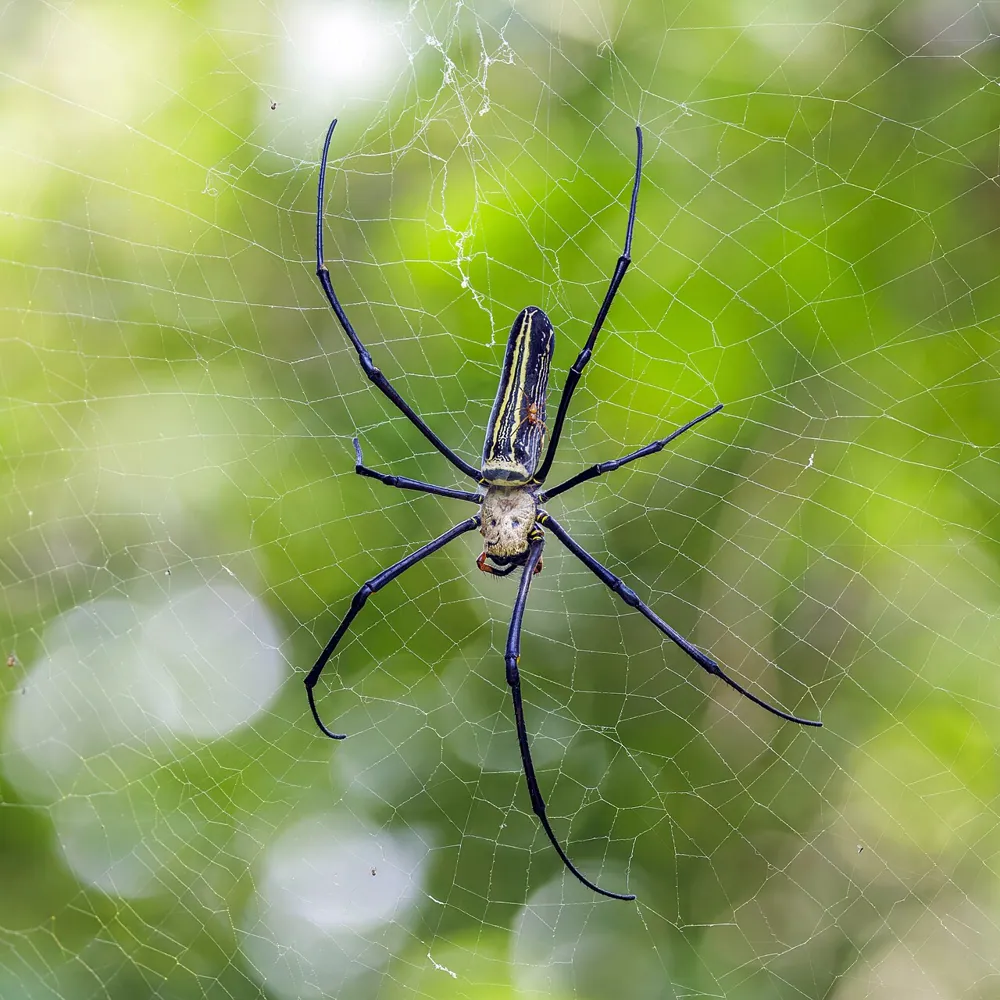
The giant golden orb-weaver is a large spider found across East and Southeast Asia and in Oceania. Adult females have bodies up to 50 mm long, while the males are tiny by comparison. Its big, yellowish webs are often seen in forests and against buildings.1

 Tsela ya go e lemoga
- Adult females are very large, with a body length of 25 to 50 mm.1
- The abdomen is mostly dark yellow-brown with yellow stripes.1
- The legs are long and black and yellow.1
- Females have a horn-like bulge on the back of the body (tergum).1
- Males are tiny, measuring about 4 to 6 mm, with light brown legs.1
Gantsi e tlhakanngwa le: Trichonephila clavata has no horn-like bulge on its back, which the giant golden orb-weaver does have. Nephila laurinae lacks the pair of yellow stripes at the back of the abdomen that this species has.1
Maatla a botlhole
Botlhole bo tswa ka meno a yone fa e loma.
E kotsi go le kae go batho?
Kotsi go batho: Kotsi e nnyeJaaka go tlhabiwa ke notshe kgotsa go le kwa tlase. Ga e na kotsi go batho. Fa e loma
- Tlhatswa fa go lomilweng mme o tsenye pakana ya aese mo go gone go fokotsa botlhoko. Batla thuso ya bongaka fa botlhoko bo le bogolo, bo anama kgotsa motho a ikutlwa a sa siama.
Ka gale leletsa nomoro ya gago ya tshoganyetso pele (112, 000, 911). Se ke kaelo e e akaretsang ya thuso ya ntlha, ga se kgakololo ya bongaka. Motheo wa thuso ya ntlha
 Nna o babalesegile
- O se ka wa ama, wa tshwara kgotsa wa tshwenya phologolo ya naga, le fa e le e nnye, le fa e lebega e robetse kgotsa e sule.
- E fe sebaka. Fa o kopana le yone, ritibala, boela morago ka bonya mme o e tlogele e tsamaye ka tsela ya yone.
- Fa e nngwe e go loma: ritibala, o se ka wa tshikinyega, leletsa nomoro ya gago ya tshoganyetso (112, 000, 911) kgotsa o ye bookelong ka bonako. Gopola gore e ne e lebega jang, setshwantsho se a thusa.
Ga e go batle. E dirisa botlhole jwa yone go tshwara dijo kgotsa go itshireletsa, mme e rata go iphitlha go feta. Go le gontsi ka go nna o babalesegile
Kae mo lefatsheng?
E kgolo go le kae?
E telele go le kae?
 khutshwane go feta monwana wa gago o monnye
 e ka taboga dimetara di le 100 ka metsotswana e le 130 (motho yo o bonako go gaisa o tlhoka 9,6)
Giant golden orb-weaver e kgolo go le kae fa e bapisiwa le WENA?
Ke dipalo fela mo sefetleng sa gago (browser). Ga go sepe se se bolokwang kgotsa se se romelwang gope.
E bonako go le kae?


Dintlha
Its silk is more robust than most human-made materials, which has drawn attention from materials scientists.1
Males can be 4 to 10 times smaller than the females, one of the biggest size differences among land animals.1
Adult females keep growing by moulting after they mature, which most spiders do not do.1
Females do not shed their genitals when they moult, so they can keep collecting sperm.1
When temperatures rise above 40 °C, it will abandon its web.1
Ya baitseanape ba botlhole
- Leina la saense
- Nephila pilipes
- Setlhopha
- Digokgo
- Lelapa
- Nephilidae2
- Lekoko
- Araneae
- Dikontinente
- Asia, Australia le Oceania
- Masea
- Females do not hang egg sacs in the web. Instead they dig a pit, lay eggs in it and cover it with plant debris or soil. Adult females lay eggs continuously.1
- Kotsi go batho
- 1 / 5: Kotsi e nnye3
Kwa dintlha di tswang teng
- Nephila pilipes (Wikipedia (CC BY-SA 4.0))
- Nephila pilipes (iNaturalist): maina le thulaganyo ya mefuta.
- Venom Wiki: seelo sa kotsi, bogolo jo bo tlwaelegileng le kakanyo ya lebelo ke tsa rona. Bona kafa re di balang ka teng: Kafa re lekanyang kotsi ka teng.
Ntlha nngwe le nngwe mo tsebeng e e na le nomoro e e supang motswedi wa yone. Fa re dirile phoso, maitshwarelo, re barati ba diphologolo, e seng kgatiso ya saense. Re bolelele kwa [email protected] mme re tla e baakanya.
 Phepheng e tshwerwe ke tlala! Venom Wiki ke porojeke ya motho a le mongwe: ke mahala, ga e na dipapatso le ditraka. Mpho e nnye e thusa go e tshegetsa mo inthaneteng.Fepa phepheng
 Redback spider
 Katipo
 Mediterranean black widow
 Diving bell spider
 European yellow sac spider
 White-tailed spider
 Deathstalker
 Indian cobra
 Indian saw-scaled viper
 King cobra
 Puff adder
 Phika ya ga Russell
_female_and_male_Double_Haven.jpg)