
 Aforika
 Asia
Asia Yuropa
 Amerika Borwa
 Australia le Oceania
 Antarctica
 Lewatle la Pacific
 Lewatle la Atlantic
 Lewatle la India
 Lewatle la Arctic
 Lewatle la Mediterranean
 Lewatle le Lehibidu
 Lewatle la Caribbean
 Lewatle la Coral
 Lewatle la China Borwa
 Lewatle la Philippines
 Lewatle la Andaman
 Lewatle la Bokone
 Lewatle la Timor le la Arafura
 Kou ya Bengal
 Gulf ya California
Mediterranean black widow
 Go loma
The Mediterranean black widow is a shiny black spider with thirteen spots on its belly, usually red. It lives in grasslands and steppes around the Mediterranean and in central Asia. Only the female's bite is dangerous to people.1

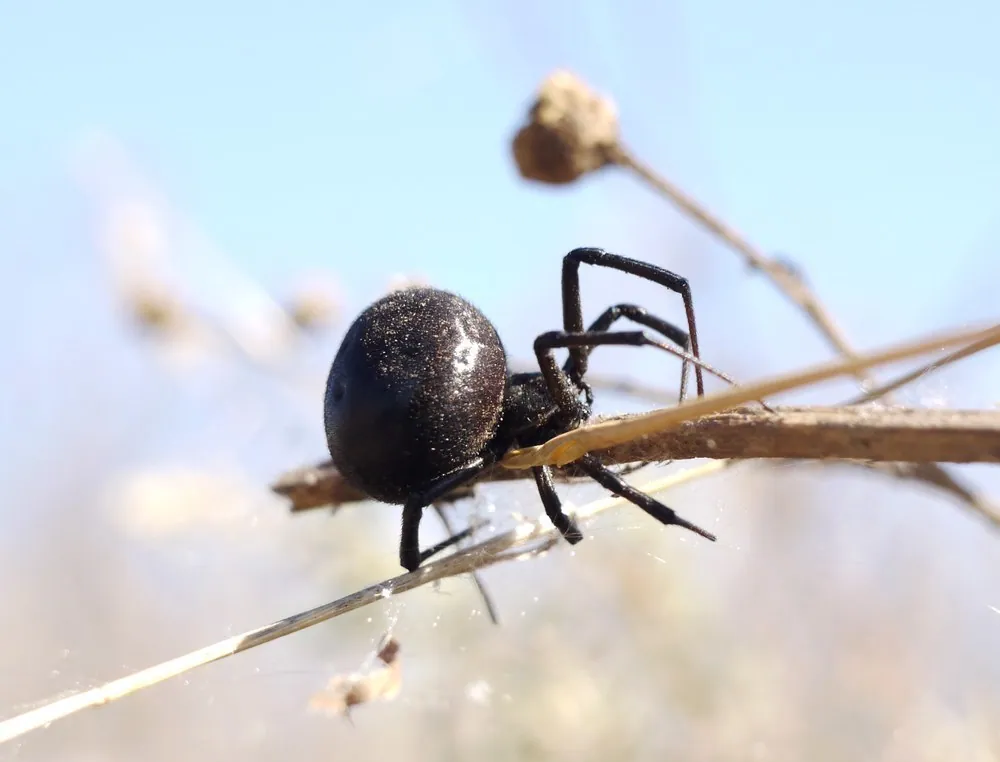
 Tsela ya go e lemoga
- Black in colour, with thirteen spots on the upper side of the abdomen.1
- The spots are usually red, but may also be yellow or orange.1
- The female has a body length of about 7 to 15 mm. The male is smaller, at 4 to 7 mm at most.1
- It lays out a web and waits for prey.1
Gantsi e tlhakanngwa le: It is similar to other widow species in the genus Latrodectus. The thirteen spots on the abdomen help tell it apart.1
Maatla a botlhole
Botlhole bo tswa ka meno a yone fa e loma.
Botlhole jo e bo tsenyang bo dira eng?
Its bite is painful. The venom contains neurotoxins, which attack the nerves. Several neurotoxins that are specific to crustaceans and insects have been found in it. The bite is fatal in rare cases.1
E kotsi go le kae go batho?
Kotsi go batho: E masisiGo lomiwa ke yone go tlhoka ngaka. Go swa go seoka thata.Its bite is painful and can be fatal in rare cases. Epidemics of bites have been reported, and Ukrainian farm workers have been bitten in the fields. In Kazakhstan, where it is called karakurt, it has been reported to bite and kill camels. Only the female's bite is dangerous to people and cattle, because the male cannot get through the thick outer skin.1
 Fa e loma
- Tlhatswa fa go lomilweng mme o tsenye pakana ya aese mo go gone go fokotsa botlhoko. Batla thuso ya bongaka fa botlhoko bo le bogolo, bo anama kgotsa motho a ikutlwa a sa siama.
Ka gale leletsa nomoro ya gago ya tshoganyetso pele (112, 000, 911). Se ke kaelo e e akaretsang ya thuso ya ntlha, ga se kgakololo ya bongaka. Motheo wa thuso ya ntlha
 Nna o babalesegile
- O se ka wa ama, wa tshwara kgotsa wa tshwenya phologolo ya naga, le fa e le e nnye, le fa e lebega e robetse kgotsa e sule.
- E fe sebaka. Fa o kopana le yone, ritibala, boela morago ka bonya mme o e tlogele e tsamaye ka tsela ya yone.
- Fa e nngwe e go loma: ritibala, o se ka wa tshikinyega, leletsa nomoro ya gago ya tshoganyetso (112, 000, 911) kgotsa o ye bookelong ka bonako. Gopola gore e ne e lebega jang, setshwantsho se a thusa.
Ga e go batle. E dirisa botlhole jwa yone go tshwara dijo kgotsa go itshireletsa, mme e rata go iphitlha go feta. Go le gontsi ka go nna o babalesegile
Kae mo lefatsheng?
E kgolo go le kae?
E telele go le kae?
 khutshwane go feta monwana wa gago o monnye
Mediterranean black widow e kgolo go le kae fa e bapisiwa le WENA?
Ke dipalo fela mo sefetleng sa gago (browser). Ga go sepe se se bolokwang kgotsa se se romelwang gope.
E bonako go le kae?


Dintlha
The French entomologist Jean Henri Fabre wrote about its fearsome reputation in Corsica, where it is called the malmignatte.1
Peptides from its venom can inhibit angiotensin-1-converting enzyme, an enzyme involved in blood pressure control.1
Its venom has been measured, with a lethal dose figure of 0.59 mg/kg.1
In Kazakhstan it is called karakurt, which means "black bug".1
Kwa dintlha di tswang teng
- Latrodectus tredecimguttatus (Wikipedia (CC BY-SA 4.0))
- Latrodectus tredecimguttatus (iNaturalist): maina le thulaganyo ya mefuta.
- Venom Wiki: seelo sa kotsi, bogolo jo bo tlwaelegileng le kakanyo ya lebelo ke tsa rona. Bona kafa re di balang ka teng: Kafa re lekanyang kotsi ka teng.
Ntlha nngwe le nngwe mo tsebeng e e na le nomoro e e supang motswedi wa yone. Fa re dirile phoso, maitshwarelo, re barati ba diphologolo, e seng kgatiso ya saense. Re bolelele kwa [email protected] mme re tla e baakanya.
 Phepheng e tshwerwe ke tlala! Venom Wiki ke porojeke ya motho a le mongwe: ke mahala, ga e na dipapatso le ditraka. Mpho e nnye e thusa go e tshegetsa mo inthaneteng.Fepa phepheng
Tse dingwe tsa setlhopha se se tshwanang: Digokgo
 Six-eyed sand spider
 Brown widow
 Diving bell spider
 European yellow sac spider
 Noble false widow
 Tarantula wolf spider
E tshela gape kwa: Yuropa
 Common European adderDivaepara le diboloboloE tlhoka ngaka
 Spanish flyDiphologolo tse dingwe tse di botlhole go di ama kgotsa go di jaE tlhoka ngakaO se ka wa ama
 Common waspDinotshe, diwasepe le dihoneteE utlwisa botlhoko fela
 European hornetDinotshe, diwasepe le dihoneteE utlwisa botlhoko fela
 Fire salamanderDigwagwa tsa botlhole, digwagwa tse dingwe le dinewtE utlwisa botlhoko felaO se ka wa ama
 Western honey beeDinotshe, diwasepe le dihoneteE utlwisa botlhoko fela