
 Aforika
 Asia
Asia Yuropa
 Amerika Borwa
 Australia le Oceania
 Antarctica
 Lewatle la Pacific
 Lewatle la Atlantic
 Lewatle la India
 Lewatle la Arctic
 Lewatle la Mediterranean
 Lewatle le Lehibidu
 Lewatle la Caribbean
 Lewatle la Coral
 Lewatle la China Borwa
 Lewatle la Philippines
 Lewatle la Andaman
 Lewatle la Bokone
 Lewatle la Timor le la Arafura
 Kou ya Bengal
 Gulf ya California
Golden tree snake
 Go loma
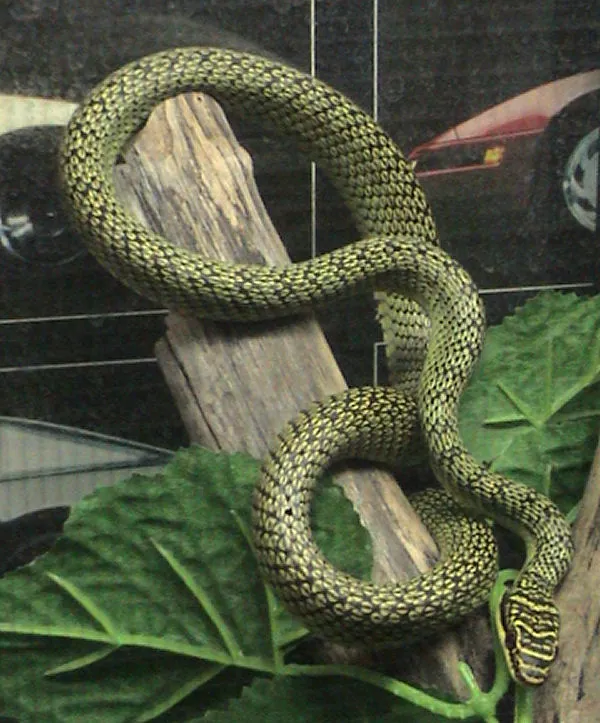
The golden tree snake is a slim, green snake with gold and black markings that lives in trees across South and Southeast Asia. It is famous for its ability to glide from tree to tree, which it does by launching itself into the air and steering with its body. It is mildly venomous, but it is not considered dangerous to people.1



 Tsela ya go e lemoga
- Usually green, with black cross-hatching and yellow or gold accents1
- Slender body with a flattened head, a blunt nose and large eyes with round pupils1
- In Sri Lanka and southern India it is mainly greenish yellow or pale green, often with reddish or orange flower-shaped spots on its back1
- In Southeast Asia it lacks the reddish spots and has less prominent black crossbars1
- Nervous and fast-moving, it climbs trees and vertical rock faces in graceful curves1
Gantsi e tlhakanngwa le: The paradise flying snake (C. paradisi) is a close relative that also glides. Its gliding is more impressive than that of the golden tree snake, which is still able to move easily from tree to tree.1
Maatla a botlhole
Botlhole bo tswa ka meno a yone fa e loma.
Botlhole jo e bo tsenyang bo dira eng?
It is mildly venomous. Its two small fangs are at the back of the upper jaw, so it must chew to get venom into prey. The venom is meant to subdue fast-moving tree-living animals and is not considered dangerous to humans.1
E kotsi go le kae go batho?
Kotsi go batho: Kotsi e nnyeJaaka go tlhabiwa ke notshe kgotsa go le kwa tlase. Ga e na kotsi go batho.It is not considered dangerous to humans and is not of medical importance. It generally does not hesitate to bite if handled.1
E dira eng fa e tshogile?
When disturbed it tries to flee, and it can glide away from predators such as birds or other reptiles.1
 Fa e loma
- Tlhatswa fa go lomilweng, dira gore motho a ritibale mme o batle thuso ya bongaka. Mefuta mengwe (jaaka boomslang) e ka bolaya diura morago.
Ka gale leletsa nomoro ya gago ya tshoganyetso pele (112, 000, 911). Se ke kaelo e e akaretsang ya thuso ya ntlha, ga se kgakololo ya bongaka. Motheo wa thuso ya ntlha
 Nna o babalesegile
- O se ka wa ama, wa tshwara kgotsa wa tshwenya phologolo ya naga, le fa e le e nnye, le fa e lebega e robetse kgotsa e sule.
- E fe sebaka. Fa o kopana le yone, ritibala, boela morago ka bonya mme o e tlogele e tsamaye ka tsela ya yone.
- Fa e nngwe e go loma: ritibala, o se ka wa tshikinyega, leletsa nomoro ya gago ya tshoganyetso (112, 000, 911) kgotsa o ye bookelong ka bonako. Gopola gore e ne e lebega jang, setshwantsho se a thusa.
Ga e go batle. E dirisa botlhole jwa yone go tshwara dijo kgotsa go itshireletsa, mme e rata go iphitlha go feta. Go le gontsi ka go nna o babalesegile
Kae mo lefatsheng?
E kgolo go le kae?
E telele go le kae?
 boleele jo bo lekanang le dikatse tsa ntlo di le 2,5 go tloga kwa nkong go ya mogatleng
 boleele jo bo lekanang le dipanana di le 7 di latelana
 e ka taboga dimetara di le 100 ka metsotswana e le 64 (motho yo o bonako go gaisa o tlhoka 9,6)
Golden tree snake e kgolo go le kae fa e bapisiwa le WENA?
Ke dipalo fela mo sefetleng sa gago (browser). Ga go sepe se se bolokwang kgotsa se se romelwang gope.
E bonako go le kae?


Dintlha
It can glide, or parachute, across distances of as much as 100 m from tree to tree.1
To glide, it curves its belly into a U-shape that acts like a parachute, then undulates through the air like it is swimming.1
It balances in the air by twisting its tail from side to side, with the tail held rigidly upwards.1
Its striking looks and gliding have made it a sought-after choice for captivity, though it often struggles in captivity.1
It is sometimes cooked for food.1
Mosenyi wa ditlhamane
Tlhamane: Many locals assume that all snakes are venomous and kill them on sight.
Nnete: The golden tree snake is only mildly venomous and is not considered dangerous to humans.1
Ya baitseanape ba botlhole
- Leina la saense
- Chrysopelea ornata
- Setlhopha
- Dinoga tse di nang le meno a botlhole kwa morago
- Lelapa
- Colubridae2
- Lekoko
- Squamata
- Dikontinente
- Asia
- Masea
- It lays eggs. Six to 12 elongated eggs are laid, and hatchlings measure 114–152 mm long.1
- Seemo sa yone kwa nageng
- Not known to be endangered1
- Kotsi go batho
- 1 / 5: Kotsi e nnye3
Kwa dintlha di tswang teng
- Chrysopelea ornata (Wikipedia (CC BY-SA 4.0))
- Chrysopelea ornata (iNaturalist): maina le thulaganyo ya mefuta.
- Venom Wiki: seelo sa kotsi, bogolo jo bo tlwaelegileng le kakanyo ya lebelo ke tsa rona. Bona kafa re di balang ka teng: Kafa re lekanyang kotsi ka teng.
Ntlha nngwe le nngwe mo tsebeng e e na le nomoro e e supang motswedi wa yone. Fa re dirile phoso, maitshwarelo, re barati ba diphologolo, e seng kgatiso ya saense. Re bolelele kwa [email protected] mme re tla e baakanya.
 Phepheng e tshwerwe ke tlala! Venom Wiki ke porojeke ya motho a le mongwe: ke mahala, ga e na dipapatso le ditraka. Mpho e nnye e thusa go e tshegetsa mo inthaneteng.Fepa phepheng
Tse dingwe tsa setlhopha se se tshwanang: Dinoga tse di nang le meno a botlhole kwa morago
 Brown tree snakeDinoga tse di nang le meno a botlhole kwa moragoE utlwisa botlhoko fela
 Tiger keelbackDinoga tse di nang le meno a botlhole kwa moragoE ka bolaya
 Red-necked keelbackDinoga tse di nang le meno a botlhole kwa moragoE tlhoka ngaka
 Green cat snakeDinoga tse di nang le meno a botlhole kwa moragoE utlwisa botlhoko fela
 Mangrove snakeDinoga tse di nang le meno a botlhole kwa moragoE utlwisa botlhoko fela
 Asian vine snakeDinoga tse di nang le meno a botlhole kwa moragoGa e na kotsi
 Deathstalker
 Indian cobra
 Indian saw-scaled viper
 King cobra
 Puff adder
 Phika ya ga Russell